A 62-year-old man comes to the office due to anorexia, fatigue, and a 9 kg (20 lb) weight loss over the past 6 months. He rarely drinks alcohol and does not use illicit drugs, although he has smoked one pack of cigarettes daily for the past 40 years. The patient has previously been diagnosed with hypertension, diverticulosis, external hemorrhoids, and osteoarthritis. Current medications are atenolol and aspirin, and he has no known drug allergies. Temperature is 37 C (98.6 F) , blood pressure is 132/88 mm Hg, pulse is 70/min, and respirations are 12/min. Physical examination reveals a soft abdomen that is mildly tender to deep palpation in the midepigastric region. The sclerae are icteric, and the skin is jaundiced. Laboratory results show: 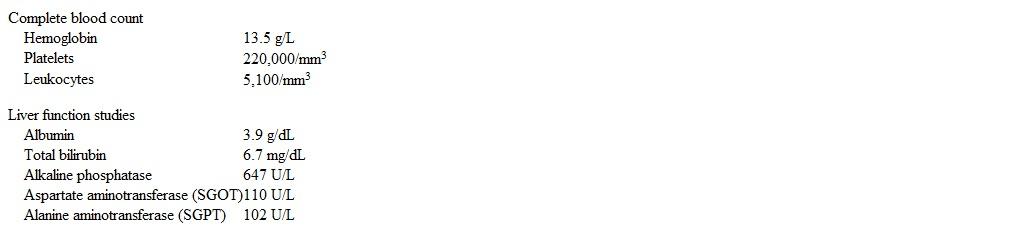 Antimitochondrial antibodies are negative. Abdominal ultrasound demonstrates mild dilation of the common bile duct; there are no stones present in the gallbladder and no evidence of gallbladder wall thickening. Which of the following is the best next step in the management of this patient's condition?
A) Abdominal CT scan
B) Endoscopic retrograde pancreatography (ERCP)
C) Percutaneous transhepatic cholangiogram (PTC)
D) Serum amylase and lipase
E) Serum CA 19-9
Correct Answer:

Verified
Q2: An imaging study detects an incidental 3.5-cm
Q3: A 25-year-old man comes to the office
Q4: A 76-year-old man comes to the office
Q5: A 78-year-old man comes to the office
Q6: A 42-year-old man comes to the office
Q8: A 61-year-old woman comes to the office
Q9: A 56-year-old man comes to the office
Q10: A 55-year-old man comes to the office
Q11: A 42-year-old man with a history of
Q12: A 56-year-old man comes to the office
Unlock this Answer For Free Now!
View this answer and more for free by performing one of the following actions

Scan the QR code to install the App and get 2 free unlocks

Unlock quizzes for free by uploading documents