A 78-year-old man is brought to the emergency department due to an episode of syncope while working in his garden. He is now alert and oriented. He has chest and neck pain that developed just prior to the syncopal episode. Over the past week, he has had a cough, chest tightness, and whitish sputum production. Medical history is significant for long-standing hypertension, hyperlipidemia, and type 2 diabetes mellitus. The patient is a lifetime nonsmoker. Temperature is 37.3 C (99.2 F) , blood pressure is 144/92 mm Hg on the right arm and 142/90 mm Hg on the left arm, and pulse is 109/min. ECG shows sinus tachycardia, voltage criteria for left ventricular hypertrophy, and no ST-segment or T-wave changes. Chest x-ray is shown in the exhibit. 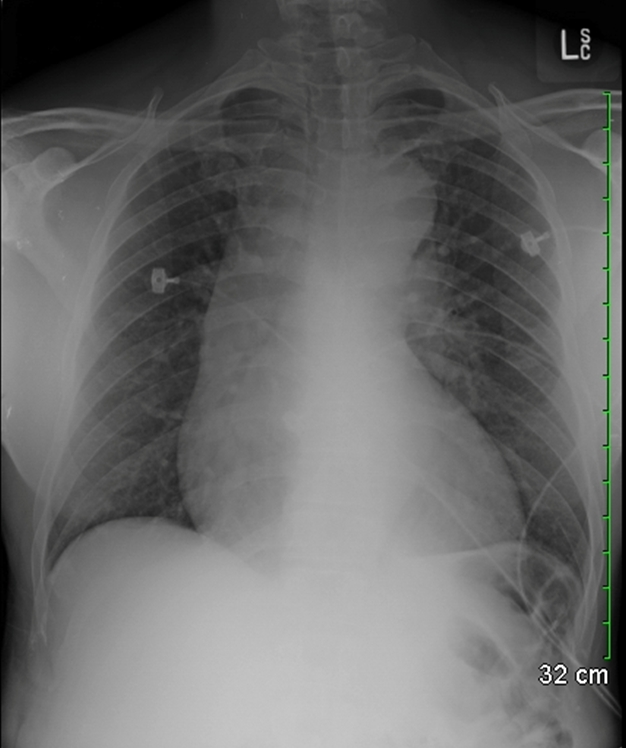 A bedside transthoracic echocardiogram shows a small pericardial effusion. Which of the following is the best next step in management of this patient?
A) Antibiotics, fluid resuscitation, and admission to intensive care unit
B) Beta blockers, anticoagulation, and admission to intensive care unit
C) Cardiac catheterization
D) CT angiography
E) Immediate emergency pericardiocentesis
Correct Answer:

Verified
Q206: A 50-year-old woman is evaluated in the
Q207: A 28-year-old woman, gravida 1 para 1,
Q208: A 62-year-old man comes to the office
Q209: A 34-year-old man comes to the emergency
Q210: A 28-year-old primigravid woman at 40 weeks
Q212: A 43-year-old woman comes to the emergency
Q213: A 38-year-old man comes to the office
Q214: An 84-year-old man is brought to the
Q215: A 42-year-old woman is evaluated in the
Q216: A 65-year-old man with exertional chest pain
Unlock this Answer For Free Now!
View this answer and more for free by performing one of the following actions

Scan the QR code to install the App and get 2 free unlocks

Unlock quizzes for free by uploading documents