A 65-year-old man comes to the emergency department due to sudden-onset chest pain followed by syncope. The pain started an hour ago, during which he had an episode of syncope lasting 1-2 minutes. The patient has had no dyspnea or palpitations. He has never had similar symptoms before. Medical history is significant for hypertension and a 40-pack-year smoking history. Blood pressure is 190/110 mm Hg in both arms; pulse is 100/min and regular; and respirations are 24/min. Pulses are symmetric and equal in all extremities. Jugular venous pressure is normal. Breath sounds are normal on both sides. There is an S4 gallop. ECG shows changes consistent with left ventricular hypertrophy. Serum troponin is normal. D-dimer is elevated. Chest x-ray shows an enlarged cardiac silhouette but is otherwise unremarkable. CT scan of the chest is obtained and is shown below: 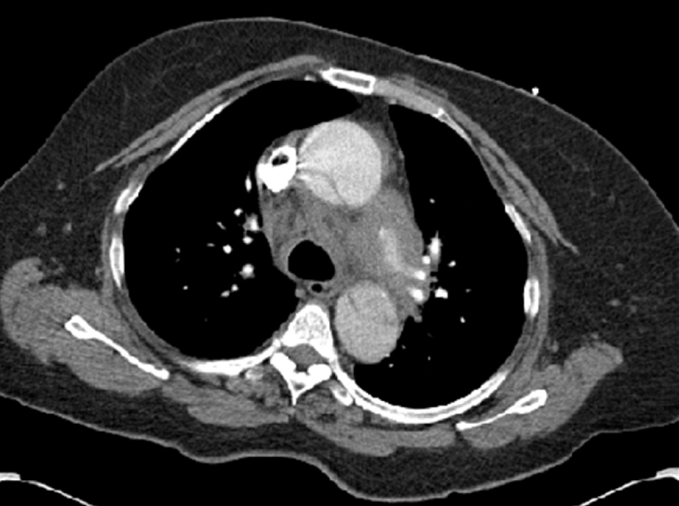 Which of the following is the best next step in management of this patient?
A) Administration of thrombolytic therapy
B) Admission to critical care unit for close blood pressure control
C) Emergent surgical repair
D) Unfractionated heparin infusion with close PTT monitoring
E) Urgent coronary angiogram
Correct Answer:

Verified
Q200: A 55-year-old man comes to the hospital
Q201: A 48-year-old woman comes to the hospital
Q202: A 36-year-old woman is undergoing upper and
Q203: A 19-year-old woman, gravida 1 para 0,
Q204: A 74-year-old man comes to urgent care
Q206: A 50-year-old woman is evaluated in the
Q207: A 28-year-old woman, gravida 1 para 1,
Q208: A 62-year-old man comes to the office
Q209: A 34-year-old man comes to the emergency
Q210: A 28-year-old primigravid woman at 40 weeks
Unlock this Answer For Free Now!
View this answer and more for free by performing one of the following actions

Scan the QR code to install the App and get 2 free unlocks

Unlock quizzes for free by uploading documents