A 72-year-old man undergoes coronary artery bypass graft (CABG) for severe coronary artery disease. He is extubated on the second postoperative day. His temperature is 36.6° C (97.9° F) , blood pressure is 120/70 mm Hg, pulse is 80/min, and respirations are 12/min. On the third postoperative day, he complains of dyspnea and worsening retrosternal pain despite continuous analgesia with morphine. His temperature is 38.6° C (101.5° F) , blood pressure is 112/52 mm Hg, pulse is 125/min and irregularly irregular, and respirations are 28/min. Examination shows normal heart sounds. A small amount of cloudy fluid is present in the sternal wound drain. His ECG shows atrial fibrillation with rapid ventricular response. An x-ray film of the chest shows widening of the mediastinum. Echocardiography reveals a small amount of pericardial fluid. Laboratory studies show: 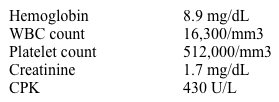 Which of the following will this patient most likely require?
A) Anticoagulation and electrical cardioversion
B) Broad-spectrum antibiotics alone
C) Nonsteroidal antiinflammatory agents alone
D) Pericardial puncture and nonsteroidal antiinflammatory agents
E) Surgical debridement and antibiotic therapy
Correct Answer:

Verified
Q221: A 58-year-old woman comes to the emergency
Q222: A 68-year-old man is recovering in the
Q223: A 76-year-old man comes for outpatient follow-up
Q224: A 72-year-old man is evaluated on day
Q225: A 62-year-old man undergoes a partial pancreatectomy
Q227: A 68-year-old man comes for outpatient follow-up
Q228: A 64-year-old man comes to the emergency
Q229: A 40-year-old woman with a medical history
Q230: A previously healthy 24-year-old man is brought
Q231: A 55-year-old man is brought to the
Unlock this Answer For Free Now!
View this answer and more for free by performing one of the following actions

Scan the QR code to install the App and get 2 free unlocks

Unlock quizzes for free by uploading documents