A 26-year-old man with a history of seizure disorder and medication nonadherence is hospitalized after a generalized tonic-clonic seizure. A witness reports that the patient lost consciousness and fell to his right side; the seizure lasted about 2 minutes. Evaluation in the emergency department reveals a low serum level of his prescribed antiepileptic drug, levetiracetam, and a displaced right femur fracture. No other injuries or laboratory abnormalities are present. Levetiracetam is restarted and the patient undergoes intramedullary nailing of the fracture with no intraoperative complications. The next day the patient is noted to be confused. Temperature is 37.2 C (99 F) , blood pressure is 142/86 mm Hg, pulse is 102/min, and respirations are 28/min. Oxygen saturation is 90% while breathing room air. On physical examination, the patient is disoriented but has no focal weakness or sensory loss. There are no skin rashes or hematoma at the surgical site. The remainder of the examination shows no abnormalities. Laboratory testing reveals the following: 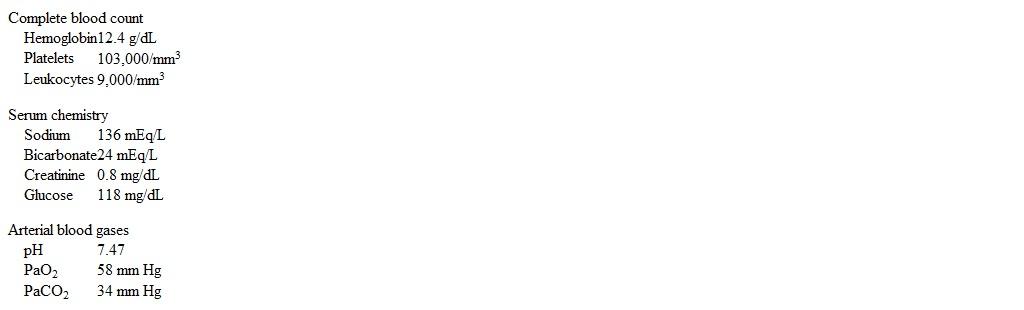 CT pulmonary angiography shows bilateral scattered ground-glass opacities but no filling defects within the pulmonary vasculature. Which of the following is the most likely cause of this patient's current condition?
A) Aspiration pneumonitis
B) Cardiogenic pulmonary edema
C) Drug-induced hypersensitivity reaction
D) Fat embolism syndrome
E) Pulmonary contusion
Correct Answer:

Verified
Q472: A 28-year-old man is the unrestrained driver
Q473: A 55-year-old man is evaluated for new-onset
Q474: A 54-year-old man with a 30-pack-year smoking
Q475: A 45-year-old man comes to the emergency
Q476: A 19-year-old woman comes to the emergency
Q478: A 44-year-old man is brought to the
Q479: A 25-year-old man comes to the emergency
Q480: A previously healthy, 22-year-old farmer is brought
Q481: A 31-year-old motorcyclist is brought to the
Q482: A 67-year-old male comes to the clinic
Unlock this Answer For Free Now!
View this answer and more for free by performing one of the following actions

Scan the QR code to install the App and get 2 free unlocks

Unlock quizzes for free by uploading documents