A study was conducted to identify factors associated with rebleeding in patients admitted to the hospital with upper gastrointestinal hemorrhage. The medical charts of 2,488 patients were analyzed retrospectively, and a logistic regression analysis was conducted to identify potential risk factors for rebleeding. An excerpt of study results is shown below. 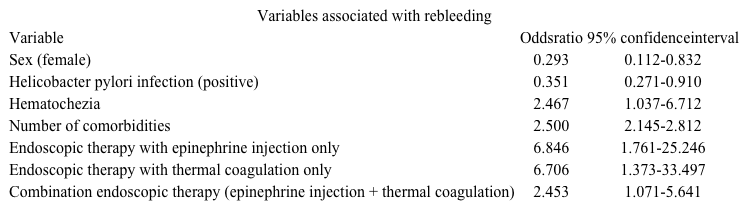 No missing data points regarding the type of endoscopic therapy received, comorbidities, or Heliobacter pylori status were reported in the study. Which of the following is the best interpretation of the study results?
A) Endoscopic therapy with epinephrine injection increases the odds of controlling rebleeding
B) The average number of comorbidities in the group of patients who rebleed is 2.5
C) The odds of hematochezia are significantly higher among female patients than among male patients
D) The odds of rebleeding are about 65% lower among patients who are H pylori-positive compared to patients who are H pylori-negative
E) The odds ratio for rebleeding among patients who undergo combination endoscopic therapy represents strong evidence of causation
Correct Answer:

Verified
Q21: An open-label randomized trial is conducted to
Q22: An 84-year-old man comes to the physician
Q23: A retrospective, matched-cohort study is conducted to
Q24: An 84-year-old man comes to the physician
Q25: A 35-year-old man comes to the emergency
Q27: A 32-year-old woman, gravida 2 para 1,
Q28: A 59-year-old man comes to the office
Q29: A new, randomized, placebo-controlled trial studied the
Q30: A study examines the role of different
Q31: A 69-year-old man with chronic kidney disease
Unlock this Answer For Free Now!
View this answer and more for free by performing one of the following actions

Scan the QR code to install the App and get 2 free unlocks

Unlock quizzes for free by uploading documents