A 36-year-old woman with chronic back pain is seen in the emergency department with flank pain radiating to the groin and blood in her urine. "This pain is killing me," she says, "and it is quite different from my usual back pain." She has been taking ibuprofen and Percocet (oxycodone/acetaminophen) daily for the past 10 years. She has no fever or dysuria. Her temperature is 36.7 C (98 F) , blood pressure is 152/91 mm Hg, pulse is 100/min, and respirations are 14/min. Her mucous membranes are moist and pale. She appears to be in mild distress due to pain. Examination shows right costovertebral tenderness. Laboratory results are as follows: 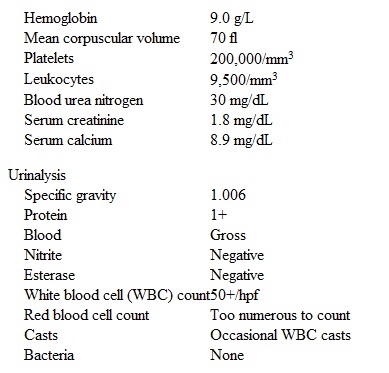 Noncontrast CT of her abdomen and pelvis reveals mild dilation of the right pelvicalyceal system, but no renal calculus is observed. Serum protein electrophoresis and urine Bence Jones proteins are negative. What is the most likely cause of her renal dysfunction?
A) Acute glomerulonephritis
B) Analgesic nephropathy
C) Prerenal azotemia
D) Pyelonephritis
E) Ureteric calculus
Correct Answer:

Verified
Q478: A 64-year-old man comes to the physician
Q479: A 45-year-old woman with cirrhosis due to
Q480: A 22-year-old woman is hospitalized after a
Q481: A 35-year-old man comes to the emergency
Q482: A 38-year-old woman, gravida 3 para 3,
Q484: A 62-year-old man returns for evaluation of
Q485: A 46-year-old nurse comes to the acute
Q486: A 38-year-old woman, gravida 3 para 3,
Q487: A 34-year-old man comes to the emergency
Q488: A 36-year-old woman comes to the emergency
Unlock this Answer For Free Now!
View this answer and more for free by performing one of the following actions

Scan the QR code to install the App and get 2 free unlocks

Unlock quizzes for free by uploading documents