Passage
Psychophysiology examines the relationship between the properties of a physical stimulus (eg, amplitude of sound waves) and how we perceive that stimulus (eg, loudness) . However, this relationship is often accompanied by a degree of uncertainty as the stimulus of interest, or signal, can be confounded by various sources of noise. Noise can be either external (arising from the environment) or internal (arising from physiological sources) .To investigate the effect of distraction on auditory perception, researchers tested the ability of subjects to detect auditory tones presented during a visual-memory task. The study included 90 participants age 18-65, and each participant completed 10 trials. Trials consisted of five 800-Hz tones presented randomly while participants viewed a set of 15 sequential pictures of common objects on a computer screen. The objects fell into one of three categories: animals, vehicles, or things that make noise. Half the participants were asked to memorize as many objects as they could (objects group) , and half were asked to remember only the categories of objects they saw (categories group) . Tones were presented bilaterally within a range of 0-20 dB. Participants noted when they detected a tone during the trial by pressing a button. Results of the study are shown in Figure 1.
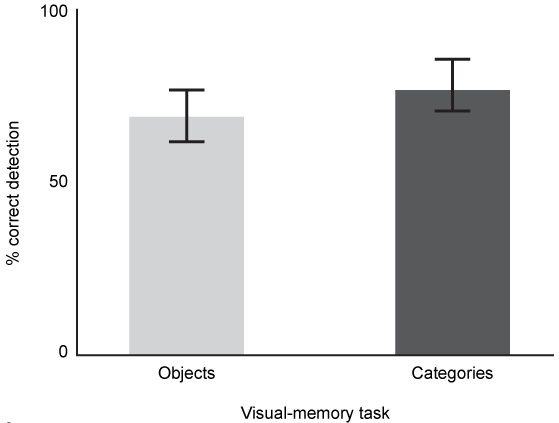 Figure 1 Mean percentage of tones correctly identified in each visual-memory task group (Note: Error bars indicate 95% confidence intervals.)
W. Yost ©2007 Academic Press.
-Which of the following conclusions can be drawn from the study as it is described in the passage?
A) Age is not related to the ability to detect auditory tones.
B) Remembering the names of objects is more difficult than remembering the categories of objects.
C) There is not sufficient evidence to establish a significant difference in the correct detection of tones between the two groups.
D) The categories group is significantly better at correctly detecting tones than the objects group.
Correct Answer:

Verified
Q67: Passage
Visual perception involves the organization and interpretation
Q68: Passage
A common misconception in medicine is that
Q69: Passage
Visual perception involves the organization and interpretation
Q70: Passage
Major depression is a mood disorder that
Q71: Passage
Psychophysiology examines the relationship between the properties
Q73: Passage
Psychophysiology examines the relationship between the properties
Q74: Passage
A common misconception in medicine is that
Q75: Passage
Visual perception involves the organization and interpretation
Q76: Passage
Major depression is a mood disorder that
Q77: Passage
Psychophysiology examines the relationship between the properties
Unlock this Answer For Free Now!
View this answer and more for free by performing one of the following actions

Scan the QR code to install the App and get 2 free unlocks

Unlock quizzes for free by uploading documents