Passage
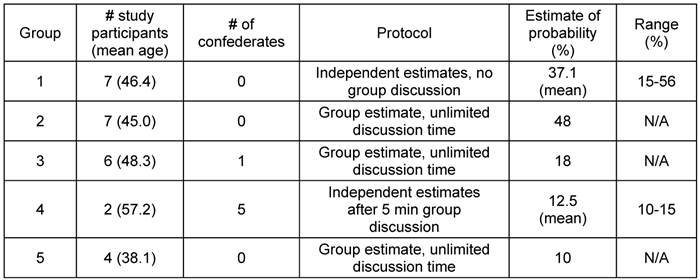
Twenty-two adults (mean age 49.5) were recruited to participate in a study they were told was to assess beliefs about cancer risk. All participants were in good health; neither they nor any first-degree relatives had been diagnosed with cancer.In the first phase of the study, participants viewed a brief video about the epidemiology and prevalence of cancer in the United States, and then were randomly assigned to one of four groups and asked to estimate the probability that they would develop cancer in their lifetimes. Group 1 consisted of seven study participants who each arrived at their estimates independently and without discussion. Group 2 consisted of seven study participants who were asked to agree on a group estimate after discussion (with unlimited time) . Group 3 contained seven members who were also asked to arrive at a consensus estimate after discussion (with unlimited time) : Six were study participants and the seventh was a confederate who suggested a very low estimate. Group 4 likewise contained seven members: Two were study participants and the other five were confederates who each suggested low estimates. Group 4 members were limited to 5 minutes of discussion and then asked to arrive at individual estimates.For the second phase of the study, four members of Group 1 who arrived at independent estimates of 20% or lower were put into a new group (Group 5) , then were given unlimited time to discuss their initial estimates and arrive at a group estimate (Table 1) .Table 1 Group Composition, Protocol, and Estimate of Developing Cancer in One's Lifetime
 S. E. Asch ©1956 American Psychological Association.
-To prevent groupthink in Groups 2, 3, and 4, experimenters could:
A) require each group member to defend an alternative estimate during discussion.
B) reward groups that reach a consensus quickly.
C) have groups participate in 15 minutes of team-building activities before discussion.
D) ask the groups to agree on a team leader.
Correct Answer:

Verified
Q130: Passage
Twenty-two adults (mean age 49.5) were recruited
Q131: Passage
Researchers conducted a pair of studies to
Q132: Passage
Post-traumatic stress disorder (PTSD) and generalized anxiety
Q133: Passage
Post-traumatic stress disorder (PTSD) and generalized anxiety
Q134: Passage
Post-traumatic stress disorder (PTSD) and generalized anxiety
Q136: Passage
Researchers conducted a pair of studies to
Q137: Passage
Researchers conducted a pair of studies to
Q138: Passage
Researchers conducted a pair of studies to
Q139: Passage
Twenty-two adults (mean age 49.5) were recruited
Q140: Passage
Researchers conducted a pair of studies to
Unlock this Answer For Free Now!
View this answer and more for free by performing one of the following actions

Scan the QR code to install the App and get 2 free unlocks

Unlock quizzes for free by uploading documents