Solved

Passage Human Gamma-Glutamyl Transpeptidase (HGGT) Is an Enzyme Involved in Cysteine

Question 107

Multiple Choice

Passage
Human gamma-glutamyl transpeptidase (hGGT) is an enzyme involved in cysteine homeostasis, and its overexpression has been linked to asthma, cancer, and other diseases.  It catalyzes the addition of water across a bond to cleave extracellular glutathione (GSH) into glutamate and a dipeptide composed of cysteine and glycine.  It is believed to function by the mechanism shown in Figure 1.
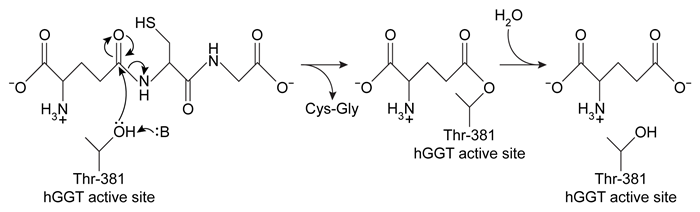
Passage Human gamma-glutamyl transpeptidase (hGGT)  is an enzyme involved in cysteine homeostasis, and its overexpression has been linked to asthma, cancer, and other diseases.  It catalyzes the addition of water across a bond to cleave extracellular glutathione (GSH)  into glutamate and a dipeptide composed of cysteine and glycine.  It is believed to function by the mechanism shown in Figure 1.    <strong>Figure 1</strong>  Proposed mechanism of hGGT-mediated GSH cleavageResearchers interested in investigating hGGT inhibitors as a treatment for pathologies related to excess hGGT activity performed the following experiments, each containing the same concentration of hGGT.Experiment 1hGGT was incubated with various concentrations of GSH in the presence or absence of 250-μM candidate compound acivicin or Compound <strong>1</strong>.  However, both candidates were found to be unsuitable as acivicin showed significant neurotoxicity and Compound <strong>1</strong> acted as an activator instead of an inhibitor.    <strong>Figure 2</strong>  Lineweaver-Burk plot of hGGT activity with respect to GSH in the presence or absence of 250-μM candidate inhibitorsExperiment 2Researchers hypothesized that slight variations in the structure of Compound <strong>1</strong> could result in hGGT inhibition and tested several derivatives, shown in Table 1.<strong>Table 1</strong>  Kinetic Parameters of hGGT in the Presence or Absence of Several Candidate Inhibitors at 250 μM    Experiment 3To better understand the physiological conditions under which hGGT operates, researchers exposed a cultured cell line expressing hGGT on the cell surface to a solution that mimicked the composition of extracellular fluid, including levels of GSH.  They found that in this setup, uninhibited hGGT results in a reaction rate that is approximately ½V<sub>max</sub>. Adapted from Wickham S, Regan N, West MB, et al. Inhibition of human ?-glutamyl transpeptidase: development of more potent, physiologically relevant, uncompetitive inhibitors. Biochem J. 2013;450(3) :547-57. -Based on the information in Experiment 3, if researchers wish to further study the inhibitor that is most potent under physiological conditions, they should choose the one that yields the lowest hGGT activity when GSH concentration is: A) orders of magnitude less than the K<sub>m</sub> of the uninhibited enzyme. B) approximately equal to the K<sub>m</sub> of the uninhibited enzyme. C) approximately four times the K<sub>m</sub> of the uninhibited enzyme. D) orders of magnitude greater than the K<sub>m</sub> of the uninhibited enzyme. Figure 1  Proposed mechanism of hGGT-mediated GSH cleavageResearchers interested in investigating hGGT inhibitors as a treatment for pathologies related to excess hGGT activity performed the following experiments, each containing the same concentration of hGGT.Experiment 1hGGT was incubated with various concentrations of GSH in the presence or absence of 250-μM candidate compound acivicin or Compound 1.  However, both candidates were found to be unsuitable as acivicin showed significant neurotoxicity and Compound 1 acted as an activator instead of an inhibitor.
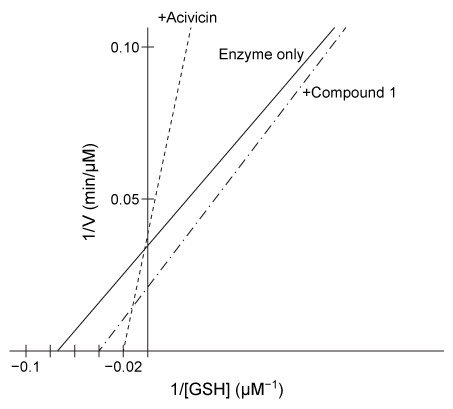
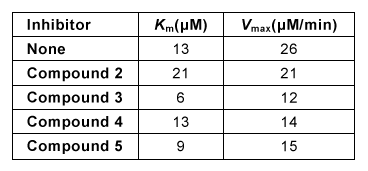
Passage Human gamma-glutamyl transpeptidase (hGGT)  is an enzyme involved in cysteine homeostasis, and its overexpression has been linked to asthma, cancer, and other diseases.  It catalyzes the addition of water across a bond to cleave extracellular glutathione (GSH)  into glutamate and a dipeptide composed of cysteine and glycine.  It is believed to function by the mechanism shown in Figure 1.    <strong>Figure 1</strong>  Proposed mechanism of hGGT-mediated GSH cleavageResearchers interested in investigating hGGT inhibitors as a treatment for pathologies related to excess hGGT activity performed the following experiments, each containing the same concentration of hGGT.Experiment 1hGGT was incubated with various concentrations of GSH in the presence or absence of 250-μM candidate compound acivicin or Compound <strong>1</strong>.  However, both candidates were found to be unsuitable as acivicin showed significant neurotoxicity and Compound <strong>1</strong> acted as an activator instead of an inhibitor.    <strong>Figure 2</strong>  Lineweaver-Burk plot of hGGT activity with respect to GSH in the presence or absence of 250-μM candidate inhibitorsExperiment 2Researchers hypothesized that slight variations in the structure of Compound <strong>1</strong> could result in hGGT inhibition and tested several derivatives, shown in Table 1.<strong>Table 1</strong>  Kinetic Parameters of hGGT in the Presence or Absence of Several Candidate Inhibitors at 250 μM    Experiment 3To better understand the physiological conditions under which hGGT operates, researchers exposed a cultured cell line expressing hGGT on the cell surface to a solution that mimicked the composition of extracellular fluid, including levels of GSH.  They found that in this setup, uninhibited hGGT results in a reaction rate that is approximately ½V<sub>max</sub>. Adapted from Wickham S, Regan N, West MB, et al. Inhibition of human ?-glutamyl transpeptidase: development of more potent, physiologically relevant, uncompetitive inhibitors. Biochem J. 2013;450(3) :547-57. -Based on the information in Experiment 3, if researchers wish to further study the inhibitor that is most potent under physiological conditions, they should choose the one that yields the lowest hGGT activity when GSH concentration is: A) orders of magnitude less than the K<sub>m</sub> of the uninhibited enzyme. B) approximately equal to the K<sub>m</sub> of the uninhibited enzyme. C) approximately four times the K<sub>m</sub> of the uninhibited enzyme. D) orders of magnitude greater than the K<sub>m</sub> of the uninhibited enzyme. Figure 2  Lineweaver-Burk plot of hGGT activity with respect to GSH in the presence or absence of 250-μM candidate inhibitorsExperiment 2Researchers hypothesized that slight variations in the structure of Compound 1 could result in hGGT inhibition and tested several derivatives, shown in Table 1.Table 1  Kinetic Parameters of hGGT in the Presence or Absence of Several Candidate Inhibitors at 250 μM
Passage Human gamma-glutamyl transpeptidase (hGGT)  is an enzyme involved in cysteine homeostasis, and its overexpression has been linked to asthma, cancer, and other diseases.  It catalyzes the addition of water across a bond to cleave extracellular glutathione (GSH)  into glutamate and a dipeptide composed of cysteine and glycine.  It is believed to function by the mechanism shown in Figure 1.    <strong>Figure 1</strong>  Proposed mechanism of hGGT-mediated GSH cleavageResearchers interested in investigating hGGT inhibitors as a treatment for pathologies related to excess hGGT activity performed the following experiments, each containing the same concentration of hGGT.Experiment 1hGGT was incubated with various concentrations of GSH in the presence or absence of 250-μM candidate compound acivicin or Compound <strong>1</strong>.  However, both candidates were found to be unsuitable as acivicin showed significant neurotoxicity and Compound <strong>1</strong> acted as an activator instead of an inhibitor.    <strong>Figure 2</strong>  Lineweaver-Burk plot of hGGT activity with respect to GSH in the presence or absence of 250-μM candidate inhibitorsExperiment 2Researchers hypothesized that slight variations in the structure of Compound <strong>1</strong> could result in hGGT inhibition and tested several derivatives, shown in Table 1.<strong>Table 1</strong>  Kinetic Parameters of hGGT in the Presence or Absence of Several Candidate Inhibitors at 250 μM    Experiment 3To better understand the physiological conditions under which hGGT operates, researchers exposed a cultured cell line expressing hGGT on the cell surface to a solution that mimicked the composition of extracellular fluid, including levels of GSH.  They found that in this setup, uninhibited hGGT results in a reaction rate that is approximately ½V<sub>max</sub>. Adapted from Wickham S, Regan N, West MB, et al. Inhibition of human ?-glutamyl transpeptidase: development of more potent, physiologically relevant, uncompetitive inhibitors. Biochem J. 2013;450(3) :547-57. -Based on the information in Experiment 3, if researchers wish to further study the inhibitor that is most potent under physiological conditions, they should choose the one that yields the lowest hGGT activity when GSH concentration is: A) orders of magnitude less than the K<sub>m</sub> of the uninhibited enzyme. B) approximately equal to the K<sub>m</sub> of the uninhibited enzyme. C) approximately four times the K<sub>m</sub> of the uninhibited enzyme. D) orders of magnitude greater than the K<sub>m</sub> of the uninhibited enzyme. Experiment 3To better understand the physiological conditions under which hGGT operates, researchers exposed a cultured cell line expressing hGGT on the cell surface to a solution that mimicked the composition of extracellular fluid, including levels of GSH.  They found that in this setup, uninhibited hGGT results in a reaction rate that is approximately ½Vmax.
Adapted from Wickham S, Regan N, West MB, et al. Inhibition of human ?-glutamyl transpeptidase: development of more potent, physiologically relevant, uncompetitive inhibitors. Biochem J. 2013;450(3) :547-57.
-Based on the information in Experiment 3, if researchers wish to further study the inhibitor that is most potent under physiological conditions, they should choose the one that yields the lowest hGGT activity when GSH concentration is:


A) orders of magnitude less than the Km of the uninhibited enzyme.
B) approximately equal to the Km of the uninhibited enzyme.
C) approximately four times the Km of the uninhibited enzyme.
D) orders of magnitude greater than the Km of the uninhibited enzyme.

Correct Answer:

verifed

Verified

Unlock this answer now
Get Access to more Verified Answers free of charge

Related Questions

Unlock this Answer For Free Now!

View this answer and more for free by performing one of the following actions

qr-code

Scan the QR code to install the App and get 2 free unlocks

upload documents

Unlock quizzes for free by uploading documents