Passage the Cystic Fibrosis Transmembrane Conductance Regulator (CFTR) Protein Is a a Chloride
Passage
The cystic fibrosis transmembrane conductance regulator (CFTR) protein is a chloride ion channel involved in the production of mucus, sweat, and digestive fluids. CFTR is composed of five domains (Figure 1) : Two transmembrane domains (TMD1 and TMD2) , two nucleotide binding domains (NBD1 and NBD2) , and one regulatory domain (R domain) .
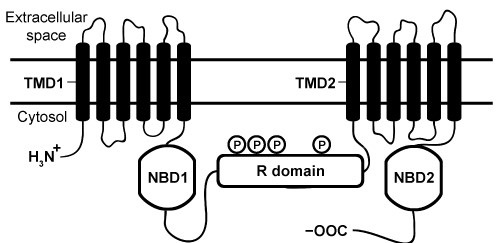 Figure 1 Schematic diagram of CFTR domainsThe NBD domains regulate CFTR activity by binding ATP, which causes a conformational change in the TMD domains. This change allows chloride ions to leave cells by passively crossing the membrane down their concentration gradient. The R domain regulates activity further through dynamic phosphorylation at several positions. The movement of chloride ions facilitates the movement of water out of the cell by osmotic pressure and helps keep secretions thin.Cystic fibrosis (CF) arises from recessively inherited mutations in the CFTR gene. The most common mutation is a three-base-pair deletion that removes a phenylalanine residue at position 508 in NBD1 (ΔF508) . This mutation causes the protein to fold incorrectly, making it more susceptible to degradation by proteases. The resulting decrease in CFTR abundance inhibits chloride ion transport, leading to thickening of normally thin secretions and increased risk of life-threatening pulmonary infections.
-According to the information in the passage, which statement best describes the role of ATP in CFTR activity? ATP:
A) is hydrolyzed to provide the energy input necessary for ion transport.
B) flows through CFTR in the opposite direction as chloride.
C) inhibits chloride transport by occupying the channel.
D) allosterically activates CFTR-mediated chloride transport.
Correct Answer:

Verified
Q159: During glycolysis, phosphofructokinase converts fructose 6-phosphate (F6P)
Q160: Passage
Nerve cells must maintain the composition of
Q161: Which statement correctly describes the cleavage of
Q162: Passage
The cystic fibrosis transmembrane conductance regulator (CFTR)
Q163: Passage
Diabetic nephropathy (kidney disease) is characterized in
Q165: Passage
Diabetic nephropathy (kidney disease) is characterized in
Q166: Polyglutaraldehyde (PGA) can form linkages with amines.
Q167: During protein folding, which of the following
Q168: Passage
The cystic fibrosis transmembrane conductance regulator (CFTR)
Q169: Passage
Diabetic nephropathy (kidney disease) is characterized in
Unlock this Answer For Free Now!
View this answer and more for free by performing one of the following actions

Scan the QR code to install the App and get 2 free unlocks

Unlock quizzes for free by uploading documents