Passage
Saliva, a secreted fluid with multiple physiologic functions, is composed of water (~99%) , proteins, and electrolytes. Together, these components facilitate nutrient consumption, respiration, and communication. For example, saliva aids in digestion by serving as a lubricant during mastication and by initiating carbohydrate and fat metabolism. In addition, the calcium and phosphate present in saliva promote tooth remineralization, and antimicrobial and chemical buffering agents give saliva protective properties.The gustatory-salivary reflex, the secretion of saliva from the salivary glands in response to gustation (taste) , is primarily mediated by the parasympathetic division of the nervous system. In general, parasympathetic pathways originate from the brain stem or the sacral spinal cord. Fibers originating from nuclei in these regions synapse onto ganglia that lie in close proximity to the target organ. Both preganglionic neurons (those originating from the nuclei) and postganglionic neurons (those originating from the ganglia) release acetylcholine (ACh) .In the gustatory-salivary reflex, activation of taste receptors in the tongue sends impulses to the superior and inferior salivatory nuclei in the brainstem. Local processing within these nuclei activates the parasympathetic pathways that innervate the salivary glands. Ultimately, ACh released from postganglionic neurons acts on the muscarinic acetylcholine receptors (mAChRs) on the secretory cells of the salivary gland to stimulate salivation (Figure 1) .
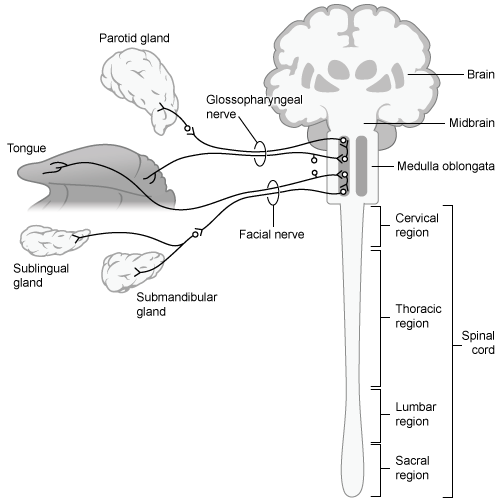 Figure 1 Parasympathetic regulation of salivary secretionSympathetic stimulation of the salivary glands also promotes salivation but to a lesser degree than parasympathetic stimulation. This may contribute to what is often perceived to be decreased salivation when the sympathetic division is more active than its counterpart. Unlike parasympathetic pathways, sympathetic pathways originate in the thoracic and lumbar spinal segments, and the ganglia lie in close proximity to the spinal cord. Although preganglionic neurons of the sympathetic nervous system release ACh, the postganglionic neurons often release norepinephrine.
-The gustatory-salivary reflex can be modulated (dampened or enhanced) by input from higher centers in the central nervous system. To modulate the salivary response, descending pathways from the brain would most likely synapse onto which part of the reflex arc?
A) The taste receptor
B) The salivary gland
C) The preganglionic neuron
D) The postganglionic neuron
Correct Answer:

Verified
Q181: Which statement most accurately describes the role
Q182: A woman carries an X-linked recessive allele
Q183: Passage
Adeno-associated virus 2 (AAV2) is a nonpathogenic,
Q184: Passage
Adeno-associated virus 2 (AAV2) is a nonpathogenic,
Q185: Assume L410 is an acquired mutation that
Q187: Which of the following is generally true
Q188: Passage
Abnormal blood lipid levels play a significant
Q189: Passage
Abnormal blood lipid levels play a significant
Q190: Passage
Abnormal blood lipid levels play a significant
Q191: A scientist claims that endurance training is
Unlock this Answer For Free Now!
View this answer and more for free by performing one of the following actions

Scan the QR code to install the App and get 2 free unlocks

Unlock quizzes for free by uploading documents