Passage
Each time a eukaryotic cell replicates its DNA, the telomeres at the ends of each chromosome become slightly shorter. When telomeres reach a critically short length, the cells enter the senescent state, in which cell division ceases (Figure 1) . In humans, conditions such as hypertension, liver disease, and Alzheimer disease have been associated with the decreased telomere length and resulting senescence that occur as part of the normal aging process.
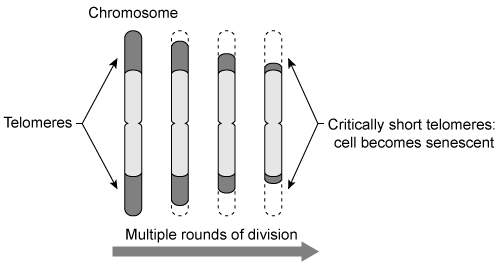 Figure 1Cells that must be able to divide indefinitely (stem cells and germ cells) express an enzyme known as telomerase. Functional telomerase consists of a protein subunit called telomerase reverse transcriptase (TERT) and a noncoding RNA subunit called telomerase RNA (TR) . Using a portion of TR as a template, telomerase extends telomeres by continuously adding the sequence 5′-TTAGGG-3′ to the ends of chromosomes. The complement strand is then filled in by DNA polymerase. Telomere extension allows these cells to avoid senescence.In healthy somatic cells, however, TERT transcription is generally downregulated by the absence of the oncogene c-Myc and the presence of the tumor suppressor protein WT1. When telomerase is suppressed, the resulting critical telomere shortening has been hypothesized to prevent uncontrolled cell proliferation in adult tissues. In cancerous somatic cells, on the other hand, increased telomerase activity is often associated with tumorigenesis. WT1 is frequently absent and c-Myc is frequently overexpressed in these cells, leading to increased TERT expression.In addition to transcriptional control, TERT can be regulated at the post-transcriptional level. The TERT gene consists of 16 exons and 15 introns that can be spliced into more than 20 different isoforms in humans. Only one isoform (the active isoform) is known to extend telomeres. However, the i2 isoform, in which intron 2 is partially included in the mature mRNA (Figure 2) , has been hypothesized to downregulate residual TERT activity in somatic cells.
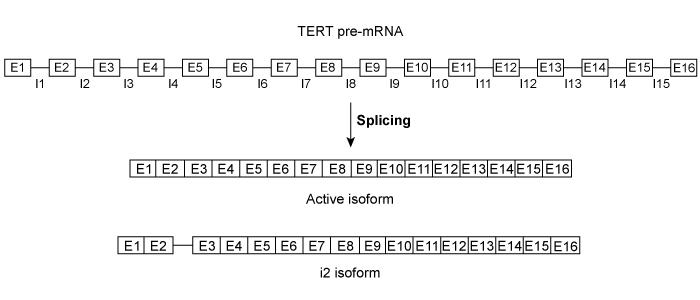 Figure 2
Adapted from Cifuentes-rojas C, Shippen DE. Telomerase regulation. Mutat Res. 2012;730(1-2) :20-7.
-Considering that healthy somatic cells typically transcribe the TERT gene only at low levels, where in the chromosomes of these cells is the gene most likely found?
A) In a relatively open, uncoiled portion of the chromosome
B) In the portion of the chromosome that binds the kinetochore
C) In a portion of the chromosome that associates with ribosomes
D) In a portion of the chromosome that is tightly wound around histones
Correct Answer:

Verified
Q215: Passage
Adeno-associated virus 2 (AAV2) is a nonpathogenic,
Q216: Passage
The fruit fly Drosophila melanogaster is frequently
Q217: Passage
The fruit fly Drosophila melanogaster is frequently
Q218: Passage
The fruit fly Drosophila melanogaster is frequently
Q219: Passage
The fruit fly Drosophila melanogaster is frequently
Q221: Passage
The sex chromosomes X and Y are
Q222: Passage
Endometriosis is a chronic, treatable disease of
Q223: Passage
Bone remodeling is the continuous, microscopic process
Q224: Passage
Endometriosis is a chronic, treatable disease of
Q225: The DNA of telomeres can be most
Unlock this Answer For Free Now!
View this answer and more for free by performing one of the following actions

Scan the QR code to install the App and get 2 free unlocks

Unlock quizzes for free by uploading documents