Passage
Beta-thalassemia is a blood disorder caused by reduced production of the β-globin subunit of hemoglobin. The erythrocytes in patients with beta-thalassemia are abnormally small, lack sufficient functional hemoglobin, and are decreased in number. These individuals require lifelong blood transfusions to correct their erythrocyte shortage. Each unit of blood transfused contains many milligrams of iron and, consequently, blood iron levels increase due to repeated transfusions. The excess iron is then continuously deposited in the organs, leading to organ damage.Transferrin (Tf) is a protein that binds free iron in the blood and plays a key role in erythropoiesis, which requires uptake of iron from the blood in a process facilitated by Tf and its cell surface receptor (TfR) . Iron-bound Tf, known as holotransferrin (holoTf) , binds TfR to form a complex that is brought into the developing erythrocyte in an endosome. Acidification of the endosome triggers a conformational change in holoTf, which allows the release of free iron into the cell and the recycling of the remaining complex components to the cell surface. Non-iron-bound Tf is referred to as apotransferrin (apoTf) , and due to its iron-binding capability, researchers believe that apoTf injections may help prevent deposition of excess iron in the organs of patients with beta-thalassemia.To investigate the effect of apoTf administration in a mouse model of beta-thalassemia, mice homozygous for an inactivating deletion in the murine β-globin gene (Hbbth−3/Hbbth−3) were given blood transfusions followed by apoTf injection. Measurements of non-transferrin-bound iron in the blood (NTBI) , plasma holoTf, and urinary holoTf were taken immediately and at 15 days post-injection. Results revealed that NTBI decreased over the tested period. Experimenters hypothesized that apoTf mediated certain regulatory changes that reduced NTBI in Hbbth−3/Hbbth−3 mice by increasing urinary holoTf excretion.
-ApoTf and TfR were analyzed by SDS-PAGE under nonreducing and reducing conditions. Based on the gels shown, which conclusion is LEAST likely to be true? 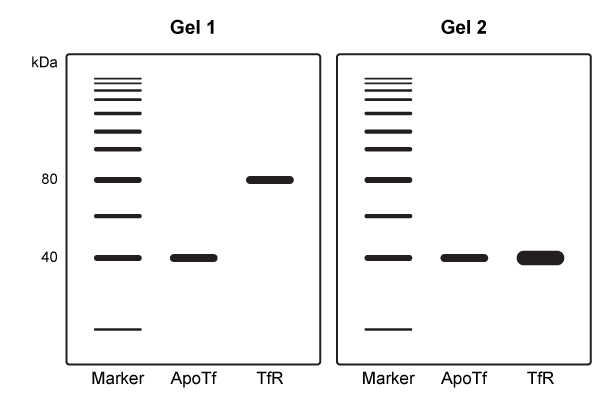
A) Gel 1 represents the nonreducing SDS-PAGE gel.
B) apoTf has a smaller molecular weight than TfR.
C) apoTf and TfR were assigned a net negative charge.
D) TfR is a monomeric protein lacking disulfide bridges.
Correct Answer:

Verified
Q206: Passage
Each time a eukaryotic cell replicates its
Q207: Passage
The fruit fly Drosophila melanogaster is frequently
Q208: Passage
Each time a eukaryotic cell replicates its
Q209: Compared to the blood flowing into the
Q210: Passage
Beta-thalassemia is a blood disorder caused by
Q212: Passage
Beta-thalassemia is a blood disorder caused by
Q213: Passage
Adeno-associated virus 2 (AAV2) is a nonpathogenic,
Q214: Passage
Beta-thalassemia is a blood disorder caused by
Q215: Passage
Adeno-associated virus 2 (AAV2) is a nonpathogenic,
Q216: Passage
The fruit fly Drosophila melanogaster is frequently
Unlock this Answer For Free Now!
View this answer and more for free by performing one of the following actions

Scan the QR code to install the App and get 2 free unlocks

Unlock quizzes for free by uploading documents