Solved

Passage

Question 152

Multiple Choice

Passage
The alkaline-earth metals are a highly reactive family of metals occupying Group 2 (IIA) of the periodic table.  In their elemental form, the alkaline-earth metals have a shiny, silvery-white to slightly yellowish appearance.  The alkaline-earth metals exhibit some similarities to the chemistry of the alkali metals (Group 1) but are a little less reactive.Atoms of the alkaline-earth metals (M) have only two valence electrons and a low first and second ionization energy.  Consequently, these metals readily lose both electrons to produce cations with a +2 charge (M+2) during reactions with nonmetals.  As a result, the alkaline-earth metals do not exist in their elemental metallic form in nature.  Instead, the Group 2 elements are found primarily as metal oxides, which form by reacting oxygen (Reaction 1) .

Passage The alkaline-earth metals are a highly reactive family of metals occupying Group 2 (IIA)  of the periodic table.  In their elemental form, the alkaline-earth metals have a shiny, silvery-white to slightly yellowish appearance.  The alkaline-earth metals exhibit some similarities to the chemistry of the alkali metals (Group 1)  but are a little less reactive.Atoms of the alkaline-earth metals (M)  have only two valence electrons and a low first and second ionization energy.  Consequently, these metals readily lose both electrons to produce cations with a +2 charge (M<sup>+2</sup>)  during reactions with nonmetals.  As a result, the alkaline-earth metals do not exist in their elemental metallic form in nature.  Instead, the Group 2 elements are found primarily as metal oxides, which form by reacting oxygen (Reaction 1) .     Similarly, elemental samples of alkaline-earth metals will react with elemental halogens (X<sub>2</sub>)  to form metal halides (Reaction 2) , all of which are ionic except for BeCl<sub>2</sub>.     Except for beryllium, the alkaline-earth metals react with water to produce very basic metal hydroxide solutions and hydrogen gas (Reaction 3) .     The most difficult alkaline-earth metal to study is radium, because it is a rare radioactive element that is produced from the nuclear decay of uranium.  The most common natural isotope, radium-226, has a half-life of 1,600 years and decays by alpha emission into radon-222 (Reaction 4) .    -What is the mass of water necessary to generate 11.2 L of hydrogen gas if calcium metal reacts with water at standard temperature and pressure (STP) ? A) 2.0 g B) 4.5 g C) 9.0 g D) 18.0 g
Similarly, elemental samples of alkaline-earth metals will react with elemental halogens (X2) to form metal halides (Reaction 2) , all of which are ionic except for BeCl2.

Passage The alkaline-earth metals are a highly reactive family of metals occupying Group 2 (IIA)  of the periodic table.  In their elemental form, the alkaline-earth metals have a shiny, silvery-white to slightly yellowish appearance.  The alkaline-earth metals exhibit some similarities to the chemistry of the alkali metals (Group 1)  but are a little less reactive.Atoms of the alkaline-earth metals (M)  have only two valence electrons and a low first and second ionization energy.  Consequently, these metals readily lose both electrons to produce cations with a +2 charge (M<sup>+2</sup>)  during reactions with nonmetals.  As a result, the alkaline-earth metals do not exist in their elemental metallic form in nature.  Instead, the Group 2 elements are found primarily as metal oxides, which form by reacting oxygen (Reaction 1) .     Similarly, elemental samples of alkaline-earth metals will react with elemental halogens (X<sub>2</sub>)  to form metal halides (Reaction 2) , all of which are ionic except for BeCl<sub>2</sub>.     Except for beryllium, the alkaline-earth metals react with water to produce very basic metal hydroxide solutions and hydrogen gas (Reaction 3) .     The most difficult alkaline-earth metal to study is radium, because it is a rare radioactive element that is produced from the nuclear decay of uranium.  The most common natural isotope, radium-226, has a half-life of 1,600 years and decays by alpha emission into radon-222 (Reaction 4) .    -What is the mass of water necessary to generate 11.2 L of hydrogen gas if calcium metal reacts with water at standard temperature and pressure (STP) ? A) 2.0 g B) 4.5 g C) 9.0 g D) 18.0 g
Except for beryllium, the alkaline-earth metals react with water to produce very basic metal hydroxide solutions and hydrogen gas (Reaction 3) .

Passage The alkaline-earth metals are a highly reactive family of metals occupying Group 2 (IIA)  of the periodic table.  In their elemental form, the alkaline-earth metals have a shiny, silvery-white to slightly yellowish appearance.  The alkaline-earth metals exhibit some similarities to the chemistry of the alkali metals (Group 1)  but are a little less reactive.Atoms of the alkaline-earth metals (M)  have only two valence electrons and a low first and second ionization energy.  Consequently, these metals readily lose both electrons to produce cations with a +2 charge (M<sup>+2</sup>)  during reactions with nonmetals.  As a result, the alkaline-earth metals do not exist in their elemental metallic form in nature.  Instead, the Group 2 elements are found primarily as metal oxides, which form by reacting oxygen (Reaction 1) .     Similarly, elemental samples of alkaline-earth metals will react with elemental halogens (X<sub>2</sub>)  to form metal halides (Reaction 2) , all of which are ionic except for BeCl<sub>2</sub>.     Except for beryllium, the alkaline-earth metals react with water to produce very basic metal hydroxide solutions and hydrogen gas (Reaction 3) .     The most difficult alkaline-earth metal to study is radium, because it is a rare radioactive element that is produced from the nuclear decay of uranium.  The most common natural isotope, radium-226, has a half-life of 1,600 years and decays by alpha emission into radon-222 (Reaction 4) .    -What is the mass of water necessary to generate 11.2 L of hydrogen gas if calcium metal reacts with water at standard temperature and pressure (STP) ? A) 2.0 g B) 4.5 g C) 9.0 g D) 18.0 g
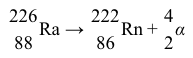
The most difficult alkaline-earth metal to study is radium, because it is a rare radioactive element that is produced from the nuclear decay of uranium.  The most common natural isotope, radium-226, has a half-life of 1,600 years and decays by alpha emission into radon-222 (Reaction 4) .
Passage The alkaline-earth metals are a highly reactive family of metals occupying Group 2 (IIA)  of the periodic table.  In their elemental form, the alkaline-earth metals have a shiny, silvery-white to slightly yellowish appearance.  The alkaline-earth metals exhibit some similarities to the chemistry of the alkali metals (Group 1)  but are a little less reactive.Atoms of the alkaline-earth metals (M)  have only two valence electrons and a low first and second ionization energy.  Consequently, these metals readily lose both electrons to produce cations with a +2 charge (M<sup>+2</sup>)  during reactions with nonmetals.  As a result, the alkaline-earth metals do not exist in their elemental metallic form in nature.  Instead, the Group 2 elements are found primarily as metal oxides, which form by reacting oxygen (Reaction 1) .     Similarly, elemental samples of alkaline-earth metals will react with elemental halogens (X<sub>2</sub>)  to form metal halides (Reaction 2) , all of which are ionic except for BeCl<sub>2</sub>.     Except for beryllium, the alkaline-earth metals react with water to produce very basic metal hydroxide solutions and hydrogen gas (Reaction 3) .     The most difficult alkaline-earth metal to study is radium, because it is a rare radioactive element that is produced from the nuclear decay of uranium.  The most common natural isotope, radium-226, has a half-life of 1,600 years and decays by alpha emission into radon-222 (Reaction 4) .    -What is the mass of water necessary to generate 11.2 L of hydrogen gas if calcium metal reacts with water at standard temperature and pressure (STP) ? A) 2.0 g B) 4.5 g C) 9.0 g D) 18.0 g
-What is the mass of water necessary to generate 11.2 L of hydrogen gas if calcium metal reacts with water at standard temperature and pressure (STP) ?


A) 2.0 g
B) 4.5 g
C) 9.0 g
D) 18.0 g

Correct Answer:

verifed

Verified

Unlock this answer now
Get Access to more Verified Answers free of charge

Related Questions

Unlock this Answer For Free Now!

View this answer and more for free by performing one of the following actions

qr-code

Scan the QR code to install the App and get 2 free unlocks

upload documents

Unlock quizzes for free by uploading documents