Solved

Passage In Hemodynamics, Blood Flow Through the Cardiovascular System Can Be

Question 7

Multiple Choice

Passage
In hemodynamics, blood flow through the cardiovascular system can be modeled as an electric circuit in which the blood serves as electricity, the blood vessels as resistive wires, and the heart as a battery (see Figure 1) .
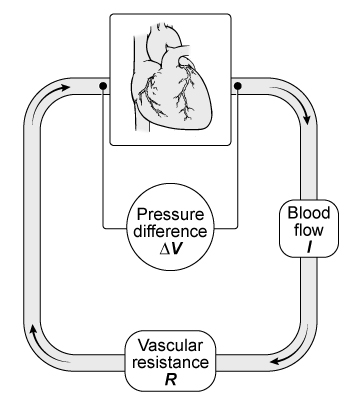
Passage In hemodynamics, blood flow through the cardiovascular system can be modeled as an electric circuit in which the blood serves as electricity, the blood vessels as resistive wires, and the heart as a battery (see Figure 1) .    <strong>Figure 1</strong>  Cardiovascular circuit modelOhm's law states that the voltage drop ΔV across each element, the current I flowing through it, and its electrical resistance R are related by ΔV = IR.  In a blood vessel, pressure difference between one vessel and the next ΔP replaces ΔV, volumetric blood flow Q replaces I, and vascular resistance R replaces electrical resistance.  Therefore, Ohm's law for blood flow in a vessel isΔP = QR<strong>Equation 1</strong>Vascular resistance is due to the blood's viscosity η and the dimensions of the vessel through which it flows.  Assuming blood vessels are cylinders, R can be approximated as    <strong>Equation 2</strong>where L is the length of the vessel, and r is its inner radius.  If Equation 2 is combined with Equation 1, the resulting equation is Poiseuille law.In a study of the circulatory system in rats, researchers measured the intravascular blood pressure of the mesenteric blood vessels.  The mesentery is the set of tissues that holds the intestines in place.  Blood flows in the following order:  aorta, superior mesenteric artery (SMA) , arterial arcade, venous arcade, superior mesenteric vein (SMV) .For the procedure, catheters with pressure transducers were inserted into each vessel via laparotomy.  Laparotomy is an invasive procedure that involves a surgical incision into the abdominal cavity.  Blood pressure measurements were taken simultaneously at the proximal end (beginning)  of each blood vessel.    <strong>Figure 2</strong>  Mesenteric blood pressure profile of rats (Note: SMA = superior mesenteric artery; SMV = superior mesenteric vein.)  -The blood pressures of an artery in the neck and in the leg of a person lying down are measured, and their difference calculated.  When the blood pressures are taken after the person stands up, their difference: A) decreases because flow resistance is greater over horizontal distances. B) remains the same because blood is modeled as an ideal fluid. C) increases because viscous pressure acts in the direction of gravity. D) increases due to the hydrostatic pressure between the two locations. Figure 1  Cardiovascular circuit modelOhm's law states that the voltage drop ΔV across each element, the current I flowing through it, and its electrical resistance R are related by ΔV = IR.  In a blood vessel, pressure difference between one vessel and the next ΔP replaces ΔV, volumetric blood flow Q replaces I, and vascular resistance R replaces electrical resistance.  Therefore, Ohm's law for blood flow in a vessel isΔP = QREquation 1Vascular resistance is due to the blood's viscosity η and the dimensions of the vessel through which it flows.  Assuming blood vessels are cylinders, R can be approximated as
Passage In hemodynamics, blood flow through the cardiovascular system can be modeled as an electric circuit in which the blood serves as electricity, the blood vessels as resistive wires, and the heart as a battery (see Figure 1) .    <strong>Figure 1</strong>  Cardiovascular circuit modelOhm's law states that the voltage drop ΔV across each element, the current I flowing through it, and its electrical resistance R are related by ΔV = IR.  In a blood vessel, pressure difference between one vessel and the next ΔP replaces ΔV, volumetric blood flow Q replaces I, and vascular resistance R replaces electrical resistance.  Therefore, Ohm's law for blood flow in a vessel isΔP = QR<strong>Equation 1</strong>Vascular resistance is due to the blood's viscosity η and the dimensions of the vessel through which it flows.  Assuming blood vessels are cylinders, R can be approximated as    <strong>Equation 2</strong>where L is the length of the vessel, and r is its inner radius.  If Equation 2 is combined with Equation 1, the resulting equation is Poiseuille law.In a study of the circulatory system in rats, researchers measured the intravascular blood pressure of the mesenteric blood vessels.  The mesentery is the set of tissues that holds the intestines in place.  Blood flows in the following order:  aorta, superior mesenteric artery (SMA) , arterial arcade, venous arcade, superior mesenteric vein (SMV) .For the procedure, catheters with pressure transducers were inserted into each vessel via laparotomy.  Laparotomy is an invasive procedure that involves a surgical incision into the abdominal cavity.  Blood pressure measurements were taken simultaneously at the proximal end (beginning)  of each blood vessel.    <strong>Figure 2</strong>  Mesenteric blood pressure profile of rats (Note: SMA = superior mesenteric artery; SMV = superior mesenteric vein.)  -The blood pressures of an artery in the neck and in the leg of a person lying down are measured, and their difference calculated.  When the blood pressures are taken after the person stands up, their difference: A) decreases because flow resistance is greater over horizontal distances. B) remains the same because blood is modeled as an ideal fluid. C) increases because viscous pressure acts in the direction of gravity. D) increases due to the hydrostatic pressure between the two locations. Equation 2where L is the length of the vessel, and r is its inner radius.  If Equation 2 is combined with Equation 1, the resulting equation is Poiseuille law.In a study of the circulatory system in rats, researchers measured the intravascular blood pressure of the mesenteric blood vessels.  The mesentery is the set of tissues that holds the intestines in place.  Blood flows in the following order:  aorta, superior mesenteric artery (SMA) , arterial arcade, venous arcade, superior mesenteric vein (SMV) .For the procedure, catheters with pressure transducers were inserted into each vessel via laparotomy.  Laparotomy is an invasive procedure that involves a surgical incision into the abdominal cavity.  Blood pressure measurements were taken simultaneously at the proximal end (beginning) of each blood vessel.
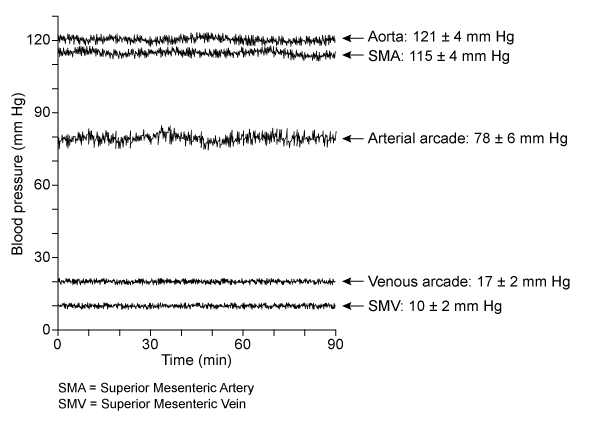
Passage In hemodynamics, blood flow through the cardiovascular system can be modeled as an electric circuit in which the blood serves as electricity, the blood vessels as resistive wires, and the heart as a battery (see Figure 1) .    <strong>Figure 1</strong>  Cardiovascular circuit modelOhm's law states that the voltage drop ΔV across each element, the current I flowing through it, and its electrical resistance R are related by ΔV = IR.  In a blood vessel, pressure difference between one vessel and the next ΔP replaces ΔV, volumetric blood flow Q replaces I, and vascular resistance R replaces electrical resistance.  Therefore, Ohm's law for blood flow in a vessel isΔP = QR<strong>Equation 1</strong>Vascular resistance is due to the blood's viscosity η and the dimensions of the vessel through which it flows.  Assuming blood vessels are cylinders, R can be approximated as    <strong>Equation 2</strong>where L is the length of the vessel, and r is its inner radius.  If Equation 2 is combined with Equation 1, the resulting equation is Poiseuille law.In a study of the circulatory system in rats, researchers measured the intravascular blood pressure of the mesenteric blood vessels.  The mesentery is the set of tissues that holds the intestines in place.  Blood flows in the following order:  aorta, superior mesenteric artery (SMA) , arterial arcade, venous arcade, superior mesenteric vein (SMV) .For the procedure, catheters with pressure transducers were inserted into each vessel via laparotomy.  Laparotomy is an invasive procedure that involves a surgical incision into the abdominal cavity.  Blood pressure measurements were taken simultaneously at the proximal end (beginning)  of each blood vessel.    <strong>Figure 2</strong>  Mesenteric blood pressure profile of rats (Note: SMA = superior mesenteric artery; SMV = superior mesenteric vein.)  -The blood pressures of an artery in the neck and in the leg of a person lying down are measured, and their difference calculated.  When the blood pressures are taken after the person stands up, their difference: A) decreases because flow resistance is greater over horizontal distances. B) remains the same because blood is modeled as an ideal fluid. C) increases because viscous pressure acts in the direction of gravity. D) increases due to the hydrostatic pressure between the two locations. Figure 2  Mesenteric blood pressure profile of rats (Note: SMA = superior mesenteric artery; SMV = superior mesenteric vein.)
-The blood pressures of an artery in the neck and in the leg of a person lying down are measured, and their difference calculated.  When the blood pressures are taken after the person stands up, their difference:


A) decreases because flow resistance is greater over horizontal distances.
B) remains the same because blood is modeled as an ideal fluid.
C) increases because viscous pressure acts in the direction of gravity.
D) increases due to the hydrostatic pressure between the two locations.

Correct Answer:

verifed

Verified

Unlock this answer now
Get Access to more Verified Answers free of charge

Related Questions

Unlock this Answer For Free Now!

View this answer and more for free by performing one of the following actions

qr-code

Scan the QR code to install the App and get 2 free unlocks

upload documents

Unlock quizzes for free by uploading documents