Passage
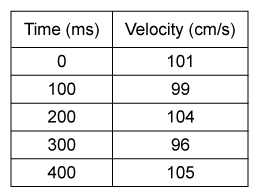
The flow of blood through the human body is typically laminar, but in certain conditions, as when blood flows through the aorta during a period of heightened physical activity, the flow can become turbulent. Blood flow can also become turbulent in abnormal cases in which the passage of blood is obstructed by constrictions within the blood vessel. The energy generated by blood turbulence creates sound vibrations that can be heard with a stethoscope.Using the technique of laser Doppler velocimetry, researchers recorded the blood velocity v at a point in the aorta of an experimental subject at different times during aerobic exercise. Table 1 shows the blood velocities observed over a 400 ms time interval.Table 1 Blood Velocity within the Aorta of an Experimental Subject (mean velocity v̅ = 101 cm/s)
 Turbulent kinetic energy (TKE) is the kinetic energy per unit mass associated with turbulence within flowing fluids and is defined as:
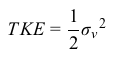 Equation 1where σv is the standard deviation of the fluctuating fluid velocities at a point within the turbulent flow.Reynolds number Re is the quantity that ultimately measures whether a flow is turbulent or laminar. Re is defined in terms of the fluid density ρ, mean velocity of the flow v̅, conduit diameter d, and dynamic viscosity η of the fluid, as given by:
 Equation 2In the context of blood flow, d is the diameter of the blood vessel, and blood has a fluid density of about 1,060 kg∙m−3 with a dynamic viscosity of about 0.003 kg∙m−1∙s−1.
-Blood flow in the aorta becomes turbulent at a Reynolds number of approximately 6,000. If the diameter of the aorta is approximately 2 cm, what is the average velocity of blood at this Reynolds number?
A) 8.50 cm/s
B) 85.0 cm/s
C) 101 cm/s
D) 170 cm/s
Correct Answer:

Verified
Q184: Passage
Black holes have played an important part
Q185: Passage
Black holes have played an important part
Q186: Passage
Black holes have played an important part
Q187: Passage
Black holes have played an important part
Q188: A tennis ball is thrown and bounced
Q190: An observer perceives a sound to be
Q191: Passage
Black holes have played an important part
Q192: A spring is extended 15 cm from
Q193: Different substances have different thermal conductivities k,
Q194: Passage
The flow of blood through the human
Unlock this Answer For Free Now!
View this answer and more for free by performing one of the following actions

Scan the QR code to install the App and get 2 free unlocks

Unlock quizzes for free by uploading documents