A 28-year-old man comes to the physician because of a 2-day history of intermittent bloody urine. He has not had dysuria or abdominal pain. There has been no change in urine output or urinary frequency. He has also had a runny nose, dry cough, and a sore throat for the past 4 days. He has no history of serious illness and takes no medications. His temperature is 38.1°C (100.6°F) , pulse is 70/min, respirations are 14/min, and blood pressure is 140/80 mm Hg. Cardiopulmonary and abdominal examinations show no abnormalities. There is flank tenderness to palpation bilaterally. Urinalysis results are as follows: 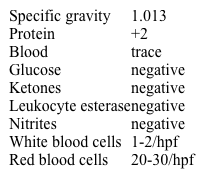 A renal biopsy is performed Which of the following findings is most likely to be seen on microscopic evaluation?
A) Apple-green birefringent mesangial deposits
B) Crescent formation with linear IgG deposits
C) Effacement of podocyte foot processes
D) Granular IgG and C3 deposits
E) Lamellated basement membrane
F) Mesangial deposition of IgA
G) Sclerosis of a portion of some glomeruli
H) Thin basement membrane
Correct Answer:

Verified
Q5: A 70-year-old woman comes to the physician
Q6: A 32-year-old woman comes to the emergency
Q7: A 22-year-old woman with polycystic ovarian syndrome
Q8: A 25-year-old man is brought to the
Q9: A 42-year-old woman comes to the physician
Q11: A 65-year-old man presented to the emergency
Q12: A 64-year-old woman gravida 2, para 2,
Q13: A 61-year-old man comes to the physician
Q14: The patient was suspected to have an
Q15: A Female newborn is born at a
Unlock this Answer For Free Now!
View this answer and more for free by performing one of the following actions

Scan the QR code to install the App and get 2 free unlocks

Unlock quizzes for free by uploading documents