Analysis of the phylogeny of flu viruses reveals that the two 1968 strains (see the accompanying figures) both carry neuraminidase N2,but their hemagglutinins are distantly related (H2 and H3) .Moreover,before the global pandemic of 1968,human flu viruses had never carried H3.This observation suggests that ________. 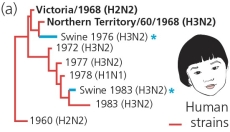
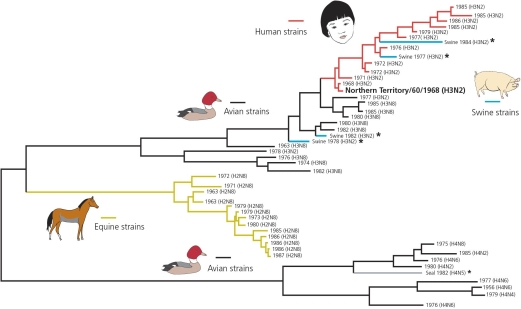
A) H3 was acquired from a nonhuman strain which, in turn, allowed the virus to infect humans on a global scale
B) flu strains, when present together in the same host cell, can trade genes
C) the 1968 human flu strain acquired its H3 gen from a bird virus
D) All of these conclusions are supported by this data.
Correct Answer:

Verified
Q1: The specific parts of foreign proteins that
Q2: In the late 1980s and early 1990s,the
Q3: Research on conditions that are relatively new
Q4: Two evolutionary hypotheses on the function of
Q6: The statement "The virulence of many pathogens
Q7: Evidence for the evolution of antibiotic resistance
Q8: A group of lineages―such as viral strains―that
Q9: Given that humans shifted from hunter-gathers to
Q10: Multicellular organisms such as humans could be
Q11: Initial studies of the influenza A virus
Unlock this Answer For Free Now!
View this answer and more for free by performing one of the following actions

Scan the QR code to install the App and get 2 free unlocks

Unlock quizzes for free by uploading documents