In west Texas, cotton has become an important crop in the last several decades. However, in this hot, dry part of the country there is little rainfall, so farmers irrigate their cotton fields. They must also regularly fertilize the cotton fields because the soil is very sandy. The figure below shows the record of annual productivity (measured in kilograms of cotton per hectare of land) since 1960 in a west Texas cotton field. Use these data to answer the following questions.
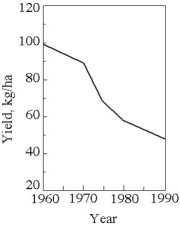
-If you were the county agriculture agent, what would be the best advice you could give the farmer who owns the field under study in the above figure?
A) Plant a variety of cotton that requires less water and can tolerate salinity.
B) Continue to fertilize, but stop irrigating the field and rely on rainfall.
C) Continue to irrigate, but stop fertilizing the field and rely on organic nutrients in the soil.
D) Continue to fertilize and irrigate, but add the nitrogen-fixing bacteria Rhizobium to the irrigation water until the productivity increases.
E) Add acid to the soil and increase its cation exchange capabilities so more nutrients are retained in the soil.
Correct Answer:

Verified
Q55: Dwarf mistletoe grows on many pine trees
Q67: What are epiphytes?
A) aerial vines common in
Q68: Most of the mass of organic material
Q73: You are conducting an experiment on plant
Q76: The figure below shows the results of
Q77: The figure below shows the results of
Q77: Micronutrients are needed in very small amounts
Q79: Plant roots can enhance the availability of
Q81: Two groups of tomatoes were grown under
Q83: Leghemoglobin is produced in some root nodules
Unlock this Answer For Free Now!
View this answer and more for free by performing one of the following actions

Scan the QR code to install the App and get 2 free unlocks

Unlock quizzes for free by uploading documents