Suppose there are 1 billion tons of titanium dioxide in the world and two periods: sooner and later. What we use sooner, we can't use later. Titanium is sometimes used to build rocket ships and road bikes among other light and durable products. With Q representing the quantity of titanium used sooner, the marginal benefit (net of any costs) from titanium used sooner is MBsooner = .6 billion - Q. The (net) marginal benefit from titanium used later, MBlater, is constant at .6 billion. That is, every unit of titanium used later has a marginal benefit of .6 billion.
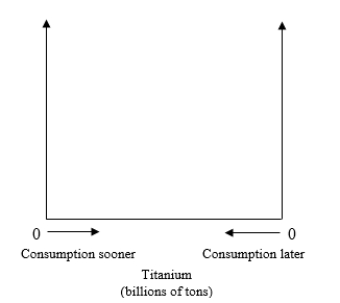 a) Illustrate this situation with a two-period model (as shown in the textbook) that includes both marginal benefit curves, labeled MBsooner and MBlater.
b) If we don't discount benefits received later, what is the dynamically efficient quantity to use sooner? _______.
c) If the present value of benefits received later is one-half of their value later, what is the dynamically efficient quantity to use in each period? Sooner ________ Later ________
d) If we have an infinite discount rate for benefits received later, what is the dynamically efficient quantity to use in each period? Sooner ________ Later ________
Correct Answer:

Verified
Q33: Identify a specific method described in the
Q34: Suppose expanded use of nuclear power would
Q35: Command-and-control environmental policies differ from market-based environmental
Q36: The textbook explains several indexes that improve
Q37: Your roommate wants you to be happy,
Q39: Draw the environmental Kuznets curve. Be sure
Q40: What is the optimal harvest condition for
Q41: Weak sustainability requires the maintenance of
A) the
Q42: In the absence of externalities, which of
Q43: The most efficient water use occurs under
Unlock this Answer For Free Now!
View this answer and more for free by performing one of the following actions

Scan the QR code to install the App and get 2 free unlocks

Unlock quizzes for free by uploading documents