Scenario: The table below shows the reservation values of ten buyers and a seller for a loaf of bread. Each buyer would buy at most one loaf and the seller can make up to ten loaves. Initially trades happen under the market mechanism with each agent making a decision according to the market price and his or her own reservation value. Then the government imposes a price ceiling of $1.00 per unit.
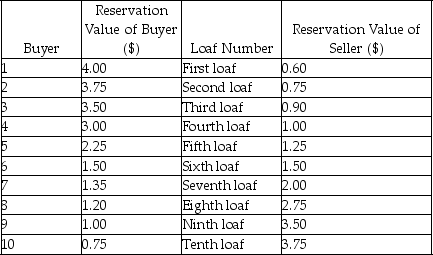
-Refer to the scenario above.Suppose that,after the price ceiling is imposed,the shortage forces buyers to offer bribes to the seller in order to secure a loaf.If each buyer offered as much as his or her reservation value,and the seller sells to the highest bidders,how many loaves will exchange hands? Is the outcome efficient?
A) 4 loaves; no the outcome is not efficient
B) 5 loaves; no the outcome is not efficient
C) 5 loaves; yes the outcome is efficient
D) 6 loaves; yes the outcome is efficient
Correct Answer:

Verified
Q214: The equity-efficiency trade-off is best represented by
Q215: Refer to the scenario above.Suppose that the
Q216: What is the type of relationship between
Q217: Those who support big government are mainly
Q218: Scenario: The table below shows the reservation
Q220: Scenario: The table below shows the reservation
Q221: Explain the equity-efficiency trade-off.Give an example of
Q222: Scenario: Concerns about its citizens' financial health
Q223: Consumer sovereignty is the view that consumers
Q224: To avoid accidents,the government of Richland does
Unlock this Answer For Free Now!
View this answer and more for free by performing one of the following actions

Scan the QR code to install the App and get 2 free unlocks

Unlock quizzes for free by uploading documents