Solved

Managers of Two Competing Oligopoly Firms, Amazon and Nile, Must

Question 32

Short Answer

Managers of two competing oligopoly firms, Amazon and Nile, must make their pricing decisions simultaneously. Amazon (A) and Nile (N) face the following demand and long-run cost conditions, which are common knowledge to the managers: Managers of two competing oligopoly firms, Amazon and Nile, must make their pricing decisions simultaneously. Amazon (A) and Nile (N) face the following demand and long-run cost conditions, which are common knowledge to the managers:     The prices,   and   , are the prices charged by Amazon and Nile, respectively. The quantities,   and   , are the respective daily quantities sold by each firm. The figure below shows Nile's best-response curve,   . Only one point on Amazon's best-response curve, point K, is shown in the figure. -Point C is not likely to be the decision outcome because it is not _______________ _____________, and either firm could unilaterally ___________ (increase, decrease) its price and earn greater daily profit.  Managers of two competing oligopoly firms, Amazon and Nile, must make their pricing decisions simultaneously. Amazon (A) and Nile (N) face the following demand and long-run cost conditions, which are common knowledge to the managers:     The prices,   and   , are the prices charged by Amazon and Nile, respectively. The quantities,   and   , are the respective daily quantities sold by each firm. The figure below shows Nile's best-response curve,   . Only one point on Amazon's best-response curve, point K, is shown in the figure. -Point C is not likely to be the decision outcome because it is not _______________ _____________, and either firm could unilaterally ___________ (increase, decrease) its price and earn greater daily profit.  The prices, Managers of two competing oligopoly firms, Amazon and Nile, must make their pricing decisions simultaneously. Amazon (A) and Nile (N) face the following demand and long-run cost conditions, which are common knowledge to the managers:     The prices,   and   , are the prices charged by Amazon and Nile, respectively. The quantities,   and   , are the respective daily quantities sold by each firm. The figure below shows Nile's best-response curve,   . Only one point on Amazon's best-response curve, point K, is shown in the figure. -Point C is not likely to be the decision outcome because it is not _______________ _____________, and either firm could unilaterally ___________ (increase, decrease) its price and earn greater daily profit.  and Managers of two competing oligopoly firms, Amazon and Nile, must make their pricing decisions simultaneously. Amazon (A) and Nile (N) face the following demand and long-run cost conditions, which are common knowledge to the managers:     The prices,   and   , are the prices charged by Amazon and Nile, respectively. The quantities,   and   , are the respective daily quantities sold by each firm. The figure below shows Nile's best-response curve,   . Only one point on Amazon's best-response curve, point K, is shown in the figure. -Point C is not likely to be the decision outcome because it is not _______________ _____________, and either firm could unilaterally ___________ (increase, decrease) its price and earn greater daily profit.  , are the prices charged by Amazon and Nile, respectively. The quantities, Managers of two competing oligopoly firms, Amazon and Nile, must make their pricing decisions simultaneously. Amazon (A) and Nile (N) face the following demand and long-run cost conditions, which are common knowledge to the managers:     The prices,   and   , are the prices charged by Amazon and Nile, respectively. The quantities,   and   , are the respective daily quantities sold by each firm. The figure below shows Nile's best-response curve,   . Only one point on Amazon's best-response curve, point K, is shown in the figure. -Point C is not likely to be the decision outcome because it is not _______________ _____________, and either firm could unilaterally ___________ (increase, decrease) its price and earn greater daily profit.  and Managers of two competing oligopoly firms, Amazon and Nile, must make their pricing decisions simultaneously. Amazon (A) and Nile (N) face the following demand and long-run cost conditions, which are common knowledge to the managers:     The prices,   and   , are the prices charged by Amazon and Nile, respectively. The quantities,   and   , are the respective daily quantities sold by each firm. The figure below shows Nile's best-response curve,   . Only one point on Amazon's best-response curve, point K, is shown in the figure. -Point C is not likely to be the decision outcome because it is not _______________ _____________, and either firm could unilaterally ___________ (increase, decrease) its price and earn greater daily profit.  , are the respective daily quantities sold by each firm. The figure below shows Nile's best-response curve, Managers of two competing oligopoly firms, Amazon and Nile, must make their pricing decisions simultaneously. Amazon (A) and Nile (N) face the following demand and long-run cost conditions, which are common knowledge to the managers:     The prices,   and   , are the prices charged by Amazon and Nile, respectively. The quantities,   and   , are the respective daily quantities sold by each firm. The figure below shows Nile's best-response curve,   . Only one point on Amazon's best-response curve, point K, is shown in the figure. -Point C is not likely to be the decision outcome because it is not _______________ _____________, and either firm could unilaterally ___________ (increase, decrease) its price and earn greater daily profit.  . Only one point on Amazon's best-response curve, point K, is shown in the figure.


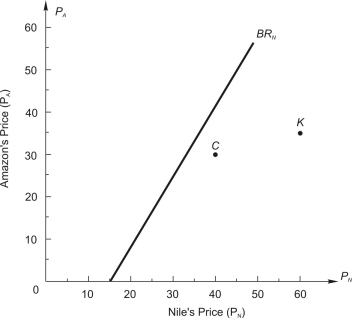
-Point C is not likely to be the decision outcome because it is not _______________ _____________, and either firm could unilaterally ___________ (increase, decrease) its price and earn greater daily profit. Managers of two competing oligopoly firms, Amazon and Nile, must make their pricing decisions simultaneously. Amazon (A) and Nile (N) face the following demand and long-run cost conditions, which are common knowledge to the managers:     The prices,   and   , are the prices charged by Amazon and Nile, respectively. The quantities,   and   , are the respective daily quantities sold by each firm. The figure below shows Nile's best-response curve,   . Only one point on Amazon's best-response curve, point K, is shown in the figure. -Point C is not likely to be the decision outcome because it is not _______________ _____________, and either firm could unilaterally ___________ (increase, decrease) its price and earn greater daily profit.

Correct Answer:

verifed

Verified

strategically stable...

View Answer

Unlock this answer now
Get Access to more Verified Answers free of charge

Related Questions

Unlock this Answer For Free Now!

View this answer and more for free by performing one of the following actions

qr-code

Scan the QR code to install the App and get 2 free unlocks

upload documents

Unlock quizzes for free by uploading documents