Suppose a relatively low income family has a monthly budget of $1,000 to allocate between food and a non-food composite good.In this problem, assume food is aggregated into a "composite food" good that is modeled on the horizontal axis, and the non-food composite good is denominated in "dollars of other consumption".The price of food is $10 per unit.Suppose further that this family's tastes exhibit kinks in indifference curves, with one such indifference curve graphed below. 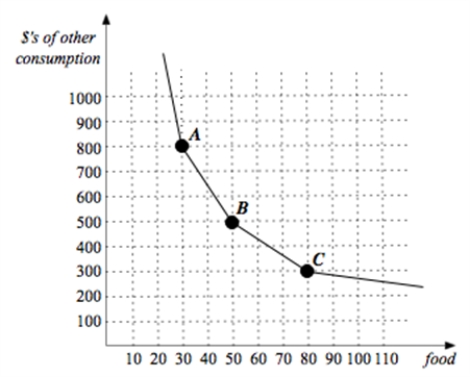
a.Draw the family's budget constraint and label the optimal consumption bundle.
b.Due to unexpected droughts, the price of food rises to $20.A cash subsidy S that leaves our family with the same level of happiness as it enjoyed prior to the price increase is proposed.How much would this subsidy cost for this family?
c.An alternative proposal suggests a price subsidy s that lowers the price of food for this family from $20 to ($20-s), with s set sufficiently high to allow the family to reach its original utility level.
d.Yet a third proposal suggests a price subsidy that leaves in tact the new price of $20 for the first 20 units of food bought by the family but then lowers the price for this family to $(20-s') while also making the family just as happy as it was before.How high does s' have to be to accomplish this?
e.If cost is all you care about, how would you rank these three policies? What if you care about food consumption for this family and believe a policy is better if it results in more food consumption?
Correct Answer:

Verified
View Answer
Unlock this answer now
Get Access to more Verified Answers free of charge
Q17: You and I both have homothetic tastes.When
Q18: Bottles of Coca-Cola and equally-sized bottles of
Q19: The price of peaches goes up and
Q20: At most museums, you can either buy
Q21: Your drink budget is entirely split between
Q23: Suppose the only two goods you care
Q24: Currently.the price of consuming housing 
Q25: Suppose the government spends the same for
Q26: Suppose you collect stamps and coins for
Q27: Suppose your tastes are defined by the
Unlock this Answer For Free Now!
View this answer and more for free by performing one of the following actions

Scan the QR code to install the App and get 2 free unlocks

Unlock quizzes for free by uploading documents