Figure 1.1 - Production Possibilities and Opportunity Costs: Linear Model versus Non-Linear Model 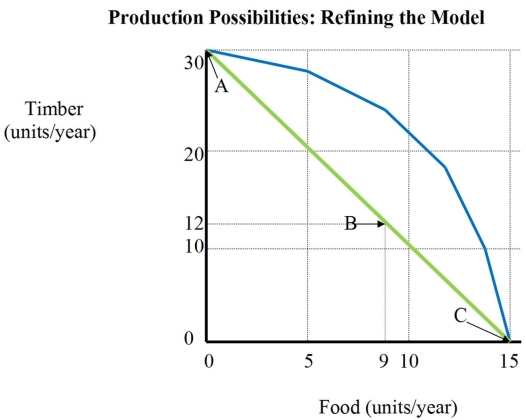 In the linear production possibilities model,we assume each of five equally-sized parcels of land contributes the same to the production of food and timber: 6 units of timber or 3 units of food.
By contrast,in the non-linear model,we will assume that there are five different types of land in equal-sized plots and that each plot may contribute as follows to the production of 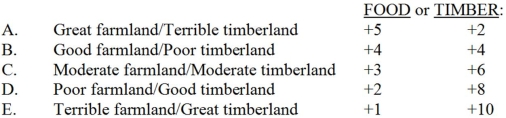
-Assuming all parcels of land are the same,there is a constant trade-off in the production of timber and food.When all land is in use,one more unit of food produced will require…
A) Two more units of timber produced
B) Five fewer units of timber produced
C) One-half fewer units of timber produced
D) Two fewer units of timber produced
Correct Answer:

Verified
Q26: The most desirable attainable mix of output
Q27: In attempting to answer the WHAT question,a
Q28: In the model where we assume that
Q29: Table 1.1 - Production possibilities and opportunity
Q30: Table 1.1 - Production possibilities and opportunity
Q32: Figure 1.1 - Production Possibilities and Opportunity
Q33: In economics,which of the following represents entrepreneurship?
A)
Q34: Output choices are necessary within a market
Q35: Which of the following statements about production
Q36: Which of the following is NOT an
Unlock this Answer For Free Now!
View this answer and more for free by performing one of the following actions

Scan the QR code to install the App and get 2 free unlocks

Unlock quizzes for free by uploading documents