Figure 1.1 - Production Possibilities and Opportunity Costs: Linear Model versus Non-Linear Model 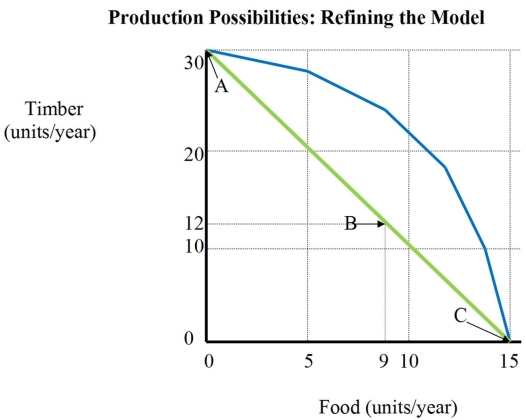 In the linear production possibilities model,we assume each of five equally-sized parcels of land contributes the same to the production of food and timber: 6 units of timber or 3 units of food.
By contrast,in the non-linear model,we will assume that there are five different types of land in equal-sized plots and that each plot may contribute as follows to the production of 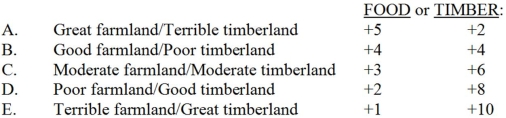
-Assuming all land is equally productive in either use,how much output of each type will be produced with 2/5 of the land in timber production and 3/5 of the land in food production?
A) 12 units of timber and 9 units of food
B) 9 units of timber and 12 units of food
C) 18 units of timber and 9 units of food
D) 9 units of timber and 18 units of food
Correct Answer:

Verified
Q20: Societies must address the question of WHAT
Q21: Assuming the level of resources and technology
Q22: Table 1.1 - Production possibilities and opportunity
Q23: Table 1.1 - Production possibilities and opportunity
Q24: Investment refers to all of the following
Q26: The most desirable attainable mix of output
Q27: In attempting to answer the WHAT question,a
Q28: In the model where we assume that
Q29: Table 1.1 - Production possibilities and opportunity
Q30: Table 1.1 - Production possibilities and opportunity
Unlock this Answer For Free Now!
View this answer and more for free by performing one of the following actions

Scan the QR code to install the App and get 2 free unlocks

Unlock quizzes for free by uploading documents