Figure 1 shows a protein enzyme labeled E that catalyzes a chemical reaction involving the substrate molecule labeled C.Figure 2 shows how another molecule, labeled D, binds to a site on the protein that is distinct from the catalytic site. 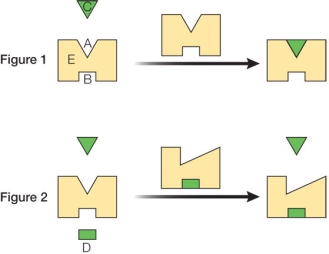 Based on the activities shown, what biological advantage does this protein gain by having the ability to bind molecule D?
A) It gains a new chemical reaction that it can catalyze.
B) It gains the ability to bind a broader range of molecules at its catalytic site.
C) It gains a mechanism for preventing the protein from being degraded.
D) It gains a means for turning the biological activity of the protein on and off.
E) It gains the ability to diffuse through cell membranes.
Correct Answer:

Verified
Q37: Refer to the figure below. 
Q38: A peptide bond forms between a(n) _
Q39: Suppose you want to construct a protein
Q40: The magnesium chelatase protein has quaternary structure.This
Q41: A molecule with the formula C15H30O15 is
Q43: When a cysteine residue in a protein
Q44: Starch and glycogen, which are both polysaccharides,
Q45: The main function of cellulose, the most
Q46: A simple sugar with the formula C5H10O5
Q47: A carbohydrate with 12 oxygen molecules would
Unlock this Answer For Free Now!
View this answer and more for free by performing one of the following actions

Scan the QR code to install the App and get 2 free unlocks

Unlock quizzes for free by uploading documents