Refer to the figure below, showing the flux of carbon through metabolic pathways involving both the cytosol and mitochondria in a human muscle cell.The shade of the arrows (light and dark) is proportional to the rate of flux through that pathway. 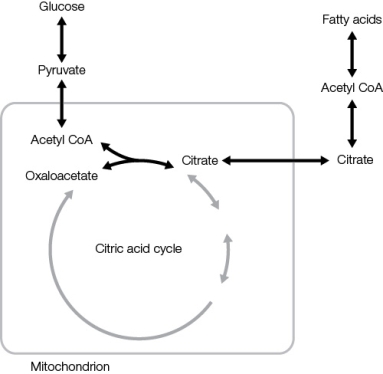 Do you expect this cell to be undergoing rapid contractions or to be inactive, and what do you expect would change as the cell suddenly shifted into the opposite level of activity?
A) The cell is inactive, and if called into high activity, it would shift metabolism of citrate through the citric acid cycle and electron transport, and away from fatty acid synthesis.
B) The cell is inactive, and if called into high activity, it would shift metabolism of citrate to synthesis of glucose via gluconeogenesis and away from fatty acid synthesis.
C) The cell is active, and if the cell became inactive, it would shift metabolism of citrate away from glucose and the citric acid cycle, and toward fatty acid synthesis.
D) The cell is active, and if the cell became inactive, it would shift metabolism of citrate through the citric acid cycle and electron transport, and away from fatty acid synthesis.
E) The cell is active, and if the cell became inactive, it would shift citrate toward synthesis of glucose via gluconeogenesis and away from fatty acid synthesis.
Correct Answer:

Verified
Q93: Refer to the graph below, containing data
Q94: The loss of a(n) _ by a
Q95: How could a carbon atom that
Q96: The enzyme-catalyzed transfer of phosphate groups to
Q97: In an oxidation-reduction reaction, the reactant that
Q99: Oxidation and _ always occur together.
Q100: Refer to the figure below. 
Q101: Carbon atoms originating in glucose are _
Q102: Different organisms have different ATP yields from
Q103: Fatty acids must be converted to _
Unlock this Answer For Free Now!
View this answer and more for free by performing one of the following actions

Scan the QR code to install the App and get 2 free unlocks

Unlock quizzes for free by uploading documents