Refer to the figure.
In the figure, identify the following groups: protostomes, deuterostomes, arrow worms, calcareous sponges, chordates, cnidarians, ctenophores, demosponges, ecdysozoans, echinoderms, glass sponges, hemichordates, lophotrochozoans, and placozoans.Additionally, identify these distinguishing traits marked with dots on the phylogenetic tree: bilateral symmetry along an anterior-posterior axis, three embryonic cell layers, centralized nervous system; blasotopore develops into mouth; blastopore develops into anus; choanocytes and spicules; exoskeleton molting; notochord; radial symmetry, silicaceous spicules; unique cell junctions, collagen and proteoglycans in extracellular matrix; nerve nets (listed twice); distinct organ systems. 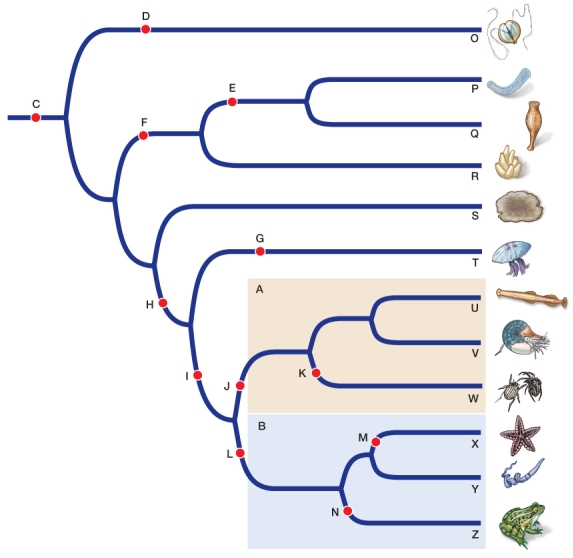
Correct Answer:

Verified
B. Deuterostomes
C. Uniqu...
View Answer
Unlock this answer now
Get Access to more Verified Answers free of charge
Q98: Placozoans, ctenophores, and cnidarians are all considered
Q99: The existence of three embryonic cell layers,
Q100: Nematocysts are
A) organelles used in the capture
Q101: There are three major groups of cnidarians:
Q102: Suppose that you obtain a sample of
Q104: Organisms that feed on decomposing organic matter
Q105: What are some of the limitations imposed
Q106: _ are organisms that eat both plants
Q107: An animal with sharp teeth and claws,
Q108: Explain the fundamental difference between protostomes and
Unlock this Answer For Free Now!
View this answer and more for free by performing one of the following actions

Scan the QR code to install the App and get 2 free unlocks

Unlock quizzes for free by uploading documents