The cross section of a long coaxial cable is shown in the figure, with radii as given. The linear charge density on the inner conductor is -40 nC/m and the linear charge density on the outer conductor is -50 nC/m. The inner and outer cylindrical surfaces are respectively denoted by A, B, C, and D, as shown. (ε0 = 8.85 × 10⁻¹² C2/N ∙ m2) The magnitude of the electric field at a point that is 94 mm from the axis is closest to 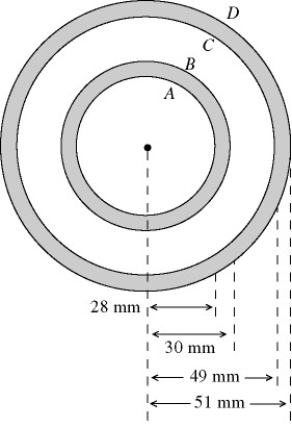
A) 17,000 N/C.
B) 15,000 N/C.
C) 13,000 N/C.
D) 11,000 N/C.
E) 9600 N/C.
Correct Answer:

Verified
Q31: A nonconducting spherical shell of inner radius
Q32: A hollow conducting spherical shell has radii
Q33: A solid nonconducting sphere of radius R
Q34: Charge is distributed uniformly throughout a large
Q35: Two extremely large nonconducting horizontal sheets each
Q36: Electric charge is uniformly distributed inside a
Q38: A hollow conducting spherical shell has radii
Q39: A hollow conducting spherical shell has radii
Q40: An infinitely long nonconducting cylinder of radius
Q41: An irregular conductor carries a surface charge
Unlock this Answer For Free Now!
View this answer and more for free by performing one of the following actions

Scan the QR code to install the App and get 2 free unlocks

Unlock quizzes for free by uploading documents