Researchers tested nitrogen loss from soil where the moss Dawsonia was growing and compared it to soil from which Dawsonia had been removed. The data are presented in the accompanying figure. 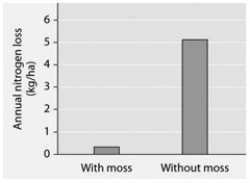
-If the actual results most closely resembled those in part (A) in the figure above, then a further question arising from these data is: "Do the Dawsonia rhizoids have to be alive to reduce soil nitrogen loss, or do dead rhizoids have the same effect?" Arrange the following steps in the correct sequence to test this hypothesis.
1) Add metabolic poison to the soil of the experimental plot of mosses.
2) Apply water equally to the experimental and control plots.
3) Measure initial soil nitrogen contents of control and experimental plots.
4) Determine nitrogen loss from the soil of control and experimental plots.
5) Establish two identical plots of Dawsonia mosses; one as a control, the other as the experimental treatment.
A) 5 → 1 → 3 → 2 → 4
B) 5 → 2 → 3 → 1 → 4
C) 5 → 3 → 1 → 2 → 4
D) 4 → 5 → 1 → 3 → 2
E) 5 → 3 → 2 →? 1 → 4
Correct Answer:

Verified
Q1: The major function of medicinal compounds in
Q2: If humans had been present to build
Q3: According to our current knowledge of plant
Q6: You want to get rid of your
Q8: Researchers tested nitrogen loss from soil where
Q9: Which of these time intervals, based on
Q10: Molecular phylogenies show all land plants are
Q11: The functional role of sporopollenin is primarily
Q11: Why are seedless vascular plants considered paraphyletic
Q16: The most direct ancestors of land plants
Unlock this Answer For Free Now!
View this answer and more for free by performing one of the following actions

Scan the QR code to install the App and get 2 free unlocks

Unlock quizzes for free by uploading documents