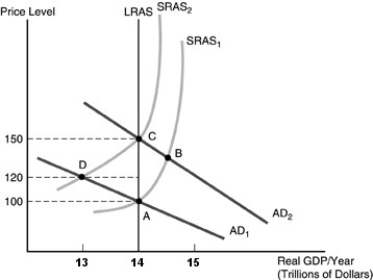
-Refer to the above figure. Suppose the economy is in long-run equilibrium at point A, and the government initiates an expansionary monetary policy to increase aggregate demand. Which of the following is a TRUE statement concerning the differences between what happens when the central bank action is unanticipated and when it is anticipated?
A) The new long-run equilibrium when the increase in aggregate demand is unanticipated is point B while the new long-run equilibrium when the increase in aggregate demand is anticipated is point C.
B) The new long-run equilibrium when the increase in aggregate demand is unanticipated is point B while the new long-run equilibrium when the increase in aggregate demand is anticipated is point A.
C) The new long-run equilibrium will be point C in either case. When the increase in aggregate demand is unanticipated, the economy moves to B in the short run, but when the increase in aggregate demand is anticipated, short-run aggregate supply shifts when the aggregate demand curve shifts, and the economy moves immediately to point C.
D) The new long-run equilibrium is point C in either case. When the increase in aggregate demand is unanticipated, the new short-run equilibrium is point B, but when the increase in aggregate demand is anticipated the new short-run equilibrium is point D.
Correct Answer:

Verified
Q160: Assume the Fed initiates an expansionary monetary
Q161: People combining the effects of past policy
Q162: Suppose that the economy is in long-run
Q163: The rational expectations hypothesis indicates that a

Unlock this Answer For Free Now!
View this answer and more for free by performing one of the following actions

Scan the QR code to install the App and get 2 free unlocks

Unlock quizzes for free by uploading documents