Solved

A Family of Six (Mother, Father, and Four Children) Had

Question 22

Essay

A family of six (mother, father, and four children) had two children with a history of chronic illness. Both children had repetitive infections of the sinuses, middle ears, and lungs due to a variety of respiratory viruses. Their other siblings were generally healthy and showed no signs of persistent or recurrent virus infections.
The two affected children had normal numbers of B cells, T cells, and NK cells in their blood. They also showed no defects in neutrophil function or in complement protein levels. The two children also had normal antibody levels to vaccine protein antigens, such as tetanus toxoid, and had normal T cell responses to antigens from the vaccine strain of Mycobacterium tuberculosis after being vaccinated.
Blood cells from one parent, one healthy child and the two affected children were examined for surface MHC protein expression by flow cytometry using two antibodies, one that recognizes all HLA class I proteins, and one that recognizes all HLA class II proteins. The results are shown in Figure
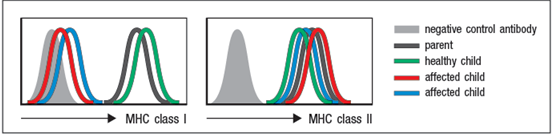
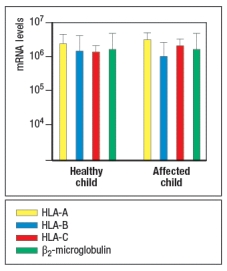
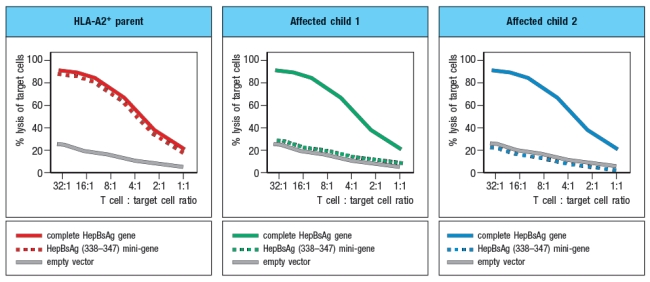
A family of six (mother, father, and four children) had two children with a history of chronic illness. Both children had repetitive infections of the sinuses, middle ears, and lungs due to a variety of respiratory viruses. Their other siblings were generally healthy and showed no signs of persistent or recurrent virus infections.   The two affected children had normal numbers of B cells, T cells, and NK cells in their blood. They also showed no defects in neutrophil function or in complement protein levels. The two children also had normal antibody levels to vaccine protein antigens, such as tetanus toxoid, and had normal T cell responses to antigens from the vaccine strain of Mycobacterium tuberculosis after being vaccinated. Blood cells from one parent, one healthy child and the two affected children were examined for surface MHC protein expression by flow cytometry using two antibodies, one that recognizes all HLA class I proteins, and one that recognizes all HLA class II proteins. The results are shown in Figure     a) Analysis of HLA genotypes from the two affected children showed that they shared one haplotype of this locus. This haplotype encodes a common HLA-A allele, HLA-A2. Based on these data, is it likely that the two affected children have a point mutation (or mutations) in the coding sequence for HLA-A2? Why or why not? b) Name two proteins that could be candidates for the defective gene in the two affected children. To address which gene defect might be present in the affected children, peripheral blood cells were isolated from one healthy child and one affected child, and mRNA was isolated from the cells. Quantitative RT-PCR was performed to assess the levels of mRNA for the three HLA class I heavy chain genes (HLA-A, -B, and –C) and for the β2-microglobulin gene. The results are shown in Figure .    In a second experiment, Western blots were performed, confirming that cell lysates from both affected children contained normal levels of all three HLA class I heavy chain proteins and the β2-microglobulin protein. c) Do these data eliminate any of your answers to part (b)? In a final experiment, peripheral blood cells from the two affected children and one HLA-A2+ parent were transfected with a construct encoding the Hepatitis B virus surface antigen (HepBsAg), a protein that is currently used in the vaccine against Hepatitis B. This protein is normally synthesized and transported to the cell surface. In addition to the full length HepBsAg construct, cells were also transfected with a mini-gene, encoding just a single HLA-A2-binding peptide derived from Hepatitis B, amino acids 338–347. Using a cytolytic CD8 T cell clone specific for HepBsAg(338–347) peptide bound to HLA-A2, the transfected cells were tested for recognition by the CD8 T cell clone using an assay that measures target cell killing. Figure Q6.29C shows the results of this experiment.      d) What is the most likely gene that is defective in the affected children?
a) Analysis of HLA genotypes from the two affected children showed that they shared one haplotype of this locus. This haplotype encodes a common HLA-A allele, HLA-A2. Based on these data, is it likely that the two affected children have a point mutation (or mutations) in the coding sequence for HLA-A2? Why or why not?
b) Name two proteins that could be candidates for the defective gene in the two affected children.
To address which gene defect might be present in the affected children, peripheral blood cells were isolated from one healthy child and one affected child, and mRNA was isolated from the cells. Quantitative RT-PCR was performed to assess the levels of mRNA for the three HLA class I heavy chain genes (HLA-A, -B, and –C) and for the β2-microglobulin gene. The results are shown in Figure .
A family of six (mother, father, and four children) had two children with a history of chronic illness. Both children had repetitive infections of the sinuses, middle ears, and lungs due to a variety of respiratory viruses. Their other siblings were generally healthy and showed no signs of persistent or recurrent virus infections.   The two affected children had normal numbers of B cells, T cells, and NK cells in their blood. They also showed no defects in neutrophil function or in complement protein levels. The two children also had normal antibody levels to vaccine protein antigens, such as tetanus toxoid, and had normal T cell responses to antigens from the vaccine strain of Mycobacterium tuberculosis after being vaccinated. Blood cells from one parent, one healthy child and the two affected children were examined for surface MHC protein expression by flow cytometry using two antibodies, one that recognizes all HLA class I proteins, and one that recognizes all HLA class II proteins. The results are shown in Figure     a) Analysis of HLA genotypes from the two affected children showed that they shared one haplotype of this locus. This haplotype encodes a common HLA-A allele, HLA-A2. Based on these data, is it likely that the two affected children have a point mutation (or mutations) in the coding sequence for HLA-A2? Why or why not? b) Name two proteins that could be candidates for the defective gene in the two affected children. To address which gene defect might be present in the affected children, peripheral blood cells were isolated from one healthy child and one affected child, and mRNA was isolated from the cells. Quantitative RT-PCR was performed to assess the levels of mRNA for the three HLA class I heavy chain genes (HLA-A, -B, and –C) and for the β2-microglobulin gene. The results are shown in Figure .    In a second experiment, Western blots were performed, confirming that cell lysates from both affected children contained normal levels of all three HLA class I heavy chain proteins and the β2-microglobulin protein. c) Do these data eliminate any of your answers to part (b)? In a final experiment, peripheral blood cells from the two affected children and one HLA-A2+ parent were transfected with a construct encoding the Hepatitis B virus surface antigen (HepBsAg), a protein that is currently used in the vaccine against Hepatitis B. This protein is normally synthesized and transported to the cell surface. In addition to the full length HepBsAg construct, cells were also transfected with a mini-gene, encoding just a single HLA-A2-binding peptide derived from Hepatitis B, amino acids 338–347. Using a cytolytic CD8 T cell clone specific for HepBsAg(338–347) peptide bound to HLA-A2, the transfected cells were tested for recognition by the CD8 T cell clone using an assay that measures target cell killing. Figure Q6.29C shows the results of this experiment.      d) What is the most likely gene that is defective in the affected children?
In a second experiment, Western blots were performed, confirming that cell lysates from both affected children contained normal levels of all three HLA class I heavy chain proteins and the β2-microglobulin protein.
c) Do these data eliminate any of your answers to part (b)?
In a final experiment, peripheral blood cells from the two affected children and one HLA-A2+ parent were transfected with a construct encoding the Hepatitis B virus surface antigen (HepBsAg), a protein that is currently used in the vaccine against Hepatitis B. This protein is normally synthesized and transported to the cell surface. In addition to the full length HepBsAg construct, cells were also transfected with a mini-gene, encoding just a single HLA-A2-binding peptide derived from Hepatitis B, amino acids 338–347. Using a cytolytic CD8 T cell clone specific for HepBsAg(338–347) peptide bound to HLA-A2, the transfected cells were tested for recognition by the CD8 T cell clone using an assay that measures target cell killing. Figure Q6.29C shows the results of this experiment.
A family of six (mother, father, and four children) had two children with a history of chronic illness. Both children had repetitive infections of the sinuses, middle ears, and lungs due to a variety of respiratory viruses. Their other siblings were generally healthy and showed no signs of persistent or recurrent virus infections.   The two affected children had normal numbers of B cells, T cells, and NK cells in their blood. They also showed no defects in neutrophil function or in complement protein levels. The two children also had normal antibody levels to vaccine protein antigens, such as tetanus toxoid, and had normal T cell responses to antigens from the vaccine strain of Mycobacterium tuberculosis after being vaccinated. Blood cells from one parent, one healthy child and the two affected children were examined for surface MHC protein expression by flow cytometry using two antibodies, one that recognizes all HLA class I proteins, and one that recognizes all HLA class II proteins. The results are shown in Figure     a) Analysis of HLA genotypes from the two affected children showed that they shared one haplotype of this locus. This haplotype encodes a common HLA-A allele, HLA-A2. Based on these data, is it likely that the two affected children have a point mutation (or mutations) in the coding sequence for HLA-A2? Why or why not? b) Name two proteins that could be candidates for the defective gene in the two affected children. To address which gene defect might be present in the affected children, peripheral blood cells were isolated from one healthy child and one affected child, and mRNA was isolated from the cells. Quantitative RT-PCR was performed to assess the levels of mRNA for the three HLA class I heavy chain genes (HLA-A, -B, and –C) and for the β2-microglobulin gene. The results are shown in Figure .    In a second experiment, Western blots were performed, confirming that cell lysates from both affected children contained normal levels of all three HLA class I heavy chain proteins and the β2-microglobulin protein. c) Do these data eliminate any of your answers to part (b)? In a final experiment, peripheral blood cells from the two affected children and one HLA-A2+ parent were transfected with a construct encoding the Hepatitis B virus surface antigen (HepBsAg), a protein that is currently used in the vaccine against Hepatitis B. This protein is normally synthesized and transported to the cell surface. In addition to the full length HepBsAg construct, cells were also transfected with a mini-gene, encoding just a single HLA-A2-binding peptide derived from Hepatitis B, amino acids 338–347. Using a cytolytic CD8 T cell clone specific for HepBsAg(338–347) peptide bound to HLA-A2, the transfected cells were tested for recognition by the CD8 T cell clone using an assay that measures target cell killing. Figure Q6.29C shows the results of this experiment.      d) What is the most likely gene that is defective in the affected children?
d) What is the most likely gene that is defective in the affected children?

Correct Answer:

verifed

Verified

a) No. The antibody used to detect MHC c...

View Answer

Unlock this answer now
Get Access to more Verified Answers free of charge

Related Questions

Unlock this Answer For Free Now!

View this answer and more for free by performing one of the following actions

qr-code

Scan the QR code to install the App and get 2 free unlocks

upload documents

Unlock quizzes for free by uploading documents