A mutagenesis screen performed on mice identified a gene with an important function in B cells. Analysis of B cells from the spleens of these mutant mice showed the results shown in Figure. However, when the C coding sequences were determined, no mutations in these DNA sequences were found. To study this further, genetic crosses were set-up with another mouse strain carrying an allelic variant of the immunoglobulin heavy chain locus. The original mutant mouse strain (strain A) carries IgMa and IgDa alleles of these heavy chain genes. The second mouse strain (strain B) carries the IgMb and IgDb alleles of the heavy chain genes. These two parental strains were crossed together, generating progeny that were all heterozygous for IgM and IgD alleles B were obtained. 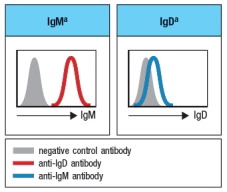
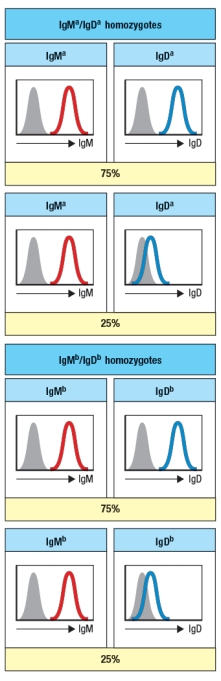
Based on these data, the mutation in the original mutant mouse strain most likely inactivates:
A) The gene for a transcription factor required for IgD gene transcription
B) A regulatory region in the immunoglobulin heavy chain gene locus required for IgD gene transcription
C) The gene for a factor required for alternative mRNA splicing of the immunoglobulin heavy chain primary mRNA transcript
D) The gene encoding the RAG-1 or RAG-2 recombinase
E) The gene for a factor that is required for IgD surface expression
Correct Answer:

Verified
Q20: The addition and subtraction of nucleotides at
Q21: The V-D-J recombination process used to generate
Q22: Several invertebrate species, such as some insect
Q23: Classical MHC molecules function as peptide-binding
Q24: In some vertebrates, such as rays and
Q26: When a B cell differentiates into a
Q27: Immunodeficiency diseases arise when individuals lack
Q28: The variable lymphocyte receptors (VLRs) of lampreys
Q29: In spite of their low affinity for
Q30: T-cell receptor spectratype analysis is used
Unlock this Answer For Free Now!
View this answer and more for free by performing one of the following actions

Scan the QR code to install the App and get 2 free unlocks

Unlock quizzes for free by uploading documents