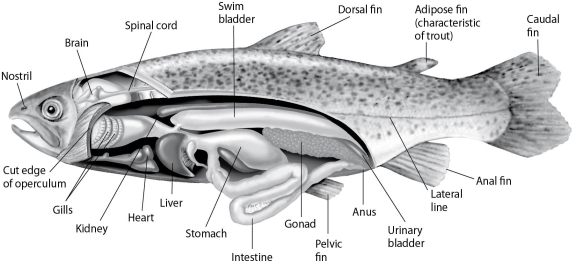
 Figure 27.2
Fishes that have swim bladders can regulate their density and thus their buoyancy. There are two types of swim bladder: physostomus and physoclistus. The ancestral version is the physostomus version, in which the swim bladder is connected to the esophagus via a short tube (Figure 27.2) . The fish fills this version by swimming to the surface, taking gulps of air, and directing them into the swim bladder. Air is removed from this version by "belching." The physoclistus version is more derived, and has lost its connection to the esophagus. Instead, gas enters and leaves the swim bladder via special circulatory mechanisms within the wall of the swim bladder.
-Rank the following fish, from most to least, in terms of the amount of energy each must use to maintain its position (depth) in the water column over the long term. 1. physoclistus fish
2) physostomus fish
3) chondrichthyan fish
A) 1, 2, 3
B) 2, 3, 1
C) 2, 1, 3
D) 3, 1, 2
E) 3, 2, 1
Correct Answer:

Verified
Q27: Which of these would a paleontologist be
Q28: In which vertebrates is fertilization exclusively internal?
A)
Q30: Among the invertebrate phyla, phylum Arthropoda is
Q44: Q57: Trichoplax adhaerens (Tp) is the only living Q58: Placozoan evolutionary relationships to other animals are Q65: The most recently discovered phylum in the Q73: Evidence indicates that an ancestral finch species Q77: Match the extant vertebrate group with the Q86: Had the teacher wanted to point out
Unlock this Answer For Free Now!
View this answer and more for free by performing one of the following actions

Scan the QR code to install the App and get 2 free unlocks

Unlock quizzes for free by uploading documents