Please use the following information to answer the question(s) below. 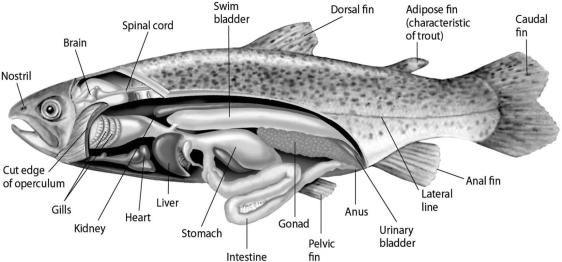 Figure 27.2
Fishes that have swim bladders can regulate their density and thus their buoyancy. There are two types of swim bladder: physostomous and physoclistous. The ancestral version is the physostomous version, in which the swim bladder is connected to the esophagus via a short tube (Figure 27.2) . The fish fills this version by swimming to the surface, taking gulps of air, and directing them into the swim bladder. Air is removed from this version by "belching." The physoclistous version is more derived and has lost its connection to the esophagus. Instead, gas enters and leaves the swim bladder via special circulatory mechanisms within the wall of the swim bladder.
-How do a physoclistous fish and a physotomous fish compare in terms of the amount of energy each must use to maintain its position (depth) in the water column over the long term?
A) a physoclistous fish uses more energy than a physostomous fish
B) a physostomous fish uses more energy than a physoclistous fish
C) a physoclistous fish and a physostomous fish use the same amount of energy
D) a physoclistous fish initially uses more energy than a physostomous fish but then decreases its energy use to be equal to the physostomous fish
Correct Answer:

Verified
Q21: Using similarities in body symmetry and other
Q52: Q71: What is true in the molecular phylogeny Q76: Please use the following information to answer Q77: Please use the following information to answer Q86: Please use the following information to answer Q88: Which of the following was probably the Q89: Fossil steroid and molecular clock evidence suggests Q91: Cycliophorans have two types of larvae.One type Q92: Which clade does not include humans?
A)synapsids
B)lobe-fins
C)lophotrochozoans
D)tetrapods
Unlock this Answer For Free Now!
View this answer and more for free by performing one of the following actions

Scan the QR code to install the App and get 2 free unlocks

Unlock quizzes for free by uploading documents