The following payoff matrix shows outcomes of various strategies that the countries of Home and Foreign can follow to decide to regulate or not regulate pollution. The columns show Foreign's actions, and the rows show Home's actions. The values in the upper right-hand corner of each element give Foreign's net benefits; the values in the lower left-hand corner of each element give Home's net benefits. Net benefits are the environmental benefits from regulation minus the costs associated with installing pollution control equipment. 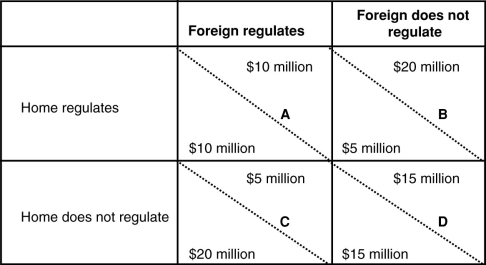 I. Using the payoff matrix, what is likely to happen if there are no international agreements to limit pollution?
II. In the payoff matrix, which element represents a Nash equilibrium?
III. Why is the element you selected in II a Nash equilibrium?
Correct Answer:

Verified
Q156: In the case of global pollution, a
Q157: Which of the following was NOT a
Q158: Did the United States ratify the Kyoto
Q159: In the case of global pollution, the
Q160: (Scenario: Payoff Matrix) The payoff matrix shows
Q162: The U.S. sugar quota sometimes causes the
Q163: Why do the U.S. and European Union
Q164: Two large countries are thinking of imposing
Q165: The authors conclude that the WTO:
A) has
Q166: Why do some economists prefer multilateral trade
Unlock this Answer For Free Now!
View this answer and more for free by performing one of the following actions

Scan the QR code to install the App and get 2 free unlocks

Unlock quizzes for free by uploading documents