A municipal water utility employs quasi-fixed capital inputs-the water treatment plant and distribution lines to homes-to supply water to 20,000 households in the community it serves.The figure below shows the cost structure of this utility for various levels of water service.Quantity of water consumption is measured in 1,000-gallon units per month.AQFC is the average quasi-fixed cost curve,and LAC is long-run average cost.Long-run marginal cost,LMC,is constant and equal to $4 per 1,000-gallon unit.The inverse demand equation is 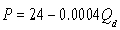 .
. 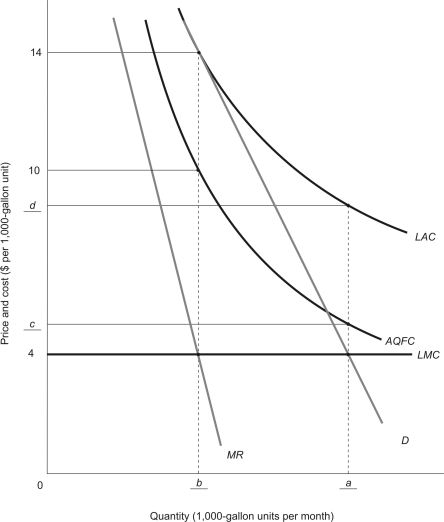 Second-best pricing does not achieve social economic efficiency because there is a deadweight loss of
A) $125,000.
B) $150,000.
C) $200,000.
D) $250,000
E) $300,000
Correct Answer:

Verified
Q9: Market or monopoly power leads to market
Q11: Firms with market power
A)face downward sloping average
Q17: we say that market prices allocate goods
Q17: As a policy option for regulating natural
Q18: long-run perfectly competitive equilibrium,economic efficiency is achieved
Q22: A municipal water utility employs quasi-fixed capital
Q23: The figure below shows the result of
Q24: The figure below shows the result of
Q25: A municipal water utility employs quasi-fixed capital
Q26: The cost and demand conditions for residential
Unlock this Answer For Free Now!
View this answer and more for free by performing one of the following actions

Scan the QR code to install the App and get 2 free unlocks

Unlock quizzes for free by uploading documents