







 تكلم مع الذكاء الاصطناعي


Deck 28: World War and Revolution, 1914-1929
ملء الشاشة (f)

سؤال

سؤال
سؤال
سؤال
سؤال
سؤال
سؤال
According to Map 28.1, "European Alliances at the Outbreak of World War I, 1914," what unique strategic problem did Germany have to confront on the eve of the First World War? 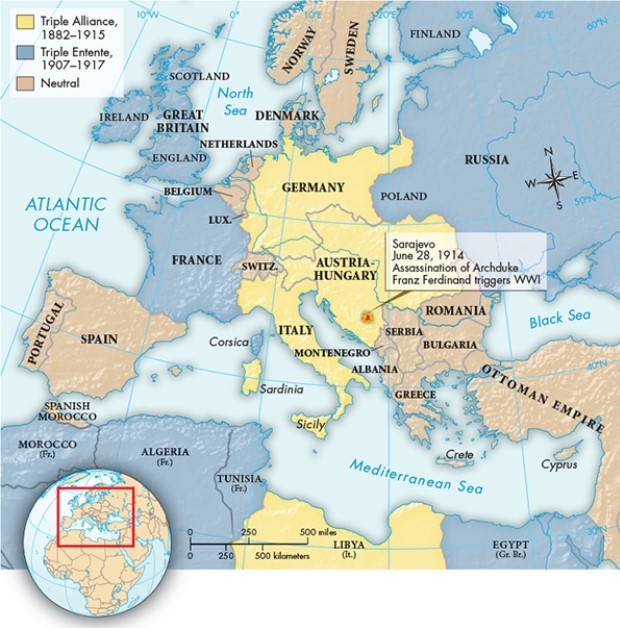
A) They had to prepare for a two-front war.
B) They were surrounded by neutral powers.
C) They had no access to the strategically vital North Sea.
D) Their only access to North Africa was through neutral territory.
A) They had to prepare for a two-front war.
B) They were surrounded by neutral powers.
C) They had no access to the strategically vital North Sea.
D) Their only access to North Africa was through neutral territory.
سؤال
سؤال
سؤال
سؤال
سؤال
سؤال
سؤال
سؤال
سؤال
سؤال
How does this painting reflect the devastating effects of trench warfare during the First World War? 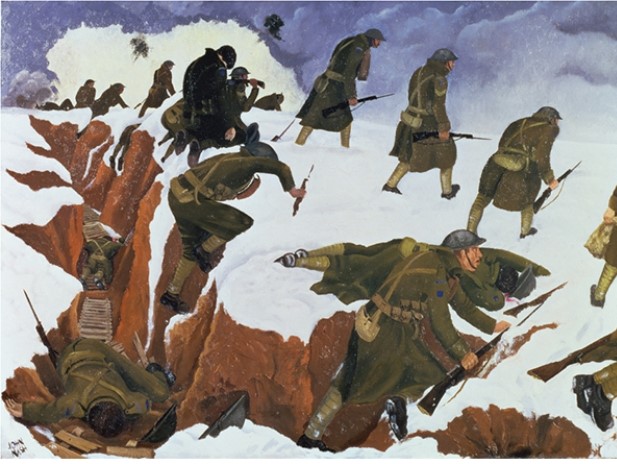
A) The soldiers' slumped shoulders and hanging heads give a sense of hopelessness.
B) The condition of the soldiers' uniforms is indicative of their poor living conditions.
C) The snow-covered ground reminds the viewer of the horrible conditions under which many soldiers fought.
D) The bayonets on the ends of the soldiers' rifles indicate that fighting often devolved into brutal hand-to-hand combat.
A) The soldiers' slumped shoulders and hanging heads give a sense of hopelessness.
B) The condition of the soldiers' uniforms is indicative of their poor living conditions.
C) The snow-covered ground reminds the viewer of the horrible conditions under which many soldiers fought.
D) The bayonets on the ends of the soldiers' rifles indicate that fighting often devolved into brutal hand-to-hand combat.
سؤال
سؤال
سؤال
سؤال
سؤال
سؤال
سؤال
سؤال
سؤال
سؤال
سؤال
According to Map 28.4, "Territorial Changes in Europe After World War I," which of the following is true regarding the demilitarized zone on the border of Germany and France? 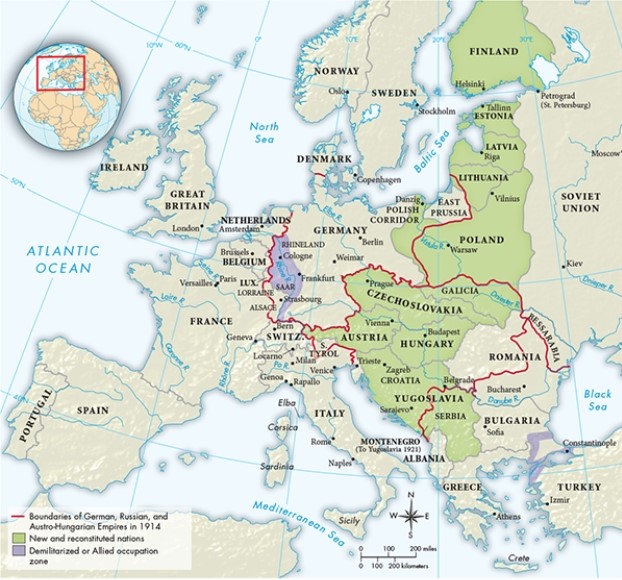
A) It was intended to serve as a buffer zone between Germany and the Balkans.
B) It was intended to protect French neutrality should another war break out in Europe.
C) Its location was in the same region where Germany launched the opening phase of the Schlieffen plan.
D) Its location was in an area that robbed Germany of access to some of its more important agricultural lands.
A) It was intended to serve as a buffer zone between Germany and the Balkans.
B) It was intended to protect French neutrality should another war break out in Europe.
C) Its location was in the same region where Germany launched the opening phase of the Schlieffen plan.
D) Its location was in an area that robbed Germany of access to some of its more important agricultural lands.
سؤال
سؤال
سؤال
سؤال
سؤال
سؤال
سؤال
Which two countries pictured in this map did not exist at the start of World War One? 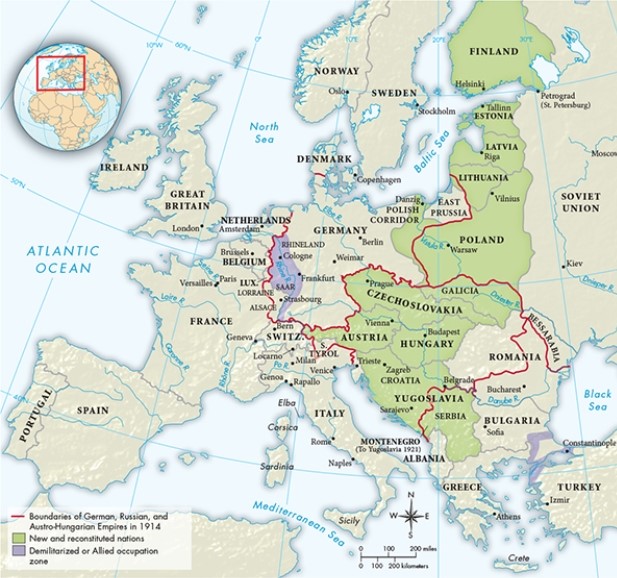
A) Bulgaria and Yugoslavia
B) Romania and Czechoslovakia
C) Bulgaria and Romania
D) Yugoslavia and Czechoslovakia
A) Bulgaria and Yugoslavia
B) Romania and Czechoslovakia
C) Bulgaria and Romania
D) Yugoslavia and Czechoslovakia
سؤال
سؤال
سؤال
سؤال
سؤال
سؤال
سؤال
سؤال
سؤال
سؤال
سؤال
Which of the following is true of the Polish Corridor pictured in Map 28.4, "Territorial Changes in Europe After World War I"? 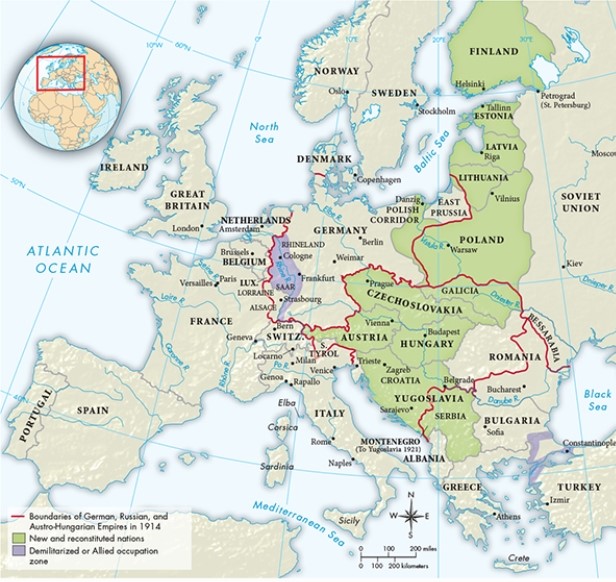
A) It consisted of territory that had originally belonged to Poland prior to its partition in the eighteenth century.
B) It was created to give Czechoslovakia access to the Baltic Sea via the Vistula River.
C) It was carved from territory that was once part of the Russian Pale of Settlement.
D) It was intended to serve the same purpose as the demilitarized zone on Germany's western border.
A) It consisted of territory that had originally belonged to Poland prior to its partition in the eighteenth century.
B) It was created to give Czechoslovakia access to the Baltic Sea via the Vistula River.
C) It was carved from territory that was once part of the Russian Pale of Settlement.
D) It was intended to serve the same purpose as the demilitarized zone on Germany's western border.
سؤال
سؤال
سؤال
سؤال
سؤال
سؤال
سؤال
سؤال
سؤال
سؤال
سؤال
سؤال
سؤال
سؤال
سؤال
سؤال
سؤال
سؤال
سؤال
سؤال
سؤال
سؤال
سؤال
سؤال
سؤال
سؤال
سؤال
سؤال
سؤال
سؤال
سؤال
سؤال
سؤال
سؤال

فتح الحزمة
قم بالتسجيل لفتح البطاقات في هذه المجموعة!
Unlock Deck
Unlock Deck
1/81

العب

ملء الشاشة (f)
Deck 28: World War and Revolution, 1914-1929
1
The colonial troops who served in World War I took which of the following home with them?
A) The concepts of capitalism
B) New military techniques
C) New higher social status
D) The idea of nationalism
A) The concepts of capitalism
B) New military techniques
C) New higher social status
D) The idea of nationalism
The idea of nationalism
2
Japan's imperialist ambitions were realized when it entered World War I to gain territory where?
A) The Philippines
B) Indonesia
C) Korea
D) China
A) The Philippines
B) Indonesia
C) Korea
D) China
China
3
The Moroccan crisis led many Western nations to begin to view what country as a threat?
A) Germany
B) The United States
C) Britain
D) Austria
A) Germany
B) The United States
C) Britain
D) Austria
Germany
4
After forcing Bismarck's resignation, what did Wilhelm II refuse to do?
A) Honor any of Bismarck's alliances
B) Continue funding the expansion of the German navy
C) Continue conflict with France, instead offering to give back some land
D) Renew the nonaggression pact with Russia
A) Honor any of Bismarck's alliances
B) Continue funding the expansion of the German navy
C) Continue conflict with France, instead offering to give back some land
D) Renew the nonaggression pact with Russia
فتح الحزمة
افتح القفل للوصول البطاقات البالغ عددها 81 في هذه المجموعة.
فتح الحزمة
k this deck
5
Which of the following was a result of the first and second Balkan wars?
A) Germany had an opportunity to display its impressive new naval firepower.
B) The Ottoman Empire suffered major territorial losses.
C) Austria-Hungary agreed to give Romania its independence.
D) Balkan nationalists suffered significant setbacks.
A) Germany had an opportunity to display its impressive new naval firepower.
B) The Ottoman Empire suffered major territorial losses.
C) Austria-Hungary agreed to give Romania its independence.
D) Balkan nationalists suffered significant setbacks.
فتح الحزمة
افتح القفل للوصول البطاقات البالغ عددها 81 في هذه المجموعة.
فتح الحزمة
k this deck
6
After the Franco-Prussian War, Bismarck's immediate concern was keeping what country or empire isolated?
A) Britain
B) Austria
C) France
D) The Ottomans
A) Britain
B) Austria
C) France
D) The Ottomans
فتح الحزمة
افتح القفل للوصول البطاقات البالغ عددها 81 في هذه المجموعة.
فتح الحزمة
k this deck
7
According to Map 28.1, "European Alliances at the Outbreak of World War I, 1914," what unique strategic problem did Germany have to confront on the eve of the First World War?
A) They had to prepare for a two-front war.
B) They were surrounded by neutral powers.
C) They had no access to the strategically vital North Sea.
D) Their only access to North Africa was through neutral territory.
A) They had to prepare for a two-front war.
B) They were surrounded by neutral powers.
C) They had no access to the strategically vital North Sea.
D) Their only access to North Africa was through neutral territory.
فتح الحزمة
افتح القفل للوصول البطاقات البالغ عددها 81 في هذه المجموعة.
فتح الحزمة
k this deck
8
Why did Italy enter the war on the Allied side?
A) To fulfill treaty commitments made before the outbreak of war
B) As a response to Germany's surprise attack
C) To protect their vital colonial interests in southwest Africa
D) To gain territory from the Austrians
A) To fulfill treaty commitments made before the outbreak of war
B) As a response to Germany's surprise attack
C) To protect their vital colonial interests in southwest Africa
D) To gain territory from the Austrians
فتح الحزمة
افتح القفل للوصول البطاقات البالغ عددها 81 في هذه المجموعة.
فتح الحزمة
k this deck
9
Germany's Schlieffen plan seemed to indicate that the country
A) did not expect to go to war with Russia.
B) was relying heavily on Italy and the Ottoman Empire.
C) expected a war of approximately thirty months.
D) anticipated war on two fronts simultaneously.
A) did not expect to go to war with Russia.
B) was relying heavily on Italy and the Ottoman Empire.
C) expected a war of approximately thirty months.
D) anticipated war on two fronts simultaneously.
فتح الحزمة
افتح القفل للوصول البطاقات البالغ عددها 81 في هذه المجموعة.
فتح الحزمة
k this deck
10
What did Serbia and Russia have in common that made them allies?
A) Both countries were Slavic.
B) Both countries hated Germany.
C) Both countries had socialist governments.
D) Both countries were predominantly Catholic.
A) Both countries were Slavic.
B) Both countries hated Germany.
C) Both countries had socialist governments.
D) Both countries were predominantly Catholic.
فتح الحزمة
افتح القفل للوصول البطاقات البالغ عددها 81 في هذه المجموعة.
فتح الحزمة
k this deck
11
Which of the following contributed in large part to the escalation of tension between Britain and Germany after 1900?
A) The Anglo-Russian Agreement of 1907
B) Germany's decision to dramatically expand its naval forces
C) Increasing British investment in the German economy
D) Britain's decision to aid Japan in the Russo-Japanese War
A) The Anglo-Russian Agreement of 1907
B) Germany's decision to dramatically expand its naval forces
C) Increasing British investment in the German economy
D) Britain's decision to aid Japan in the Russo-Japanese War
فتح الحزمة
افتح القفل للوصول البطاقات البالغ عددها 81 في هذه المجموعة.
فتح الحزمة
k this deck
12
Germany's initial offensive was stopped on the outskirts of Paris at what battle?
A) The Battle of Verdun
B) The Battle of the Somme
C) The Battle of the Marne
D) The Battle of Ypres
A) The Battle of Verdun
B) The Battle of the Somme
C) The Battle of the Marne
D) The Battle of Ypres
فتح الحزمة
افتح القفل للوصول البطاقات البالغ عددها 81 في هذه المجموعة.
فتح الحزمة
k this deck
13
What happened at the Battles of Tannenberg and the Masurian Lakes that would result in far-reaching consequences?
A) France stopped two German offensives.
B) Russia suffered staggering losses.
C) Austria was forced to retreat deep into its territory.
D) Germany lost two of its leading generals.
A) France stopped two German offensives.
B) Russia suffered staggering losses.
C) Austria was forced to retreat deep into its territory.
D) Germany lost two of its leading generals.
فتح الحزمة
افتح القفل للوصول البطاقات البالغ عددها 81 في هذه المجموعة.
فتح الحزمة
k this deck
14
For what reason is Walter Rathenau remembered?
A) For organizing a May Day rally in opposition to the German war effort
B) For his involvement in the assassination of Archduke Franz Ferdinand
C) For his leading role in Germany's total-war mobilization
D) For the antiwar novels he wrote after the war
A) For organizing a May Day rally in opposition to the German war effort
B) For his involvement in the assassination of Archduke Franz Ferdinand
C) For his leading role in Germany's total-war mobilization
D) For the antiwar novels he wrote after the war
فتح الحزمة
افتح القفل للوصول البطاقات البالغ عددها 81 في هذه المجموعة.
فتح الحزمة
k this deck
15
How much territory did the British and French gain as a result of the Battle of the Somme in 1916?
A) All of Belgium
B) Most of northern France
C) One hundred twenty-five square miles
D) None at all
A) All of Belgium
B) Most of northern France
C) One hundred twenty-five square miles
D) None at all
فتح الحزمة
افتح القفل للوصول البطاقات البالغ عددها 81 في هذه المجموعة.
فتح الحزمة
k this deck
16
Which of the following was one of the Serbian grievances against the Austrian Empire?
A) The Austrians had supported the Ottomans in the First Balkan War.
B) Austria had repressed Catholic minorities in the empire.
C) The Austrians had allied with Russia against Serbia.
D) Austria annexed Bosnia-Herzegovina in 1908.
A) The Austrians had supported the Ottomans in the First Balkan War.
B) Austria had repressed Catholic minorities in the empire.
C) The Austrians had allied with Russia against Serbia.
D) Austria annexed Bosnia-Herzegovina in 1908.
فتح الحزمة
افتح القفل للوصول البطاقات البالغ عددها 81 في هذه المجموعة.
فتح الحزمة
k this deck
17
How does this painting reflect the devastating effects of trench warfare during the First World War?
A) The soldiers' slumped shoulders and hanging heads give a sense of hopelessness.
B) The condition of the soldiers' uniforms is indicative of their poor living conditions.
C) The snow-covered ground reminds the viewer of the horrible conditions under which many soldiers fought.
D) The bayonets on the ends of the soldiers' rifles indicate that fighting often devolved into brutal hand-to-hand combat.
A) The soldiers' slumped shoulders and hanging heads give a sense of hopelessness.
B) The condition of the soldiers' uniforms is indicative of their poor living conditions.
C) The snow-covered ground reminds the viewer of the horrible conditions under which many soldiers fought.
D) The bayonets on the ends of the soldiers' rifles indicate that fighting often devolved into brutal hand-to-hand combat.
فتح الحزمة
افتح القفل للوصول البطاقات البالغ عددها 81 في هذه المجموعة.
فتح الحزمة
k this deck
18
Why did Bulgaria join the Central Powers?
A) It had a pact with the Ottomans.
B) It owed Germany money.
C) There were old tensions between it and Serbia.
D) It was worried about Russian aggression.
A) It had a pact with the Ottomans.
B) It owed Germany money.
C) There were old tensions between it and Serbia.
D) It was worried about Russian aggression.
فتح الحزمة
افتح القفل للوصول البطاقات البالغ عددها 81 في هذه المجموعة.
فتح الحزمة
k this deck
19
What did the British ask Hussein ibn-Ali to do for them in 1915?
A) Send troops to the western front
B) Revolt against the Turks
C) Sell them oil at a discount
D) Help Jewish settlers in Palestine
A) Send troops to the western front
B) Revolt against the Turks
C) Sell them oil at a discount
D) Help Jewish settlers in Palestine
فتح الحزمة
افتح القفل للوصول البطاقات البالغ عددها 81 في هذه المجموعة.
فتح الحزمة
k this deck
20
Why did Germany stop its submarines from sinking merchant vessels without warning in the summer of 1915?
A) The United States entered the war.
B) The Germans lost the U-38 during an attack on a Q-ship.
C) The British bombed German submarine bases.
D) The Germans sank the Lusitania passenger ship.
A) The United States entered the war.
B) The Germans lost the U-38 during an attack on a Q-ship.
C) The British bombed German submarine bases.
D) The Germans sank the Lusitania passenger ship.
فتح الحزمة
افتح القفل للوصول البطاقات البالغ عددها 81 في هذه المجموعة.
فتح الحزمة
k this deck
21
According to the Treaty of Versailles, Lebanon, Syria, Iraq, and Palestine became which of the following?
A) Independent states
B) Part of an Arab commonwealth
C) League of Nations mandates
D) Territories in a revived Ottoman Empire
A) Independent states
B) Part of an Arab commonwealth
C) League of Nations mandates
D) Territories in a revived Ottoman Empire
فتح الحزمة
افتح القفل للوصول البطاقات البالغ عددها 81 في هذه المجموعة.
فتح الحزمة
k this deck
22
What did Russia give up in the Treaty of Brest-Litovsk?
A) Petrograd
B) One-third of its population
C) Its right to have an army
D) One-half of its railroads
A) Petrograd
B) One-third of its population
C) Its right to have an army
D) One-half of its railroads
فتح الحزمة
افتح القفل للوصول البطاقات البالغ عددها 81 في هذه المجموعة.
فتح الحزمة
k this deck
23
When Germany refused to make its second reparations payment in 1922, what was the immediate result?
A) The United States recalled its ambassador from Berlin.
B) Great Britain broke off diplomatic contact.
C) France appealed to the League of Nations.
D) France and Belgium occupied the Ruhr district.
A) The United States recalled its ambassador from Berlin.
B) Great Britain broke off diplomatic contact.
C) France appealed to the League of Nations.
D) France and Belgium occupied the Ruhr district.
فتح الحزمة
افتح القفل للوصول البطاقات البالغ عددها 81 في هذه المجموعة.
فتح الحزمة
k this deck
24
What did the Auxiliary Service Law of December 1916 declare?
A) All American males between ages eighteen and forty-five were subject to conscription.
B) All German men between ages seventeen and sixty had to work only at jobs connected to the war effort.
C) All German women were declared subject to conscription for noncombat roles in the military.
D) Irish subjects of the British crown were drafted for service in British arms factories.
A) All American males between ages eighteen and forty-five were subject to conscription.
B) All German men between ages seventeen and sixty had to work only at jobs connected to the war effort.
C) All German women were declared subject to conscription for noncombat roles in the military.
D) Irish subjects of the British crown were drafted for service in British arms factories.
فتح الحزمة
افتح القفل للوصول البطاقات البالغ عددها 81 في هذه المجموعة.
فتح الحزمة
k this deck
25
Who carried out the Bolshevik seizure of power in Russia in 1917?
A) Vladimir Lenin
B) Alexander Kerensky
C) Leon Trotsky
D) Joseph Stalin
A) Vladimir Lenin
B) Alexander Kerensky
C) Leon Trotsky
D) Joseph Stalin
فتح الحزمة
افتح القفل للوصول البطاقات البالغ عددها 81 في هذه المجموعة.
فتح الحزمة
k this deck
26
What did President Woodrow Wilson believe would help to avert future wars?
A) Creating a League of Nations
B) Disarming and punishing Germany
C) Continuing wartime alliances
D) Fortifying the French-German border
A) Creating a League of Nations
B) Disarming and punishing Germany
C) Continuing wartime alliances
D) Fortifying the French-German border
فتح الحزمة
افتح القفل للوصول البطاقات البالغ عددها 81 في هذه المجموعة.
فتح الحزمة
k this deck
27
Who declared a provisional government in Russia in March 1917?
A) The navy
B) The Duma
C) The Communist Party
D) The noble class
A) The navy
B) The Duma
C) The Communist Party
D) The noble class
فتح الحزمة
افتح القفل للوصول البطاقات البالغ عددها 81 في هذه المجموعة.
فتح الحزمة
k this deck
28
According to Map 28.4, "Territorial Changes in Europe After World War I," which of the following is true regarding the demilitarized zone on the border of Germany and France?
A) It was intended to serve as a buffer zone between Germany and the Balkans.
B) It was intended to protect French neutrality should another war break out in Europe.
C) Its location was in the same region where Germany launched the opening phase of the Schlieffen plan.
D) Its location was in an area that robbed Germany of access to some of its more important agricultural lands.
A) It was intended to serve as a buffer zone between Germany and the Balkans.
B) It was intended to protect French neutrality should another war break out in Europe.
C) Its location was in the same region where Germany launched the opening phase of the Schlieffen plan.
D) Its location was in an area that robbed Germany of access to some of its more important agricultural lands.
فتح الحزمة
افتح القفل للوصول البطاقات البالغ عددها 81 في هذه المجموعة.
فتح الحزمة
k this deck
29
At the end of the war, how were women in Britain, Germany, and Austria rewarded for their war efforts?
A) They were granted more property rights.
B) They were given the right to vote.
C) Their salaries were increased.
D) They were finally allowed to run for public office.
A) They were granted more property rights.
B) They were given the right to vote.
C) Their salaries were increased.
D) They were finally allowed to run for public office.
فتح الحزمة
افتح القفل للوصول البطاقات البالغ عددها 81 في هذه المجموعة.
فتح الحزمة
k this deck
30
Which of the following certainly can be regarded to have weakened Russia's provisional government?
A) The announcement that Russia was quitting the war
B) Government confiscation of large landholdings
C) The dissolution of the Duma
D) The requirement that it share power with the Petrograd Soviet
A) The announcement that Russia was quitting the war
B) Government confiscation of large landholdings
C) The dissolution of the Duma
D) The requirement that it share power with the Petrograd Soviet
فتح الحزمة
افتح القفل للوصول البطاقات البالغ عددها 81 في هذه المجموعة.
فتح الحزمة
k this deck
31
Who was Tsarina Alexandra's most trusted adviser?
A) Vasily Kosoy
B) Nicholas Romanov
C) Rasput
D) Alexander Popov
A) Vasily Kosoy
B) Nicholas Romanov
C) Rasput
D) Alexander Popov
فتح الحزمة
افتح القفل للوصول البطاقات البالغ عددها 81 في هذه المجموعة.
فتح الحزمة
k this deck
32
Which of the following allowed Lenin and the Reds to win the Russian civil war?
A) Many Whites were sympathetic to the Red Army.
B) The Whites lacked munitions and manpower.
C) The tsar publicly supported the Red Army.
D) The Whites failed to create a unified agenda.
A) Many Whites were sympathetic to the Red Army.
B) The Whites lacked munitions and manpower.
C) The tsar publicly supported the Red Army.
D) The Whites failed to create a unified agenda.
فتح الحزمة
افتح القفل للوصول البطاقات البالغ عددها 81 في هذه المجموعة.
فتح الحزمة
k this deck
33
Which of the following was a major reason British leaders favored a less harsh peace with Germany after World War I?
A) The royal families of the two nations had several connections by marriage.
B) Prior to the war, Germany had been Britain's second-largest export market.
C) Britain hoped to invest in Germany's industrial Ruhr district.
D) Britain feared France would dominate the European continent without a strong Germany.
A) The royal families of the two nations had several connections by marriage.
B) Prior to the war, Germany had been Britain's second-largest export market.
C) Britain hoped to invest in Germany's industrial Ruhr district.
D) Britain feared France would dominate the European continent without a strong Germany.
فتح الحزمة
افتح القفل للوصول البطاقات البالغ عددها 81 في هذه المجموعة.
فتح الحزمة
k this deck
34
What happened to the German emperor in November 1918?
A) He was captured by American soldiers.
B) He abdicated and fled to Holland.
C) He was arrested and tried for war crimes.
D) He was assassinated by a German communist.
A) He was captured by American soldiers.
B) He abdicated and fled to Holland.
C) He was arrested and tried for war crimes.
D) He was assassinated by a German communist.
فتح الحزمة
افتح القفل للوصول البطاقات البالغ عددها 81 في هذه المجموعة.
فتح الحزمة
k this deck
35
Which two countries pictured in this map did not exist at the start of World War One?
A) Bulgaria and Yugoslavia
B) Romania and Czechoslovakia
C) Bulgaria and Romania
D) Yugoslavia and Czechoslovakia
A) Bulgaria and Yugoslavia
B) Romania and Czechoslovakia
C) Bulgaria and Romania
D) Yugoslavia and Czechoslovakia
فتح الحزمة
افتح القفل للوصول البطاقات البالغ عددها 81 في هذه المجموعة.
فتح الحزمة
k this deck
36
What can be regarded as Russia's single greatest problem in World War I?
A) Inefficient, outdated weapons
B) Weak overall leadership
C) A lack of nationalist support
D) A shortage of ordinary soldiers
A) Inefficient, outdated weapons
B) Weak overall leadership
C) A lack of nationalist support
D) A shortage of ordinary soldiers
فتح الحزمة
افتح القفل للوصول البطاقات البالغ عددها 81 في هذه المجموعة.
فتح الحزمة
k this deck
37
Very early in the war, Russia experienced a shortage of what?
A) Ships
B) Bayonets
C) Uniforms
D) Shells
A) Ships
B) Bayonets
C) Uniforms
D) Shells
فتح الحزمة
افتح القفل للوصول البطاقات البالغ عددها 81 في هذه المجموعة.
فتح الحزمة
k this deck
38
Which of the following characterized the 1916 Easter Rebellion in Ireland?
A) It centered on Irish nationalists agitating for self-rule.
B) It involved thousands of women protesting the lack of respect for woman suffrage.
C) It was a major suffrage rally led by Irish Catholics.
D) It was organized and carried out by Irish soldiers as an antiwar protest.
A) It centered on Irish nationalists agitating for self-rule.
B) It involved thousands of women protesting the lack of respect for woman suffrage.
C) It was a major suffrage rally led by Irish Catholics.
D) It was organized and carried out by Irish soldiers as an antiwar protest.
فتح الحزمة
افتح القفل للوصول البطاقات البالغ عددها 81 في هذه المجموعة.
فتح الحزمة
k this deck
39
France's Georges Clemenceau gave up his demand for a buffer state between France and Germany in exchange for what?
A) An extension of the Allied occupation of Germany by five years
B) French takeover of the entire German fleet
C) French annexation of the Saar
D) A defensive military alliance with Britain and the United States
A) An extension of the Allied occupation of Germany by five years
B) French takeover of the entire German fleet
C) French annexation of the Saar
D) A defensive military alliance with Britain and the United States
فتح الحزمة
افتح القفل للوصول البطاقات البالغ عددها 81 في هذه المجموعة.
فتح الحزمة
k this deck
40
The tsar abdicated following a bread march in Petrograd held predominately by whom?
A) Monks
B) Soldiers
C) Farmers
D) Women
A) Monks
B) Soldiers
C) Farmers
D) Women
فتح الحزمة
افتح القفل للوصول البطاقات البالغ عددها 81 في هذه المجموعة.
فتح الحزمة
k this deck
41
What self-governing states were created in the Treaty of Versailles, and what lands were parceled out to the victors as colonies?
فتح الحزمة
افتح القفل للوصول البطاقات البالغ عددها 81 في هذه المجموعة.
فتح الحزمة
k this deck
42
What is Walter Gropius best known for?
A) He created the Bauhaus school of architecture.
B) He was the most prominent of the Chicago school of architects.
C) He specialized in art nouveau architectural design.
D) He was considered a genius for creating postimpressionist designs.
A) He created the Bauhaus school of architecture.
B) He was the most prominent of the Chicago school of architects.
C) He specialized in art nouveau architectural design.
D) He was considered a genius for creating postimpressionist designs.
فتح الحزمة
افتح القفل للوصول البطاقات البالغ عددها 81 في هذه المجموعة.
فتح الحزمة
k this deck
43
What were the ethnic divisions in the Balkans leading up to World War I? What events precipitated the first and second Balkan wars?
فتح الحزمة
افتح القفل للوصول البطاقات البالغ عددها 81 في هذه المجموعة.
فتح الحزمة
k this deck
44
In Sigmund Freud's psychoanalytical theory, the id is the part of the psyche that is believed to be responsible for
A) mediating between instinctual drives and reality.
B) setting moral limitations on action.
C) harboring the instinctual drives for sex, aggression, and pleasure.
D) clinging to the mother even after adulthood is reached
A) mediating between instinctual drives and reality.
B) setting moral limitations on action.
C) harboring the instinctual drives for sex, aggression, and pleasure.
D) clinging to the mother even after adulthood is reached
فتح الحزمة
افتح القفل للوصول البطاقات البالغ عددها 81 في هذه المجموعة.
فتح الحزمة
k this deck
45
What changes did Russia introduce with the March Revolution?
فتح الحزمة
افتح القفل للوصول البطاقات البالغ عددها 81 في هذه المجموعة.
فتح الحزمة
k this deck
46
Which of the following is true of the Polish Corridor pictured in Map 28.4, "Territorial Changes in Europe After World War I"?
A) It consisted of territory that had originally belonged to Poland prior to its partition in the eighteenth century.
B) It was created to give Czechoslovakia access to the Baltic Sea via the Vistula River.
C) It was carved from territory that was once part of the Russian Pale of Settlement.
D) It was intended to serve the same purpose as the demilitarized zone on Germany's western border.
A) It consisted of territory that had originally belonged to Poland prior to its partition in the eighteenth century.
B) It was created to give Czechoslovakia access to the Baltic Sea via the Vistula River.
C) It was carved from territory that was once part of the Russian Pale of Settlement.
D) It was intended to serve the same purpose as the demilitarized zone on Germany's western border.
فتح الحزمة
افتح القفل للوصول البطاقات البالغ عددها 81 في هذه المجموعة.
فتح الحزمة
k this deck
47
The parliamentary governments of Germany in the mid- to late 1920s were dominated by what group?
A) Social Democrats
B) Right-wing nationalists
C) Moderate businessmen
D) Conservative aristocrats
A) Social Democrats
B) Right-wing nationalists
C) Moderate businessmen
D) Conservative aristocrats
فتح الحزمة
افتح القفل للوصول البطاقات البالغ عددها 81 في هذه المجموعة.
فتح الحزمة
k this deck
48
Which of the following generally characterizes the 1928 Kellogg-Briand Pact?
A) It was an economic alliance between the United States and France.
B) It exemplified the isolationist desires of the United States.
C) It renounced war as a part of national policy.
D) It allowed Britain to have the largest navy and France an army.
A) It was an economic alliance between the United States and France.
B) It exemplified the isolationist desires of the United States.
C) It renounced war as a part of national policy.
D) It allowed Britain to have the largest navy and France an army.
فتح الحزمة
افتح القفل للوصول البطاقات البالغ عددها 81 في هذه المجموعة.
فتح الحزمة
k this deck
49
Which of these was agreed to in Locarno, Switzerland, in 1925?
A) The United States agreed to defend France against German aggression.
B) Germany agreed to pay war reparations.
C) Britain pledged to defend Belgian neutrality.
D) Germany and France agreed to accept their common border.
A) The United States agreed to defend France against German aggression.
B) Germany agreed to pay war reparations.
C) Britain pledged to defend Belgian neutrality.
D) Germany and France agreed to accept their common border.
فتح الحزمة
افتح القفل للوصول البطاقات البالغ عددها 81 في هذه المجموعة.
فتح الحزمة
k this deck
50
Which of the following was included in the Dawes Plan?
A) It granted Germany large loans from the United States to promote recovery.
B) It ended the reparations program.
C) It appointed a British overseer of Germany's debt.
D) It allowed Germany to pay a portion of its reparations in goods rather than cash.
A) It granted Germany large loans from the United States to promote recovery.
B) It ended the reparations program.
C) It appointed a British overseer of Germany's debt.
D) It allowed Germany to pay a portion of its reparations in goods rather than cash.
فتح الحزمة
افتح القفل للوصول البطاقات البالغ عددها 81 في هذه المجموعة.
فتح الحزمة
k this deck
51
Why did Africans serve in the British and French armies?
فتح الحزمة
افتح القفل للوصول البطاقات البالغ عددها 81 في هذه المجموعة.
فتح الحزمة
k this deck
52
Where is the Ruhr Valley? Why did France and Belgium occupy this region when Germany refused to make its second reparations payment?
فتح الحزمة
افتح القفل للوصول البطاقات البالغ عددها 81 في هذه المجموعة.
فتح الحزمة
k this deck
53
Why did the general public find post-1919 philosophy, science, and psychoanalysis unsettling?
فتح الحزمة
افتح القفل للوصول البطاقات البالغ عددها 81 في هذه المجموعة.
فتح الحزمة
k this deck
54
German Chancellor Streseman agreed to pay reparations, asking for what in return?
A) For the British to intervene to suppress the protests in the Ruhr
B) For Austria to pay one-half of the reparations
C) To trade the Rhineland to France instead of paying cash
D) A re-examination of the amount Germany was to repay
A) For the British to intervene to suppress the protests in the Ruhr
B) For Austria to pay one-half of the reparations
C) To trade the Rhineland to France instead of paying cash
D) A re-examination of the amount Germany was to repay
فتح الحزمة
افتح القفل للوصول البطاقات البالغ عددها 81 في هذه المجموعة.
فتح الحزمة
k this deck
55
In World War I, the western front became an immovable mass of heavily armed, defensive trenches. Why did this happen, and what effect did it have on the war's progress?
فتح الحزمة
افتح القفل للوصول البطاقات البالغ عددها 81 في هذه المجموعة.
فتح الحزمة
k this deck
56
Which of Albert Einstein's accomplishments further undermined Newtonian physics?
A) His discovery of quanta
B) His theory of special relativity
C) His discovery of the radioactive properties of radium
D) His successful test to split the atom
A) His discovery of quanta
B) His theory of special relativity
C) His discovery of the radioactive properties of radium
D) His successful test to split the atom
فتح الحزمة
افتح القفل للوصول البطاقات البالغ عددها 81 في هذه المجموعة.
فتح الحزمة
k this deck
57
What was the status of organized Christianity in Europe in the 1920s?
فتح الحزمة
افتح القفل للوصول البطاقات البالغ عددها 81 في هذه المجموعة.
فتح الحزمة
k this deck
58
In the 1920s, every major country established which of these?
A) National radio broadcasting networks
B) National television broadcasting networks
C) Free public health insurance systems
D) Mandatory military service programs
A) National radio broadcasting networks
B) National television broadcasting networks
C) Free public health insurance systems
D) Mandatory military service programs
فتح الحزمة
افتح القفل للوصول البطاقات البالغ عددها 81 في هذه المجموعة.
فتح الحزمة
k this deck
59
Why did France want Germany to be treated so harshly after World War I?
فتح الحزمة
افتح القفل للوصول البطاقات البالغ عددها 81 في هذه المجموعة.
فتح الحزمة
k this deck
60
What were Bismarck's goals in crafting the alliance system? What limited his success with these alliances?
فتح الحزمة
افتح القفل للوصول البطاقات البالغ عددها 81 في هذه المجموعة.
فتح الحزمة
k this deck
61
Use the following to answer questions :
modernism
A)The glorification of the military as the supreme ideal of the state with all other interests subordinate to it.
B)The alliance of Great Britain, France, and Russia in the First World War.
C)Fighting behind rows of ditches, mines, and barbed wire; used in World War I with a staggering cost in lives and minimal gains in territory.
D)Practiced by countries fighting in World War I, a war in which the government plans and controls all aspects of economic and social life in order to make the greatest possible military effort.
E)The first phase of the Russian Revolution of 1917, in which unplanned uprisings led to the abdication of the tsar and the establishment of a transitional democratic government that was then overthrown in November by Lenin and the Bolsheviks.
F)A counter-government to the 1917 Russian provisional government, this organization was a huge, fluctuating mass meeting of two to three thousand workers, soldiers, and socialist intellectuals.
G)The "majority group"; this was Lenin's camp of the Russian party of Marxist socialism.
H)The application of the total-war concept to a civil conflict; the Bolsheviks seized grain from peasants, introduced rationing, nationalized all banks and industry, and required everyone to work.
I)A permanent international organization established during the 1919 Paris Peace Conference to protect member states from aggression and avert future wars.
J)The 1919 peace settlement that ended World War I; it declared Germany responsible for the war, limited Germany's army to one hundred thousand men, and forced Germany to pay huge reparations.
K)The product of the 1924 World War I reparations commission, accepted by Germany, France, and Britain, that reduced Germany's yearly reparations, made payment dependent on German economic prosperity, and granted Germany large loans from the United States to promote recovery.
L)Adolf Hitler's autobiography, published in 1925, which also contains Hitler's political ideology.
M)The name given to a highly diverse and even contradictory philosophy that stresses the meaninglessness of existence and the search for moral values in a world of terror and uncertainty.
N)Freudian terms for the primitive, irrational unconscious; the rationalizing conscious that mediates what a person can do; and the ingrained moral values that specify what a person should do.
O)A variety of cultural movements at the end of the nineteenth century and beginning of the twentieth that rebelled against traditional forms and conventions of the past.
P)The principle that buildings, like industrial products, should serve the purpose for which they were made as well as possible.
modernism
A)The glorification of the military as the supreme ideal of the state with all other interests subordinate to it.
B)The alliance of Great Britain, France, and Russia in the First World War.
C)Fighting behind rows of ditches, mines, and barbed wire; used in World War I with a staggering cost in lives and minimal gains in territory.
D)Practiced by countries fighting in World War I, a war in which the government plans and controls all aspects of economic and social life in order to make the greatest possible military effort.
E)The first phase of the Russian Revolution of 1917, in which unplanned uprisings led to the abdication of the tsar and the establishment of a transitional democratic government that was then overthrown in November by Lenin and the Bolsheviks.
F)A counter-government to the 1917 Russian provisional government, this organization was a huge, fluctuating mass meeting of two to three thousand workers, soldiers, and socialist intellectuals.
G)The "majority group"; this was Lenin's camp of the Russian party of Marxist socialism.
H)The application of the total-war concept to a civil conflict; the Bolsheviks seized grain from peasants, introduced rationing, nationalized all banks and industry, and required everyone to work.
I)A permanent international organization established during the 1919 Paris Peace Conference to protect member states from aggression and avert future wars.
J)The 1919 peace settlement that ended World War I; it declared Germany responsible for the war, limited Germany's army to one hundred thousand men, and forced Germany to pay huge reparations.
K)The product of the 1924 World War I reparations commission, accepted by Germany, France, and Britain, that reduced Germany's yearly reparations, made payment dependent on German economic prosperity, and granted Germany large loans from the United States to promote recovery.
L)Adolf Hitler's autobiography, published in 1925, which also contains Hitler's political ideology.
M)The name given to a highly diverse and even contradictory philosophy that stresses the meaninglessness of existence and the search for moral values in a world of terror and uncertainty.
N)Freudian terms for the primitive, irrational unconscious; the rationalizing conscious that mediates what a person can do; and the ingrained moral values that specify what a person should do.
O)A variety of cultural movements at the end of the nineteenth century and beginning of the twentieth that rebelled against traditional forms and conventions of the past.
P)The principle that buildings, like industrial products, should serve the purpose for which they were made as well as possible.
فتح الحزمة
افتح القفل للوصول البطاقات البالغ عددها 81 في هذه المجموعة.
فتح الحزمة
k this deck
62
Use the following to answer questions :
existentialism
A)The glorification of the military as the supreme ideal of the state with all other interests subordinate to it.
B)The alliance of Great Britain, France, and Russia in the First World War.
C)Fighting behind rows of ditches, mines, and barbed wire; used in World War I with a staggering cost in lives and minimal gains in territory.
D)Practiced by countries fighting in World War I, a war in which the government plans and controls all aspects of economic and social life in order to make the greatest possible military effort.
E)The first phase of the Russian Revolution of 1917, in which unplanned uprisings led to the abdication of the tsar and the establishment of a transitional democratic government that was then overthrown in November by Lenin and the Bolsheviks.
F)A counter-government to the 1917 Russian provisional government, this organization was a huge, fluctuating mass meeting of two to three thousand workers, soldiers, and socialist intellectuals.
G)The "majority group"; this was Lenin's camp of the Russian party of Marxist socialism.
H)The application of the total-war concept to a civil conflict; the Bolsheviks seized grain from peasants, introduced rationing, nationalized all banks and industry, and required everyone to work.
I)A permanent international organization established during the 1919 Paris Peace Conference to protect member states from aggression and avert future wars.
J)The 1919 peace settlement that ended World War I; it declared Germany responsible for the war, limited Germany's army to one hundred thousand men, and forced Germany to pay huge reparations.
K)The product of the 1924 World War I reparations commission, accepted by Germany, France, and Britain, that reduced Germany's yearly reparations, made payment dependent on German economic prosperity, and granted Germany large loans from the United States to promote recovery.
L)Adolf Hitler's autobiography, published in 1925, which also contains Hitler's political ideology.
M)The name given to a highly diverse and even contradictory philosophy that stresses the meaninglessness of existence and the search for moral values in a world of terror and uncertainty.
N)Freudian terms for the primitive, irrational unconscious; the rationalizing conscious that mediates what a person can do; and the ingrained moral values that specify what a person should do.
O)A variety of cultural movements at the end of the nineteenth century and beginning of the twentieth that rebelled against traditional forms and conventions of the past.
P)The principle that buildings, like industrial products, should serve the purpose for which they were made as well as possible.
existentialism
A)The glorification of the military as the supreme ideal of the state with all other interests subordinate to it.
B)The alliance of Great Britain, France, and Russia in the First World War.
C)Fighting behind rows of ditches, mines, and barbed wire; used in World War I with a staggering cost in lives and minimal gains in territory.
D)Practiced by countries fighting in World War I, a war in which the government plans and controls all aspects of economic and social life in order to make the greatest possible military effort.
E)The first phase of the Russian Revolution of 1917, in which unplanned uprisings led to the abdication of the tsar and the establishment of a transitional democratic government that was then overthrown in November by Lenin and the Bolsheviks.
F)A counter-government to the 1917 Russian provisional government, this organization was a huge, fluctuating mass meeting of two to three thousand workers, soldiers, and socialist intellectuals.
G)The "majority group"; this was Lenin's camp of the Russian party of Marxist socialism.
H)The application of the total-war concept to a civil conflict; the Bolsheviks seized grain from peasants, introduced rationing, nationalized all banks and industry, and required everyone to work.
I)A permanent international organization established during the 1919 Paris Peace Conference to protect member states from aggression and avert future wars.
J)The 1919 peace settlement that ended World War I; it declared Germany responsible for the war, limited Germany's army to one hundred thousand men, and forced Germany to pay huge reparations.
K)The product of the 1924 World War I reparations commission, accepted by Germany, France, and Britain, that reduced Germany's yearly reparations, made payment dependent on German economic prosperity, and granted Germany large loans from the United States to promote recovery.
L)Adolf Hitler's autobiography, published in 1925, which also contains Hitler's political ideology.
M)The name given to a highly diverse and even contradictory philosophy that stresses the meaninglessness of existence and the search for moral values in a world of terror and uncertainty.
N)Freudian terms for the primitive, irrational unconscious; the rationalizing conscious that mediates what a person can do; and the ingrained moral values that specify what a person should do.
O)A variety of cultural movements at the end of the nineteenth century and beginning of the twentieth that rebelled against traditional forms and conventions of the past.
P)The principle that buildings, like industrial products, should serve the purpose for which they were made as well as possible.
فتح الحزمة
افتح القفل للوصول البطاقات البالغ عددها 81 في هذه المجموعة.
فتح الحزمة
k this deck
63
Use the following to answer questions :
Triple Entente
A)The glorification of the military as the supreme ideal of the state with all other interests subordinate to it.
B)The alliance of Great Britain, France, and Russia in the First World War.
C)Fighting behind rows of ditches, mines, and barbed wire; used in World War I with a staggering cost in lives and minimal gains in territory.
D)Practiced by countries fighting in World War I, a war in which the government plans and controls all aspects of economic and social life in order to make the greatest possible military effort.
E)The first phase of the Russian Revolution of 1917, in which unplanned uprisings led to the abdication of the tsar and the establishment of a transitional democratic government that was then overthrown in November by Lenin and the Bolsheviks.
F)A counter-government to the 1917 Russian provisional government, this organization was a huge, fluctuating mass meeting of two to three thousand workers, soldiers, and socialist intellectuals.
G)The "majority group"; this was Lenin's camp of the Russian party of Marxist socialism.
H)The application of the total-war concept to a civil conflict; the Bolsheviks seized grain from peasants, introduced rationing, nationalized all banks and industry, and required everyone to work.
I)A permanent international organization established during the 1919 Paris Peace Conference to protect member states from aggression and avert future wars.
J)The 1919 peace settlement that ended World War I; it declared Germany responsible for the war, limited Germany's army to one hundred thousand men, and forced Germany to pay huge reparations.
K)The product of the 1924 World War I reparations commission, accepted by Germany, France, and Britain, that reduced Germany's yearly reparations, made payment dependent on German economic prosperity, and granted Germany large loans from the United States to promote recovery.
L)Adolf Hitler's autobiography, published in 1925, which also contains Hitler's political ideology.
M)The name given to a highly diverse and even contradictory philosophy that stresses the meaninglessness of existence and the search for moral values in a world of terror and uncertainty.
N)Freudian terms for the primitive, irrational unconscious; the rationalizing conscious that mediates what a person can do; and the ingrained moral values that specify what a person should do.
O)A variety of cultural movements at the end of the nineteenth century and beginning of the twentieth that rebelled against traditional forms and conventions of the past.
P)The principle that buildings, like industrial products, should serve the purpose for which they were made as well as possible.
Triple Entente
A)The glorification of the military as the supreme ideal of the state with all other interests subordinate to it.
B)The alliance of Great Britain, France, and Russia in the First World War.
C)Fighting behind rows of ditches, mines, and barbed wire; used in World War I with a staggering cost in lives and minimal gains in territory.
D)Practiced by countries fighting in World War I, a war in which the government plans and controls all aspects of economic and social life in order to make the greatest possible military effort.
E)The first phase of the Russian Revolution of 1917, in which unplanned uprisings led to the abdication of the tsar and the establishment of a transitional democratic government that was then overthrown in November by Lenin and the Bolsheviks.
F)A counter-government to the 1917 Russian provisional government, this organization was a huge, fluctuating mass meeting of two to three thousand workers, soldiers, and socialist intellectuals.
G)The "majority group"; this was Lenin's camp of the Russian party of Marxist socialism.
H)The application of the total-war concept to a civil conflict; the Bolsheviks seized grain from peasants, introduced rationing, nationalized all banks and industry, and required everyone to work.
I)A permanent international organization established during the 1919 Paris Peace Conference to protect member states from aggression and avert future wars.
J)The 1919 peace settlement that ended World War I; it declared Germany responsible for the war, limited Germany's army to one hundred thousand men, and forced Germany to pay huge reparations.
K)The product of the 1924 World War I reparations commission, accepted by Germany, France, and Britain, that reduced Germany's yearly reparations, made payment dependent on German economic prosperity, and granted Germany large loans from the United States to promote recovery.
L)Adolf Hitler's autobiography, published in 1925, which also contains Hitler's political ideology.
M)The name given to a highly diverse and even contradictory philosophy that stresses the meaninglessness of existence and the search for moral values in a world of terror and uncertainty.
N)Freudian terms for the primitive, irrational unconscious; the rationalizing conscious that mediates what a person can do; and the ingrained moral values that specify what a person should do.
O)A variety of cultural movements at the end of the nineteenth century and beginning of the twentieth that rebelled against traditional forms and conventions of the past.
P)The principle that buildings, like industrial products, should serve the purpose for which they were made as well as possible.
فتح الحزمة
افتح القفل للوصول البطاقات البالغ عددها 81 في هذه المجموعة.
فتح الحزمة
k this deck
64
Use the following to answer questions :
March Revolution
A)The glorification of the military as the supreme ideal of the state with all other interests subordinate to it.
B)The alliance of Great Britain, France, and Russia in the First World War.
C)Fighting behind rows of ditches, mines, and barbed wire; used in World War I with a staggering cost in lives and minimal gains in territory.
D)Practiced by countries fighting in World War I, a war in which the government plans and controls all aspects of economic and social life in order to make the greatest possible military effort.
E)The first phase of the Russian Revolution of 1917, in which unplanned uprisings led to the abdication of the tsar and the establishment of a transitional democratic government that was then overthrown in November by Lenin and the Bolsheviks.
F)A counter-government to the 1917 Russian provisional government, this organization was a huge, fluctuating mass meeting of two to three thousand workers, soldiers, and socialist intellectuals.
G)The "majority group"; this was Lenin's camp of the Russian party of Marxist socialism.
H)The application of the total-war concept to a civil conflict; the Bolsheviks seized grain from peasants, introduced rationing, nationalized all banks and industry, and required everyone to work.
I)A permanent international organization established during the 1919 Paris Peace Conference to protect member states from aggression and avert future wars.
J)The 1919 peace settlement that ended World War I; it declared Germany responsible for the war, limited Germany's army to one hundred thousand men, and forced Germany to pay huge reparations.
K)The product of the 1924 World War I reparations commission, accepted by Germany, France, and Britain, that reduced Germany's yearly reparations, made payment dependent on German economic prosperity, and granted Germany large loans from the United States to promote recovery.
L)Adolf Hitler's autobiography, published in 1925, which also contains Hitler's political ideology.
M)The name given to a highly diverse and even contradictory philosophy that stresses the meaninglessness of existence and the search for moral values in a world of terror and uncertainty.
N)Freudian terms for the primitive, irrational unconscious; the rationalizing conscious that mediates what a person can do; and the ingrained moral values that specify what a person should do.
O)A variety of cultural movements at the end of the nineteenth century and beginning of the twentieth that rebelled against traditional forms and conventions of the past.
P)The principle that buildings, like industrial products, should serve the purpose for which they were made as well as possible.
March Revolution
A)The glorification of the military as the supreme ideal of the state with all other interests subordinate to it.
B)The alliance of Great Britain, France, and Russia in the First World War.
C)Fighting behind rows of ditches, mines, and barbed wire; used in World War I with a staggering cost in lives and minimal gains in territory.
D)Practiced by countries fighting in World War I, a war in which the government plans and controls all aspects of economic and social life in order to make the greatest possible military effort.
E)The first phase of the Russian Revolution of 1917, in which unplanned uprisings led to the abdication of the tsar and the establishment of a transitional democratic government that was then overthrown in November by Lenin and the Bolsheviks.
F)A counter-government to the 1917 Russian provisional government, this organization was a huge, fluctuating mass meeting of two to three thousand workers, soldiers, and socialist intellectuals.
G)The "majority group"; this was Lenin's camp of the Russian party of Marxist socialism.
H)The application of the total-war concept to a civil conflict; the Bolsheviks seized grain from peasants, introduced rationing, nationalized all banks and industry, and required everyone to work.
I)A permanent international organization established during the 1919 Paris Peace Conference to protect member states from aggression and avert future wars.
J)The 1919 peace settlement that ended World War I; it declared Germany responsible for the war, limited Germany's army to one hundred thousand men, and forced Germany to pay huge reparations.
K)The product of the 1924 World War I reparations commission, accepted by Germany, France, and Britain, that reduced Germany's yearly reparations, made payment dependent on German economic prosperity, and granted Germany large loans from the United States to promote recovery.
L)Adolf Hitler's autobiography, published in 1925, which also contains Hitler's political ideology.
M)The name given to a highly diverse and even contradictory philosophy that stresses the meaninglessness of existence and the search for moral values in a world of terror and uncertainty.
N)Freudian terms for the primitive, irrational unconscious; the rationalizing conscious that mediates what a person can do; and the ingrained moral values that specify what a person should do.
O)A variety of cultural movements at the end of the nineteenth century and beginning of the twentieth that rebelled against traditional forms and conventions of the past.
P)The principle that buildings, like industrial products, should serve the purpose for which they were made as well as possible.
فتح الحزمة
افتح القفل للوصول البطاقات البالغ عددها 81 في هذه المجموعة.
فتح الحزمة
k this deck
65
How did the Great War change the opportunities available to women? What happened when the war was over? What did not change, and why?
فتح الحزمة
افتح القفل للوصول البطاقات البالغ عددها 81 في هذه المجموعة.
فتح الحزمة
k this deck
66
Use the following to answer questions :
Bolsheviks
A)The glorification of the military as the supreme ideal of the state with all other interests subordinate to it.
B)The alliance of Great Britain, France, and Russia in the First World War.
C)Fighting behind rows of ditches, mines, and barbed wire; used in World War I with a staggering cost in lives and minimal gains in territory.
D)Practiced by countries fighting in World War I, a war in which the government plans and controls all aspects of economic and social life in order to make the greatest possible military effort.
E)The first phase of the Russian Revolution of 1917, in which unplanned uprisings led to the abdication of the tsar and the establishment of a transitional democratic government that was then overthrown in November by Lenin and the Bolsheviks.
F)A counter-government to the 1917 Russian provisional government, this organization was a huge, fluctuating mass meeting of two to three thousand workers, soldiers, and socialist intellectuals.
G)The "majority group"; this was Lenin's camp of the Russian party of Marxist socialism.
H)The application of the total-war concept to a civil conflict; the Bolsheviks seized grain from peasants, introduced rationing, nationalized all banks and industry, and required everyone to work.
I)A permanent international organization established during the 1919 Paris Peace Conference to protect member states from aggression and avert future wars.
J)The 1919 peace settlement that ended World War I; it declared Germany responsible for the war, limited Germany's army to one hundred thousand men, and forced Germany to pay huge reparations.
K)The product of the 1924 World War I reparations commission, accepted by Germany, France, and Britain, that reduced Germany's yearly reparations, made payment dependent on German economic prosperity, and granted Germany large loans from the United States to promote recovery.
L)Adolf Hitler's autobiography, published in 1925, which also contains Hitler's political ideology.
M)The name given to a highly diverse and even contradictory philosophy that stresses the meaninglessness of existence and the search for moral values in a world of terror and uncertainty.
N)Freudian terms for the primitive, irrational unconscious; the rationalizing conscious that mediates what a person can do; and the ingrained moral values that specify what a person should do.
O)A variety of cultural movements at the end of the nineteenth century and beginning of the twentieth that rebelled against traditional forms and conventions of the past.
P)The principle that buildings, like industrial products, should serve the purpose for which they were made as well as possible.
Bolsheviks
A)The glorification of the military as the supreme ideal of the state with all other interests subordinate to it.
B)The alliance of Great Britain, France, and Russia in the First World War.
C)Fighting behind rows of ditches, mines, and barbed wire; used in World War I with a staggering cost in lives and minimal gains in territory.
D)Practiced by countries fighting in World War I, a war in which the government plans and controls all aspects of economic and social life in order to make the greatest possible military effort.
E)The first phase of the Russian Revolution of 1917, in which unplanned uprisings led to the abdication of the tsar and the establishment of a transitional democratic government that was then overthrown in November by Lenin and the Bolsheviks.
F)A counter-government to the 1917 Russian provisional government, this organization was a huge, fluctuating mass meeting of two to three thousand workers, soldiers, and socialist intellectuals.
G)The "majority group"; this was Lenin's camp of the Russian party of Marxist socialism.
H)The application of the total-war concept to a civil conflict; the Bolsheviks seized grain from peasants, introduced rationing, nationalized all banks and industry, and required everyone to work.
I)A permanent international organization established during the 1919 Paris Peace Conference to protect member states from aggression and avert future wars.
J)The 1919 peace settlement that ended World War I; it declared Germany responsible for the war, limited Germany's army to one hundred thousand men, and forced Germany to pay huge reparations.
K)The product of the 1924 World War I reparations commission, accepted by Germany, France, and Britain, that reduced Germany's yearly reparations, made payment dependent on German economic prosperity, and granted Germany large loans from the United States to promote recovery.
L)Adolf Hitler's autobiography, published in 1925, which also contains Hitler's political ideology.
M)The name given to a highly diverse and even contradictory philosophy that stresses the meaninglessness of existence and the search for moral values in a world of terror and uncertainty.
N)Freudian terms for the primitive, irrational unconscious; the rationalizing conscious that mediates what a person can do; and the ingrained moral values that specify what a person should do.
O)A variety of cultural movements at the end of the nineteenth century and beginning of the twentieth that rebelled against traditional forms and conventions of the past.
P)The principle that buildings, like industrial products, should serve the purpose for which they were made as well as possible.
فتح الحزمة
افتح القفل للوصول البطاقات البالغ عددها 81 في هذه المجموعة.
فتح الحزمة
k this deck
67
Use the following to answer questions :
militarism
A)The glorification of the military as the supreme ideal of the state with all other interests subordinate to it.
B)The alliance of Great Britain, France, and Russia in the First World War.
C)Fighting behind rows of ditches, mines, and barbed wire; used in World War I with a staggering cost in lives and minimal gains in territory.
D)Practiced by countries fighting in World War I, a war in which the government plans and controls all aspects of economic and social life in order to make the greatest possible military effort.
E)The first phase of the Russian Revolution of 1917, in which unplanned uprisings led to the abdication of the tsar and the establishment of a transitional democratic government that was then overthrown in November by Lenin and the Bolsheviks.
F)A counter-government to the 1917 Russian provisional government, this organization was a huge, fluctuating mass meeting of two to three thousand workers, soldiers, and socialist intellectuals.
G)The "majority group"; this was Lenin's camp of the Russian party of Marxist socialism.
H)The application of the total-war concept to a civil conflict; the Bolsheviks seized grain from peasants, introduced rationing, nationalized all banks and industry, and required everyone to work.
I)A permanent international organization established during the 1919 Paris Peace Conference to protect member states from aggression and avert future wars.
J)The 1919 peace settlement that ended World War I; it declared Germany responsible for the war, limited Germany's army to one hundred thousand men, and forced Germany to pay huge reparations.
K)The product of the 1924 World War I reparations commission, accepted by Germany, France, and Britain, that reduced Germany's yearly reparations, made payment dependent on German economic prosperity, and granted Germany large loans from the United States to promote recovery.
L)Adolf Hitler's autobiography, published in 1925, which also contains Hitler's political ideology.
M)The name given to a highly diverse and even contradictory philosophy that stresses the meaninglessness of existence and the search for moral values in a world of terror and uncertainty.
N)Freudian terms for the primitive, irrational unconscious; the rationalizing conscious that mediates what a person can do; and the ingrained moral values that specify what a person should do.
O)A variety of cultural movements at the end of the nineteenth century and beginning of the twentieth that rebelled against traditional forms and conventions of the past.
P)The principle that buildings, like industrial products, should serve the purpose for which they were made as well as possible.
militarism
A)The glorification of the military as the supreme ideal of the state with all other interests subordinate to it.
B)The alliance of Great Britain, France, and Russia in the First World War.
C)Fighting behind rows of ditches, mines, and barbed wire; used in World War I with a staggering cost in lives and minimal gains in territory.
D)Practiced by countries fighting in World War I, a war in which the government plans and controls all aspects of economic and social life in order to make the greatest possible military effort.
E)The first phase of the Russian Revolution of 1917, in which unplanned uprisings led to the abdication of the tsar and the establishment of a transitional democratic government that was then overthrown in November by Lenin and the Bolsheviks.
F)A counter-government to the 1917 Russian provisional government, this organization was a huge, fluctuating mass meeting of two to three thousand workers, soldiers, and socialist intellectuals.
G)The "majority group"; this was Lenin's camp of the Russian party of Marxist socialism.
H)The application of the total-war concept to a civil conflict; the Bolsheviks seized grain from peasants, introduced rationing, nationalized all banks and industry, and required everyone to work.
I)A permanent international organization established during the 1919 Paris Peace Conference to protect member states from aggression and avert future wars.
J)The 1919 peace settlement that ended World War I; it declared Germany responsible for the war, limited Germany's army to one hundred thousand men, and forced Germany to pay huge reparations.
K)The product of the 1924 World War I reparations commission, accepted by Germany, France, and Britain, that reduced Germany's yearly reparations, made payment dependent on German economic prosperity, and granted Germany large loans from the United States to promote recovery.
L)Adolf Hitler's autobiography, published in 1925, which also contains Hitler's political ideology.
M)The name given to a highly diverse and even contradictory philosophy that stresses the meaninglessness of existence and the search for moral values in a world of terror and uncertainty.
N)Freudian terms for the primitive, irrational unconscious; the rationalizing conscious that mediates what a person can do; and the ingrained moral values that specify what a person should do.
O)A variety of cultural movements at the end of the nineteenth century and beginning of the twentieth that rebelled against traditional forms and conventions of the past.
P)The principle that buildings, like industrial products, should serve the purpose for which they were made as well as possible.
فتح الحزمة
افتح القفل للوصول البطاقات البالغ عددها 81 في هذه المجموعة.
فتح الحزمة
k this deck
68
Use the following to answer questions :
Mein Kampf
A)The glorification of the military as the supreme ideal of the state with all other interests subordinate to it.
B)The alliance of Great Britain, France, and Russia in the First World War.
C)Fighting behind rows of ditches, mines, and barbed wire; used in World War I with a staggering cost in lives and minimal gains in territory.
D)Practiced by countries fighting in World War I, a war in which the government plans and controls all aspects of economic and social life in order to make the greatest possible military effort.
E)The first phase of the Russian Revolution of 1917, in which unplanned uprisings led to the abdication of the tsar and the establishment of a transitional democratic government that was then overthrown in November by Lenin and the Bolsheviks.
F)A counter-government to the 1917 Russian provisional government, this organization was a huge, fluctuating mass meeting of two to three thousand workers, soldiers, and socialist intellectuals.
G)The "majority group"; this was Lenin's camp of the Russian party of Marxist socialism.
H)The application of the total-war concept to a civil conflict; the Bolsheviks seized grain from peasants, introduced rationing, nationalized all banks and industry, and required everyone to work.
I)A permanent international organization established during the 1919 Paris Peace Conference to protect member states from aggression and avert future wars.
J)The 1919 peace settlement that ended World War I; it declared Germany responsible for the war, limited Germany's army to one hundred thousand men, and forced Germany to pay huge reparations.
K)The product of the 1924 World War I reparations commission, accepted by Germany, France, and Britain, that reduced Germany's yearly reparations, made payment dependent on German economic prosperity, and granted Germany large loans from the United States to promote recovery.
L)Adolf Hitler's autobiography, published in 1925, which also contains Hitler's political ideology.
M)The name given to a highly diverse and even contradictory philosophy that stresses the meaninglessness of existence and the search for moral values in a world of terror and uncertainty.
N)Freudian terms for the primitive, irrational unconscious; the rationalizing conscious that mediates what a person can do; and the ingrained moral values that specify what a person should do.
O)A variety of cultural movements at the end of the nineteenth century and beginning of the twentieth that rebelled against traditional forms and conventions of the past.
P)The principle that buildings, like industrial products, should serve the purpose for which they were made as well as possible.
Mein Kampf
A)The glorification of the military as the supreme ideal of the state with all other interests subordinate to it.
B)The alliance of Great Britain, France, and Russia in the First World War.
C)Fighting behind rows of ditches, mines, and barbed wire; used in World War I with a staggering cost in lives and minimal gains in territory.
D)Practiced by countries fighting in World War I, a war in which the government plans and controls all aspects of economic and social life in order to make the greatest possible military effort.
E)The first phase of the Russian Revolution of 1917, in which unplanned uprisings led to the abdication of the tsar and the establishment of a transitional democratic government that was then overthrown in November by Lenin and the Bolsheviks.
F)A counter-government to the 1917 Russian provisional government, this organization was a huge, fluctuating mass meeting of two to three thousand workers, soldiers, and socialist intellectuals.
G)The "majority group"; this was Lenin's camp of the Russian party of Marxist socialism.
H)The application of the total-war concept to a civil conflict; the Bolsheviks seized grain from peasants, introduced rationing, nationalized all banks and industry, and required everyone to work.
I)A permanent international organization established during the 1919 Paris Peace Conference to protect member states from aggression and avert future wars.
J)The 1919 peace settlement that ended World War I; it declared Germany responsible for the war, limited Germany's army to one hundred thousand men, and forced Germany to pay huge reparations.
K)The product of the 1924 World War I reparations commission, accepted by Germany, France, and Britain, that reduced Germany's yearly reparations, made payment dependent on German economic prosperity, and granted Germany large loans from the United States to promote recovery.
L)Adolf Hitler's autobiography, published in 1925, which also contains Hitler's political ideology.
M)The name given to a highly diverse and even contradictory philosophy that stresses the meaninglessness of existence and the search for moral values in a world of terror and uncertainty.
N)Freudian terms for the primitive, irrational unconscious; the rationalizing conscious that mediates what a person can do; and the ingrained moral values that specify what a person should do.
O)A variety of cultural movements at the end of the nineteenth century and beginning of the twentieth that rebelled against traditional forms and conventions of the past.
P)The principle that buildings, like industrial products, should serve the purpose for which they were made as well as possible.
فتح الحزمة
افتح القفل للوصول البطاقات البالغ عددها 81 في هذه المجموعة.
فتح الحزمة
k this deck
69
Use the following to answer questions :
trench warfare
A)The glorification of the military as the supreme ideal of the state with all other interests subordinate to it.
B)The alliance of Great Britain, France, and Russia in the First World War.
C)Fighting behind rows of ditches, mines, and barbed wire; used in World War I with a staggering cost in lives and minimal gains in territory.
D)Practiced by countries fighting in World War I, a war in which the government plans and controls all aspects of economic and social life in order to make the greatest possible military effort.
E)The first phase of the Russian Revolution of 1917, in which unplanned uprisings led to the abdication of the tsar and the establishment of a transitional democratic government that was then overthrown in November by Lenin and the Bolsheviks.
F)A counter-government to the 1917 Russian provisional government, this organization was a huge, fluctuating mass meeting of two to three thousand workers, soldiers, and socialist intellectuals.
G)The "majority group"; this was Lenin's camp of the Russian party of Marxist socialism.
H)The application of the total-war concept to a civil conflict; the Bolsheviks seized grain from peasants, introduced rationing, nationalized all banks and industry, and required everyone to work.
I)A permanent international organization established during the 1919 Paris Peace Conference to protect member states from aggression and avert future wars.
J)The 1919 peace settlement that ended World War I; it declared Germany responsible for the war, limited Germany's army to one hundred thousand men, and forced Germany to pay huge reparations.
K)The product of the 1924 World War I reparations commission, accepted by Germany, France, and Britain, that reduced Germany's yearly reparations, made payment dependent on German economic prosperity, and granted Germany large loans from the United States to promote recovery.
L)Adolf Hitler's autobiography, published in 1925, which also contains Hitler's political ideology.
M)The name given to a highly diverse and even contradictory philosophy that stresses the meaninglessness of existence and the search for moral values in a world of terror and uncertainty.
N)Freudian terms for the primitive, irrational unconscious; the rationalizing conscious that mediates what a person can do; and the ingrained moral values that specify what a person should do.
O)A variety of cultural movements at the end of the nineteenth century and beginning of the twentieth that rebelled against traditional forms and conventions of the past.
P)The principle that buildings, like industrial products, should serve the purpose for which they were made as well as possible.
trench warfare
A)The glorification of the military as the supreme ideal of the state with all other interests subordinate to it.
B)The alliance of Great Britain, France, and Russia in the First World War.
C)Fighting behind rows of ditches, mines, and barbed wire; used in World War I with a staggering cost in lives and minimal gains in territory.
D)Practiced by countries fighting in World War I, a war in which the government plans and controls all aspects of economic and social life in order to make the greatest possible military effort.
E)The first phase of the Russian Revolution of 1917, in which unplanned uprisings led to the abdication of the tsar and the establishment of a transitional democratic government that was then overthrown in November by Lenin and the Bolsheviks.
F)A counter-government to the 1917 Russian provisional government, this organization was a huge, fluctuating mass meeting of two to three thousand workers, soldiers, and socialist intellectuals.
G)The "majority group"; this was Lenin's camp of the Russian party of Marxist socialism.
H)The application of the total-war concept to a civil conflict; the Bolsheviks seized grain from peasants, introduced rationing, nationalized all banks and industry, and required everyone to work.
I)A permanent international organization established during the 1919 Paris Peace Conference to protect member states from aggression and avert future wars.
J)The 1919 peace settlement that ended World War I; it declared Germany responsible for the war, limited Germany's army to one hundred thousand men, and forced Germany to pay huge reparations.
K)The product of the 1924 World War I reparations commission, accepted by Germany, France, and Britain, that reduced Germany's yearly reparations, made payment dependent on German economic prosperity, and granted Germany large loans from the United States to promote recovery.
L)Adolf Hitler's autobiography, published in 1925, which also contains Hitler's political ideology.
M)The name given to a highly diverse and even contradictory philosophy that stresses the meaninglessness of existence and the search for moral values in a world of terror and uncertainty.
N)Freudian terms for the primitive, irrational unconscious; the rationalizing conscious that mediates what a person can do; and the ingrained moral values that specify what a person should do.
O)A variety of cultural movements at the end of the nineteenth century and beginning of the twentieth that rebelled against traditional forms and conventions of the past.
P)The principle that buildings, like industrial products, should serve the purpose for which they were made as well as possible.
فتح الحزمة
افتح القفل للوصول البطاقات البالغ عددها 81 في هذه المجموعة.
فتح الحزمة
k this deck
70
When the provisional government came to power in Russia in March 1917, what problems did it face? How did the Bolsheviks capitalize on these difficulties?
فتح الحزمة
افتح القفل للوصول البطاقات البالغ عددها 81 في هذه المجموعة.
فتح الحزمة
k this deck
71
Use the following to answer questions :
War Communism
A)The glorification of the military as the supreme ideal of the state with all other interests subordinate to it.
B)The alliance of Great Britain, France, and Russia in the First World War.
C)Fighting behind rows of ditches, mines, and barbed wire; used in World War I with a staggering cost in lives and minimal gains in territory.
D)Practiced by countries fighting in World War I, a war in which the government plans and controls all aspects of economic and social life in order to make the greatest possible military effort.
E)The first phase of the Russian Revolution of 1917, in which unplanned uprisings led to the abdication of the tsar and the establishment of a transitional democratic government that was then overthrown in November by Lenin and the Bolsheviks.
F)A counter-government to the 1917 Russian provisional government, this organization was a huge, fluctuating mass meeting of two to three thousand workers, soldiers, and socialist intellectuals.
G)The "majority group"; this was Lenin's camp of the Russian party of Marxist socialism.
H)The application of the total-war concept to a civil conflict; the Bolsheviks seized grain from peasants, introduced rationing, nationalized all banks and industry, and required everyone to work.
I)A permanent international organization established during the 1919 Paris Peace Conference to protect member states from aggression and avert future wars.
J)The 1919 peace settlement that ended World War I; it declared Germany responsible for the war, limited Germany's army to one hundred thousand men, and forced Germany to pay huge reparations.
K)The product of the 1924 World War I reparations commission, accepted by Germany, France, and Britain, that reduced Germany's yearly reparations, made payment dependent on German economic prosperity, and granted Germany large loans from the United States to promote recovery.
L)Adolf Hitler's autobiography, published in 1925, which also contains Hitler's political ideology.
M)The name given to a highly diverse and even contradictory philosophy that stresses the meaninglessness of existence and the search for moral values in a world of terror and uncertainty.
N)Freudian terms for the primitive, irrational unconscious; the rationalizing conscious that mediates what a person can do; and the ingrained moral values that specify what a person should do.
O)A variety of cultural movements at the end of the nineteenth century and beginning of the twentieth that rebelled against traditional forms and conventions of the past.
P)The principle that buildings, like industrial products, should serve the purpose for which they were made as well as possible.
War Communism
A)The glorification of the military as the supreme ideal of the state with all other interests subordinate to it.
B)The alliance of Great Britain, France, and Russia in the First World War.
C)Fighting behind rows of ditches, mines, and barbed wire; used in World War I with a staggering cost in lives and minimal gains in territory.
D)Practiced by countries fighting in World War I, a war in which the government plans and controls all aspects of economic and social life in order to make the greatest possible military effort.
E)The first phase of the Russian Revolution of 1917, in which unplanned uprisings led to the abdication of the tsar and the establishment of a transitional democratic government that was then overthrown in November by Lenin and the Bolsheviks.
F)A counter-government to the 1917 Russian provisional government, this organization was a huge, fluctuating mass meeting of two to three thousand workers, soldiers, and socialist intellectuals.
G)The "majority group"; this was Lenin's camp of the Russian party of Marxist socialism.
H)The application of the total-war concept to a civil conflict; the Bolsheviks seized grain from peasants, introduced rationing, nationalized all banks and industry, and required everyone to work.
I)A permanent international organization established during the 1919 Paris Peace Conference to protect member states from aggression and avert future wars.
J)The 1919 peace settlement that ended World War I; it declared Germany responsible for the war, limited Germany's army to one hundred thousand men, and forced Germany to pay huge reparations.
K)The product of the 1924 World War I reparations commission, accepted by Germany, France, and Britain, that reduced Germany's yearly reparations, made payment dependent on German economic prosperity, and granted Germany large loans from the United States to promote recovery.
L)Adolf Hitler's autobiography, published in 1925, which also contains Hitler's political ideology.
M)The name given to a highly diverse and even contradictory philosophy that stresses the meaninglessness of existence and the search for moral values in a world of terror and uncertainty.
N)Freudian terms for the primitive, irrational unconscious; the rationalizing conscious that mediates what a person can do; and the ingrained moral values that specify what a person should do.
O)A variety of cultural movements at the end of the nineteenth century and beginning of the twentieth that rebelled against traditional forms and conventions of the past.
P)The principle that buildings, like industrial products, should serve the purpose for which they were made as well as possible.
فتح الحزمة
افتح القفل للوصول البطاقات البالغ عددها 81 في هذه المجموعة.
فتح الحزمة
k this deck
72
Use the following to answer questions :
Treaty of Versailles
A)The glorification of the military as the supreme ideal of the state with all other interests subordinate to it.
B)The alliance of Great Britain, France, and Russia in the First World War.
C)Fighting behind rows of ditches, mines, and barbed wire; used in World War I with a staggering cost in lives and minimal gains in territory.
D)Practiced by countries fighting in World War I, a war in which the government plans and controls all aspects of economic and social life in order to make the greatest possible military effort.
E)The first phase of the Russian Revolution of 1917, in which unplanned uprisings led to the abdication of the tsar and the establishment of a transitional democratic government that was then overthrown in November by Lenin and the Bolsheviks.
F)A counter-government to the 1917 Russian provisional government, this organization was a huge, fluctuating mass meeting of two to three thousand workers, soldiers, and socialist intellectuals.
G)The "majority group"; this was Lenin's camp of the Russian party of Marxist socialism.
H)The application of the total-war concept to a civil conflict; the Bolsheviks seized grain from peasants, introduced rationing, nationalized all banks and industry, and required everyone to work.
I)A permanent international organization established during the 1919 Paris Peace Conference to protect member states from aggression and avert future wars.
J)The 1919 peace settlement that ended World War I; it declared Germany responsible for the war, limited Germany's army to one hundred thousand men, and forced Germany to pay huge reparations.
K)The product of the 1924 World War I reparations commission, accepted by Germany, France, and Britain, that reduced Germany's yearly reparations, made payment dependent on German economic prosperity, and granted Germany large loans from the United States to promote recovery.
L)Adolf Hitler's autobiography, published in 1925, which also contains Hitler's political ideology.
M)The name given to a highly diverse and even contradictory philosophy that stresses the meaninglessness of existence and the search for moral values in a world of terror and uncertainty.
N)Freudian terms for the primitive, irrational unconscious; the rationalizing conscious that mediates what a person can do; and the ingrained moral values that specify what a person should do.
O)A variety of cultural movements at the end of the nineteenth century and beginning of the twentieth that rebelled against traditional forms and conventions of the past.
P)The principle that buildings, like industrial products, should serve the purpose for which they were made as well as possible.
Treaty of Versailles
A)The glorification of the military as the supreme ideal of the state with all other interests subordinate to it.
B)The alliance of Great Britain, France, and Russia in the First World War.
C)Fighting behind rows of ditches, mines, and barbed wire; used in World War I with a staggering cost in lives and minimal gains in territory.
D)Practiced by countries fighting in World War I, a war in which the government plans and controls all aspects of economic and social life in order to make the greatest possible military effort.
E)The first phase of the Russian Revolution of 1917, in which unplanned uprisings led to the abdication of the tsar and the establishment of a transitional democratic government that was then overthrown in November by Lenin and the Bolsheviks.
F)A counter-government to the 1917 Russian provisional government, this organization was a huge, fluctuating mass meeting of two to three thousand workers, soldiers, and socialist intellectuals.
G)The "majority group"; this was Lenin's camp of the Russian party of Marxist socialism.
H)The application of the total-war concept to a civil conflict; the Bolsheviks seized grain from peasants, introduced rationing, nationalized all banks and industry, and required everyone to work.
I)A permanent international organization established during the 1919 Paris Peace Conference to protect member states from aggression and avert future wars.
J)The 1919 peace settlement that ended World War I; it declared Germany responsible for the war, limited Germany's army to one hundred thousand men, and forced Germany to pay huge reparations.
K)The product of the 1924 World War I reparations commission, accepted by Germany, France, and Britain, that reduced Germany's yearly reparations, made payment dependent on German economic prosperity, and granted Germany large loans from the United States to promote recovery.
L)Adolf Hitler's autobiography, published in 1925, which also contains Hitler's political ideology.
M)The name given to a highly diverse and even contradictory philosophy that stresses the meaninglessness of existence and the search for moral values in a world of terror and uncertainty.
N)Freudian terms for the primitive, irrational unconscious; the rationalizing conscious that mediates what a person can do; and the ingrained moral values that specify what a person should do.
O)A variety of cultural movements at the end of the nineteenth century and beginning of the twentieth that rebelled against traditional forms and conventions of the past.
P)The principle that buildings, like industrial products, should serve the purpose for which they were made as well as possible.
فتح الحزمة
افتح القفل للوصول البطاقات البالغ عددها 81 في هذه المجموعة.
فتح الحزمة
k this deck
73
Use the following to answer questions :
functionalism
A)The glorification of the military as the supreme ideal of the state with all other interests subordinate to it.
B)The alliance of Great Britain, France, and Russia in the First World War.
C)Fighting behind rows of ditches, mines, and barbed wire; used in World War I with a staggering cost in lives and minimal gains in territory.
D)Practiced by countries fighting in World War I, a war in which the government plans and controls all aspects of economic and social life in order to make the greatest possible military effort.
E)The first phase of the Russian Revolution of 1917, in which unplanned uprisings led to the abdication of the tsar and the establishment of a transitional democratic government that was then overthrown in November by Lenin and the Bolsheviks.
F)A counter-government to the 1917 Russian provisional government, this organization was a huge, fluctuating mass meeting of two to three thousand workers, soldiers, and socialist intellectuals.
G)The "majority group"; this was Lenin's camp of the Russian party of Marxist socialism.
H)The application of the total-war concept to a civil conflict; the Bolsheviks seized grain from peasants, introduced rationing, nationalized all banks and industry, and required everyone to work.
I)A permanent international organization established during the 1919 Paris Peace Conference to protect member states from aggression and avert future wars.
J)The 1919 peace settlement that ended World War I; it declared Germany responsible for the war, limited Germany's army to one hundred thousand men, and forced Germany to pay huge reparations.
K)The product of the 1924 World War I reparations commission, accepted by Germany, France, and Britain, that reduced Germany's yearly reparations, made payment dependent on German economic prosperity, and granted Germany large loans from the United States to promote recovery.
L)Adolf Hitler's autobiography, published in 1925, which also contains Hitler's political ideology.
M)The name given to a highly diverse and even contradictory philosophy that stresses the meaninglessness of existence and the search for moral values in a world of terror and uncertainty.
N)Freudian terms for the primitive, irrational unconscious; the rationalizing conscious that mediates what a person can do; and the ingrained moral values that specify what a person should do.
O)A variety of cultural movements at the end of the nineteenth century and beginning of the twentieth that rebelled against traditional forms and conventions of the past.
P)The principle that buildings, like industrial products, should serve the purpose for which they were made as well as possible.
functionalism
A)The glorification of the military as the supreme ideal of the state with all other interests subordinate to it.
B)The alliance of Great Britain, France, and Russia in the First World War.
C)Fighting behind rows of ditches, mines, and barbed wire; used in World War I with a staggering cost in lives and minimal gains in territory.
D)Practiced by countries fighting in World War I, a war in which the government plans and controls all aspects of economic and social life in order to make the greatest possible military effort.
E)The first phase of the Russian Revolution of 1917, in which unplanned uprisings led to the abdication of the tsar and the establishment of a transitional democratic government that was then overthrown in November by Lenin and the Bolsheviks.
F)A counter-government to the 1917 Russian provisional government, this organization was a huge, fluctuating mass meeting of two to three thousand workers, soldiers, and socialist intellectuals.
G)The "majority group"; this was Lenin's camp of the Russian party of Marxist socialism.
H)The application of the total-war concept to a civil conflict; the Bolsheviks seized grain from peasants, introduced rationing, nationalized all banks and industry, and required everyone to work.
I)A permanent international organization established during the 1919 Paris Peace Conference to protect member states from aggression and avert future wars.
J)The 1919 peace settlement that ended World War I; it declared Germany responsible for the war, limited Germany's army to one hundred thousand men, and forced Germany to pay huge reparations.
K)The product of the 1924 World War I reparations commission, accepted by Germany, France, and Britain, that reduced Germany's yearly reparations, made payment dependent on German economic prosperity, and granted Germany large loans from the United States to promote recovery.
L)Adolf Hitler's autobiography, published in 1925, which also contains Hitler's political ideology.
M)The name given to a highly diverse and even contradictory philosophy that stresses the meaninglessness of existence and the search for moral values in a world of terror and uncertainty.
N)Freudian terms for the primitive, irrational unconscious; the rationalizing conscious that mediates what a person can do; and the ingrained moral values that specify what a person should do.
O)A variety of cultural movements at the end of the nineteenth century and beginning of the twentieth that rebelled against traditional forms and conventions of the past.
P)The principle that buildings, like industrial products, should serve the purpose for which they were made as well as possible.
فتح الحزمة
افتح القفل للوصول البطاقات البالغ عددها 81 في هذه المجموعة.
فتح الحزمة
k this deck
74
Use the following to answer questions :
Dawes Plan
A)The glorification of the military as the supreme ideal of the state with all other interests subordinate to it.
B)The alliance of Great Britain, France, and Russia in the First World War.
C)Fighting behind rows of ditches, mines, and barbed wire; used in World War I with a staggering cost in lives and minimal gains in territory.
D)Practiced by countries fighting in World War I, a war in which the government plans and controls all aspects of economic and social life in order to make the greatest possible military effort.
E)The first phase of the Russian Revolution of 1917, in which unplanned uprisings led to the abdication of the tsar and the establishment of a transitional democratic government that was then overthrown in November by Lenin and the Bolsheviks.
F)A counter-government to the 1917 Russian provisional government, this organization was a huge, fluctuating mass meeting of two to three thousand workers, soldiers, and socialist intellectuals.
G)The "majority group"; this was Lenin's camp of the Russian party of Marxist socialism.
H)The application of the total-war concept to a civil conflict; the Bolsheviks seized grain from peasants, introduced rationing, nationalized all banks and industry, and required everyone to work.
I)A permanent international organization established during the 1919 Paris Peace Conference to protect member states from aggression and avert future wars.
J)The 1919 peace settlement that ended World War I; it declared Germany responsible for the war, limited Germany's army to one hundred thousand men, and forced Germany to pay huge reparations.
K)The product of the 1924 World War I reparations commission, accepted by Germany, France, and Britain, that reduced Germany's yearly reparations, made payment dependent on German economic prosperity, and granted Germany large loans from the United States to promote recovery.
L)Adolf Hitler's autobiography, published in 1925, which also contains Hitler's political ideology.
M)The name given to a highly diverse and even contradictory philosophy that stresses the meaninglessness of existence and the search for moral values in a world of terror and uncertainty.
N)Freudian terms for the primitive, irrational unconscious; the rationalizing conscious that mediates what a person can do; and the ingrained moral values that specify what a person should do.
O)A variety of cultural movements at the end of the nineteenth century and beginning of the twentieth that rebelled against traditional forms and conventions of the past.
P)The principle that buildings, like industrial products, should serve the purpose for which they were made as well as possible.
Dawes Plan
A)The glorification of the military as the supreme ideal of the state with all other interests subordinate to it.
B)The alliance of Great Britain, France, and Russia in the First World War.
C)Fighting behind rows of ditches, mines, and barbed wire; used in World War I with a staggering cost in lives and minimal gains in territory.
D)Practiced by countries fighting in World War I, a war in which the government plans and controls all aspects of economic and social life in order to make the greatest possible military effort.
E)The first phase of the Russian Revolution of 1917, in which unplanned uprisings led to the abdication of the tsar and the establishment of a transitional democratic government that was then overthrown in November by Lenin and the Bolsheviks.
F)A counter-government to the 1917 Russian provisional government, this organization was a huge, fluctuating mass meeting of two to three thousand workers, soldiers, and socialist intellectuals.
G)The "majority group"; this was Lenin's camp of the Russian party of Marxist socialism.
H)The application of the total-war concept to a civil conflict; the Bolsheviks seized grain from peasants, introduced rationing, nationalized all banks and industry, and required everyone to work.
I)A permanent international organization established during the 1919 Paris Peace Conference to protect member states from aggression and avert future wars.
J)The 1919 peace settlement that ended World War I; it declared Germany responsible for the war, limited Germany's army to one hundred thousand men, and forced Germany to pay huge reparations.
K)The product of the 1924 World War I reparations commission, accepted by Germany, France, and Britain, that reduced Germany's yearly reparations, made payment dependent on German economic prosperity, and granted Germany large loans from the United States to promote recovery.
L)Adolf Hitler's autobiography, published in 1925, which also contains Hitler's political ideology.
M)The name given to a highly diverse and even contradictory philosophy that stresses the meaninglessness of existence and the search for moral values in a world of terror and uncertainty.
N)Freudian terms for the primitive, irrational unconscious; the rationalizing conscious that mediates what a person can do; and the ingrained moral values that specify what a person should do.
O)A variety of cultural movements at the end of the nineteenth century and beginning of the twentieth that rebelled against traditional forms and conventions of the past.
P)The principle that buildings, like industrial products, should serve the purpose for which they were made as well as possible.
فتح الحزمة
افتح القفل للوصول البطاقات البالغ عددها 81 في هذه المجموعة.
فتح الحزمة
k this deck
75
Use the following to answer questions :
Petrograd Soviet
A)The glorification of the military as the supreme ideal of the state with all other interests subordinate to it.
B)The alliance of Great Britain, France, and Russia in the First World War.
C)Fighting behind rows of ditches, mines, and barbed wire; used in World War I with a staggering cost in lives and minimal gains in territory.
D)Practiced by countries fighting in World War I, a war in which the government plans and controls all aspects of economic and social life in order to make the greatest possible military effort.
E)The first phase of the Russian Revolution of 1917, in which unplanned uprisings led to the abdication of the tsar and the establishment of a transitional democratic government that was then overthrown in November by Lenin and the Bolsheviks.
F)A counter-government to the 1917 Russian provisional government, this organization was a huge, fluctuating mass meeting of two to three thousand workers, soldiers, and socialist intellectuals.
G)The "majority group"; this was Lenin's camp of the Russian party of Marxist socialism.
H)The application of the total-war concept to a civil conflict; the Bolsheviks seized grain from peasants, introduced rationing, nationalized all banks and industry, and required everyone to work.
I)A permanent international organization established during the 1919 Paris Peace Conference to protect member states from aggression and avert future wars.
J)The 1919 peace settlement that ended World War I; it declared Germany responsible for the war, limited Germany's army to one hundred thousand men, and forced Germany to pay huge reparations.
K)The product of the 1924 World War I reparations commission, accepted by Germany, France, and Britain, that reduced Germany's yearly reparations, made payment dependent on German economic prosperity, and granted Germany large loans from the United States to promote recovery.
L)Adolf Hitler's autobiography, published in 1925, which also contains Hitler's political ideology.
M)The name given to a highly diverse and even contradictory philosophy that stresses the meaninglessness of existence and the search for moral values in a world of terror and uncertainty.
N)Freudian terms for the primitive, irrational unconscious; the rationalizing conscious that mediates what a person can do; and the ingrained moral values that specify what a person should do.
O)A variety of cultural movements at the end of the nineteenth century and beginning of the twentieth that rebelled against traditional forms and conventions of the past.
P)The principle that buildings, like industrial products, should serve the purpose for which they were made as well as possible.
Petrograd Soviet
A)The glorification of the military as the supreme ideal of the state with all other interests subordinate to it.
B)The alliance of Great Britain, France, and Russia in the First World War.
C)Fighting behind rows of ditches, mines, and barbed wire; used in World War I with a staggering cost in lives and minimal gains in territory.
D)Practiced by countries fighting in World War I, a war in which the government plans and controls all aspects of economic and social life in order to make the greatest possible military effort.
E)The first phase of the Russian Revolution of 1917, in which unplanned uprisings led to the abdication of the tsar and the establishment of a transitional democratic government that was then overthrown in November by Lenin and the Bolsheviks.
F)A counter-government to the 1917 Russian provisional government, this organization was a huge, fluctuating mass meeting of two to three thousand workers, soldiers, and socialist intellectuals.
G)The "majority group"; this was Lenin's camp of the Russian party of Marxist socialism.
H)The application of the total-war concept to a civil conflict; the Bolsheviks seized grain from peasants, introduced rationing, nationalized all banks and industry, and required everyone to work.
I)A permanent international organization established during the 1919 Paris Peace Conference to protect member states from aggression and avert future wars.
J)The 1919 peace settlement that ended World War I; it declared Germany responsible for the war, limited Germany's army to one hundred thousand men, and forced Germany to pay huge reparations.
K)The product of the 1924 World War I reparations commission, accepted by Germany, France, and Britain, that reduced Germany's yearly reparations, made payment dependent on German economic prosperity, and granted Germany large loans from the United States to promote recovery.
L)Adolf Hitler's autobiography, published in 1925, which also contains Hitler's political ideology.
M)The name given to a highly diverse and even contradictory philosophy that stresses the meaninglessness of existence and the search for moral values in a world of terror and uncertainty.
N)Freudian terms for the primitive, irrational unconscious; the rationalizing conscious that mediates what a person can do; and the ingrained moral values that specify what a person should do.
O)A variety of cultural movements at the end of the nineteenth century and beginning of the twentieth that rebelled against traditional forms and conventions of the past.
P)The principle that buildings, like industrial products, should serve the purpose for which they were made as well as possible.
فتح الحزمة
افتح القفل للوصول البطاقات البالغ عددها 81 في هذه المجموعة.
فتح الحزمة
k this deck
76
In what ways did nationalism contribute to the origins of World War I, its outbreak, and the course of the war? How did nationalism affect the Treaty of Versailles?
فتح الحزمة
افتح القفل للوصول البطاقات البالغ عددها 81 في هذه المجموعة.
فتح الحزمة
k this deck
77
What changes in the international situation heightened tensions between Britain and Germany in the first decade of the twentieth century?
فتح الحزمة
افتح القفل للوصول البطاقات البالغ عددها 81 في هذه المجموعة.
فتح الحزمة
k this deck
78
Discuss the phenomenon of "total war" and its impact on the social, political, and economic structure of Europe during and after the war.
فتح الحزمة
افتح القفل للوصول البطاقات البالغ عددها 81 في هذه المجموعة.
فتح الحزمة
k this deck
79
Use the following to answer questions :
id, ego, superego
A)The glorification of the military as the supreme ideal of the state with all other interests subordinate to it.
B)The alliance of Great Britain, France, and Russia in the First World War.
C)Fighting behind rows of ditches, mines, and barbed wire; used in World War I with a staggering cost in lives and minimal gains in territory.
D)Practiced by countries fighting in World War I, a war in which the government plans and controls all aspects of economic and social life in order to make the greatest possible military effort.
E)The first phase of the Russian Revolution of 1917, in which unplanned uprisings led to the abdication of the tsar and the establishment of a transitional democratic government that was then overthrown in November by Lenin and the Bolsheviks.
F)A counter-government to the 1917 Russian provisional government, this organization was a huge, fluctuating mass meeting of two to three thousand workers, soldiers, and socialist intellectuals.
G)The "majority group"; this was Lenin's camp of the Russian party of Marxist socialism.
H)The application of the total-war concept to a civil conflict; the Bolsheviks seized grain from peasants, introduced rationing, nationalized all banks and industry, and required everyone to work.
I)A permanent international organization established during the 1919 Paris Peace Conference to protect member states from aggression and avert future wars.
J)The 1919 peace settlement that ended World War I; it declared Germany responsible for the war, limited Germany's army to one hundred thousand men, and forced Germany to pay huge reparations.
K)The product of the 1924 World War I reparations commission, accepted by Germany, France, and Britain, that reduced Germany's yearly reparations, made payment dependent on German economic prosperity, and granted Germany large loans from the United States to promote recovery.
L)Adolf Hitler's autobiography, published in 1925, which also contains Hitler's political ideology.
M)The name given to a highly diverse and even contradictory philosophy that stresses the meaninglessness of existence and the search for moral values in a world of terror and uncertainty.
N)Freudian terms for the primitive, irrational unconscious; the rationalizing conscious that mediates what a person can do; and the ingrained moral values that specify what a person should do.
O)A variety of cultural movements at the end of the nineteenth century and beginning of the twentieth that rebelled against traditional forms and conventions of the past.
P)The principle that buildings, like industrial products, should serve the purpose for which they were made as well as possible.
id, ego, superego
A)The glorification of the military as the supreme ideal of the state with all other interests subordinate to it.
B)The alliance of Great Britain, France, and Russia in the First World War.
C)Fighting behind rows of ditches, mines, and barbed wire; used in World War I with a staggering cost in lives and minimal gains in territory.
D)Practiced by countries fighting in World War I, a war in which the government plans and controls all aspects of economic and social life in order to make the greatest possible military effort.
E)The first phase of the Russian Revolution of 1917, in which unplanned uprisings led to the abdication of the tsar and the establishment of a transitional democratic government that was then overthrown in November by Lenin and the Bolsheviks.
F)A counter-government to the 1917 Russian provisional government, this organization was a huge, fluctuating mass meeting of two to three thousand workers, soldiers, and socialist intellectuals.
G)The "majority group"; this was Lenin's camp of the Russian party of Marxist socialism.
H)The application of the total-war concept to a civil conflict; the Bolsheviks seized grain from peasants, introduced rationing, nationalized all banks and industry, and required everyone to work.
I)A permanent international organization established during the 1919 Paris Peace Conference to protect member states from aggression and avert future wars.
J)The 1919 peace settlement that ended World War I; it declared Germany responsible for the war, limited Germany's army to one hundred thousand men, and forced Germany to pay huge reparations.
K)The product of the 1924 World War I reparations commission, accepted by Germany, France, and Britain, that reduced Germany's yearly reparations, made payment dependent on German economic prosperity, and granted Germany large loans from the United States to promote recovery.
L)Adolf Hitler's autobiography, published in 1925, which also contains Hitler's political ideology.
M)The name given to a highly diverse and even contradictory philosophy that stresses the meaninglessness of existence and the search for moral values in a world of terror and uncertainty.
N)Freudian terms for the primitive, irrational unconscious; the rationalizing conscious that mediates what a person can do; and the ingrained moral values that specify what a person should do.
O)A variety of cultural movements at the end of the nineteenth century and beginning of the twentieth that rebelled against traditional forms and conventions of the past.
P)The principle that buildings, like industrial products, should serve the purpose for which they were made as well as possible.
فتح الحزمة
افتح القفل للوصول البطاقات البالغ عددها 81 في هذه المجموعة.
فتح الحزمة
k this deck
80
Use the following to answer questions :
total war
A)The glorification of the military as the supreme ideal of the state with all other interests subordinate to it.
B)The alliance of Great Britain, France, and Russia in the First World War.
C)Fighting behind rows of ditches, mines, and barbed wire; used in World War I with a staggering cost in lives and minimal gains in territory.
D)Practiced by countries fighting in World War I, a war in which the government plans and controls all aspects of economic and social life in order to make the greatest possible military effort.
E)The first phase of the Russian Revolution of 1917, in which unplanned uprisings led to the abdication of the tsar and the establishment of a transitional democratic government that was then overthrown in November by Lenin and the Bolsheviks.
F)A counter-government to the 1917 Russian provisional government, this organization was a huge, fluctuating mass meeting of two to three thousand workers, soldiers, and socialist intellectuals.
G)The "majority group"; this was Lenin's camp of the Russian party of Marxist socialism.
H)The application of the total-war concept to a civil conflict; the Bolsheviks seized grain from peasants, introduced rationing, nationalized all banks and industry, and required everyone to work.
I)A permanent international organization established during the 1919 Paris Peace Conference to protect member states from aggression and avert future wars.
J)The 1919 peace settlement that ended World War I; it declared Germany responsible for the war, limited Germany's army to one hundred thousand men, and forced Germany to pay huge reparations.
K)The product of the 1924 World War I reparations commission, accepted by Germany, France, and Britain, that reduced Germany's yearly reparations, made payment dependent on German economic prosperity, and granted Germany large loans from the United States to promote recovery.
L)Adolf Hitler's autobiography, published in 1925, which also contains Hitler's political ideology.
M)The name given to a highly diverse and even contradictory philosophy that stresses the meaninglessness of existence and the search for moral values in a world of terror and uncertainty.
N)Freudian terms for the primitive, irrational unconscious; the rationalizing conscious that mediates what a person can do; and the ingrained moral values that specify what a person should do.
O)A variety of cultural movements at the end of the nineteenth century and beginning of the twentieth that rebelled against traditional forms and conventions of the past.
P)The principle that buildings, like industrial products, should serve the purpose for which they were made as well as possible.
total war
A)The glorification of the military as the supreme ideal of the state with all other interests subordinate to it.
B)The alliance of Great Britain, France, and Russia in the First World War.
C)Fighting behind rows of ditches, mines, and barbed wire; used in World War I with a staggering cost in lives and minimal gains in territory.
D)Practiced by countries fighting in World War I, a war in which the government plans and controls all aspects of economic and social life in order to make the greatest possible military effort.
E)The first phase of the Russian Revolution of 1917, in which unplanned uprisings led to the abdication of the tsar and the establishment of a transitional democratic government that was then overthrown in November by Lenin and the Bolsheviks.
F)A counter-government to the 1917 Russian provisional government, this organization was a huge, fluctuating mass meeting of two to three thousand workers, soldiers, and socialist intellectuals.
G)The "majority group"; this was Lenin's camp of the Russian party of Marxist socialism.
H)The application of the total-war concept to a civil conflict; the Bolsheviks seized grain from peasants, introduced rationing, nationalized all banks and industry, and required everyone to work.
I)A permanent international organization established during the 1919 Paris Peace Conference to protect member states from aggression and avert future wars.
J)The 1919 peace settlement that ended World War I; it declared Germany responsible for the war, limited Germany's army to one hundred thousand men, and forced Germany to pay huge reparations.
K)The product of the 1924 World War I reparations commission, accepted by Germany, France, and Britain, that reduced Germany's yearly reparations, made payment dependent on German economic prosperity, and granted Germany large loans from the United States to promote recovery.
L)Adolf Hitler's autobiography, published in 1925, which also contains Hitler's political ideology.
M)The name given to a highly diverse and even contradictory philosophy that stresses the meaninglessness of existence and the search for moral values in a world of terror and uncertainty.
N)Freudian terms for the primitive, irrational unconscious; the rationalizing conscious that mediates what a person can do; and the ingrained moral values that specify what a person should do.
O)A variety of cultural movements at the end of the nineteenth century and beginning of the twentieth that rebelled against traditional forms and conventions of the past.
P)The principle that buildings, like industrial products, should serve the purpose for which they were made as well as possible.
فتح الحزمة
افتح القفل للوصول البطاقات البالغ عددها 81 في هذه المجموعة.
فتح الحزمة
k this deck
فتح الحزمة
افتح القفل للوصول البطاقات البالغ عددها 81 في هذه المجموعة.






