You're a banker. A client wishes to buy a guaranteed note with a 100% indexation to the stock index's growth. In other words, he does not want any coupon but requires 100% of the index growth. You wonder about the maturity of such a note. You check the prices of various index calls traded on the market for different maturities. Their strike is the current index level and their price is expressed as a percentage of this level. (For instance, if the CAC is worth 3,000, the strike is 3,000, and the one-year maturity call trades at 11% of 3,000. You also check the price of a zero-coupon in percentage for various maturities. The following graph shows, for each a maturity, the price of the option, that of the zero-coupon and 100%-zero. 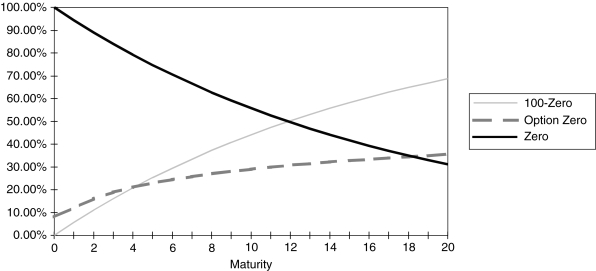 a. What is the maturity of the guaranteed note (Coupon = 0%, indexation = 100%)? Justify.
b. If as a banker, you want to make a profit, should you lengthen or shorten the maturity of that note? Explain why.
c. Everything remaining constant (i.e., same volatility and interest rate), should the maturity of the guaranteed note be shorter or longer if the index pays a low dividend rather than a high one? Why?
Correct Answer:

Verified
View Answer
Unlock this answer now
Get Access to more Verified Answers free of charge
Q36: A young investment banker meets one
Q37: Titi, a Japanese company, issued a
Q38: Bank PAPOUF decides to issue two
Q39: A company without default risk can issue
Q40: A company without default risk can
Q42: The Kingdom of Papou issues a very-bull
Q43: A nine-year bond has a yield-to-maturity of
Q44: Strumpf Ltd. decides to issue a convertible
Q45: On April 1, 2000, a corporation
Q46: Guaranteed note.
You are a young banker offering
Unlock this Answer For Free Now!
View this answer and more for free by performing one of the following actions

Scan the QR code to install the App and get 2 free unlocks

Unlock quizzes for free by uploading documents