You have discovered a new protein that regulates microtubule dynamics.First, you isolated proteins from a cellular extract that bound to a tubulin affinity column.You then separated the proteins from each other by loading the mixture of proteins on an ion-exchange column, eluting the column with increasing salt concentration, and collecting small "fractions" of protein as they dripped from the column.To test whether each fraction contained microtubule regulators, you mixed it with fluorescent tubulin and purified centrosomes, and then analyzed the reaction microscopically to measure the size of the astral microtubules formed.You found that fractions 8, 9, and 10 promoted the formation of unusually long astral microtubules.Because electrophoretic separation of the fractions on a gel revealed a plentiful protein with an apparent molecular mass of 98 kD, you named the protein p98.
A.Propose two ways in which p98 might change the dynamic behavior of microtubules to account for the observed change in microtubule length.(Hint: There are four simple possible mechanisms.)
B.Video microscopy of fluorescent tubulin in reactions with purified centrosomes allowed you to follow the behavior of individual microtubules over time.You graphed the changes in microtubule length in the absence (Figure 18-19A) and presence (Figure 18-19B) of p98.Five representative microtubules are shown for each condition.Does p98 alter the rate of microtubule growth or shrinkage? Does p98 alter the frequency of catastrophes (a sudden and rapid decline in microtubule length) or rescues (when a microtubule switches from shrinking to growing)? Explain your answers.
C.After demonstrating the consequences of p98 addition on microtubule dynamics in vitro with the use of purified components, you want to determine whether the protein has the same effects in a complex cellular extract that naturally contains p98.You remove the p98 protein from an extract of Xenopous eggs in mitosis by using antibodies that specifically recognize p98.The p98-depleted extract is then mixed with sperm nuclei, centrosomes, and fluorescent tubulin.How would you expect the microtubules to behave? (A) NO p98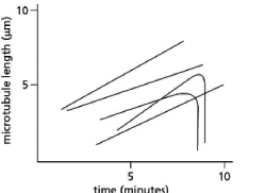
(B) PLUS p98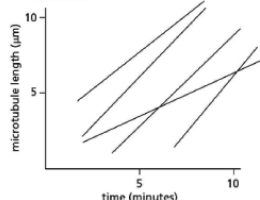
Figure 18-19
Correct Answer:

Verified
View Answer
Unlock this answer now
Get Access to more Verified Answers free of charge
Q57: Examine the schematic representation of centrosome duplication
Q58: Which of the following statements about apoptosis
Q59: Programmed cell death occurs
A)by means of an
Q60: Name the stage of M phase in
Q61: The lengths of microtubules in various stages
Q62: Imagine that you could microinject cytochrome c
Q63: Your friend is intrigued by Cdks and
Q64: The number of cells in an adult
Q65: For each of the following sentences,
Q66: What is the cause of the massive
Unlock this Answer For Free Now!
View this answer and more for free by performing one of the following actions

Scan the QR code to install the App and get 2 free unlocks

Unlock quizzes for free by uploading documents