A 5-year-old girl is brought to the emergency department for evaluation of a rash. Her mother noticed a few red spots on the child's cheeks this morning, which subsequently spread to the neck and trunk as the day progressed. The patient has a history of partial complex seizures, which have been well controlled with carbamazepine. Vital signs are normal. The lips are slightly pale, and the oropharynx is clear. There is no lymphadenopathy. The abdomen is soft with no palpable masses or hepatosplenomegaly. Skin examination shows flat, red, pinpoint lesions that do not blanch on the face, neck, trunk, and extremities. Neurological examination is unremarkable. Laboratory results are as follows: 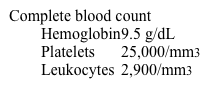 Peripheral smear reveals a paucity of cells with normal morphologic appearance of all cell lines. Which of the following mechanisms is most likely responsible for this patient's current condition?
A) Autoantibodies against hematopoietic stem cells
B) Impaired DNA synthesis due to vitamin deficiency
C) Medication-associated adverse effect
D) Peripheral cell sequestration in splenic sinusoids
E) Thrombotic microangiopathic hemolysis
Correct Answer:

Verified
Q206: A 36-year-old woman with mitral valve prolapse
Q207: A 52-year-old man comes to the emergency
Q208: Two antineoplastic drugs are shown to inhibit
Q209: A 70-year-old man develops progressive fatigue and
Q210: A 61-year-old man comes to the office
Q212: A 62-year-old woman is evaluated for refractory
Q213: A 45-year-old-woman comes to the office for
Q214: A 78-year-old man is found unresponsive and
Q215: Cancer cells from a 23-year-old male with
Q216: A 63-year-old man comes to the emergency
Unlock this Answer For Free Now!
View this answer and more for free by performing one of the following actions

Scan the QR code to install the App and get 2 free unlocks

Unlock quizzes for free by uploading documents