A 61-year-old woman comes to the emergency department due to fever, chills, and left flank pain that began abruptly last evening. A month ago, the patient was treated for a urinary tract infection with a short course of ciprofloxacin. She otherwise has no medical problems and currently takes no medications. She has no history of hospitalizations or surgeries.
Temperature is 39.4 C (103 F) , blood pressure is 80/40 mm Hg, pulse is 120/min, and respirations are 24/min. Pulse oximetry shows 94% on room air. Mucous membranes are dry and jugular veins are flat. Cardiopulmonary auscultation reveals clear lung fields and normal heart sounds without murmurs. The abdomen is soft and nontender. Left costovertebral angle tenderness is present. Skin examination is normal. The extremities are warm with no edema. Neurologic examination is within normal limits.
Laboratory results are as follows: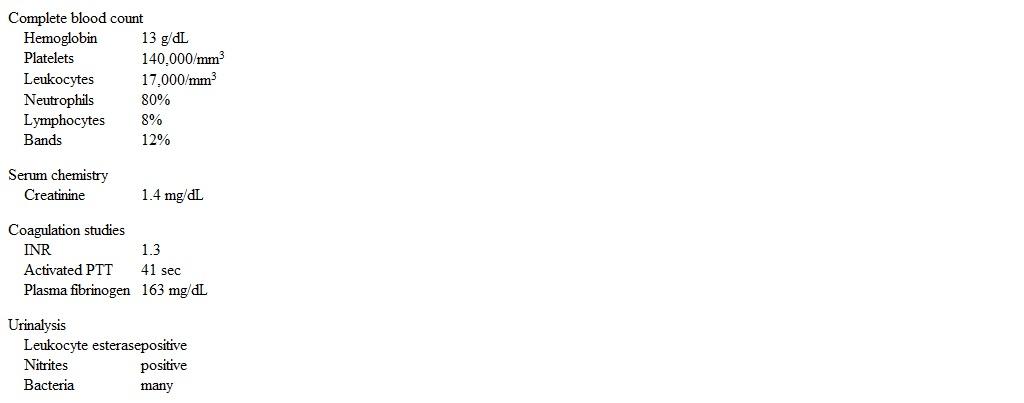 Broad-spectrum antibiotics and intravenous fluids are initiated, and the patient is admitted to the intensive care unit. Enoxaparin is given for prophylaxis against deep vein thrombosis. On hospital day 2, urine and blood cultures are positive for Escherichia coli and antibiotics are narrowed based on culture sensitivities. Repeat laboratory testing is similar to admission, except platelet count has dropped to 105,000/mm3.
Which of the following is the most appropriate next step in management of this patient?
A) Continue enoxaparin
B) Continue enoxaparin and send PF4 antibody test
C) Stop enoxaparin and send PF4 antibody test
D) Stop enoxaparin and start empiric argatroban while awaiting PF4 antibody results
E) Switch enoxaparin to tinzaparin
Correct Answer:

Verified
Q92: A 31-year-old man comes to the emergency
Q93: A 37-year-old woman comes to the emergency
Q94: A 27-year-old woman comes to the emergency
Q95: A 24-year-old man with sickle cell disease
Q96: A 60-year-old woman comes to the emergency
Q98: A 67-year-old man comes to the emergency
Q99: A 62-year-old man is brought to the
Q100: A 50-year-old man is brought to the
Q101: A 23-year-old woman is brought to the
Q102: A 34-year-old man comes to the emergency
Unlock this Answer For Free Now!
View this answer and more for free by performing one of the following actions

Scan the QR code to install the App and get 2 free unlocks

Unlock quizzes for free by uploading documents