A 60-year-old woman comes to the emergency department due to 2 weeks of worsening bilateral headaches, blurry vision, dizziness, and tingling sensation in her feet. She has had no fevers, night sweats, unintentional weight loss, or jaw pain but has had several episodes of epistaxis. The patient has a history of hypertension and takes chlorthalidone. She does not use tobacco, alcohol, or illicit drugs.
Temperature is 37.2 C (99.0 F) , blood pressure is 166/98 mm Hg, pulse is 85/min, and respirations are 14/min. Physical examination shows moist mucous membranes, normal tympanic membranes, and no sinus tenderness. Bilateral pupils are equal and reactive. Visual acuity is decreased in both eyes, and funduscopic examination reveals dilated, segmented, and tortuous retinal veins. Facial sensation and strength are normal. Bilateral upper- and lower-extremity muscle strength is normal. There is decreased pinprick sensation and loss of ankle reflex bilaterally.
Laboratory results are as follows: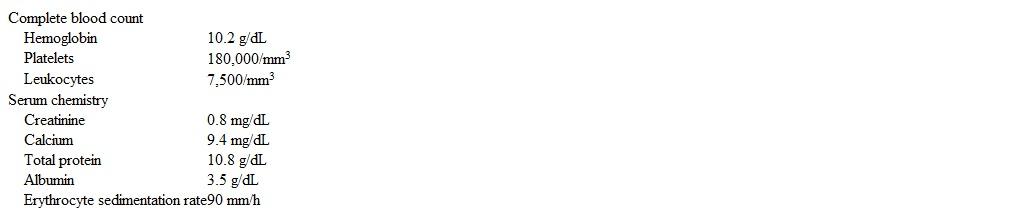 Which of the following is the most appropriate next step in management of this patient?
A) Carbonic anhydrase inhibitors and loop diuretics
B) High-dose glucocorticoids
C) Intravenous antihypertensives
D) Serum protein electrophoresis
E) Temporal artery biopsy
Correct Answer:

Verified
Q91: A 19-year-old man from Arizona is brought
Q92: A 31-year-old man comes to the emergency
Q93: A 37-year-old woman comes to the emergency
Q94: A 27-year-old woman comes to the emergency
Q95: A 24-year-old man with sickle cell disease
Q97: A 61-year-old woman comes to the emergency
Q98: A 67-year-old man comes to the emergency
Q99: A 62-year-old man is brought to the
Q100: A 50-year-old man is brought to the
Q101: A 23-year-old woman is brought to the
Unlock this Answer For Free Now!
View this answer and more for free by performing one of the following actions

Scan the QR code to install the App and get 2 free unlocks

Unlock quizzes for free by uploading documents