A 65-year-old man presents to the emergency department because of a nosebleed, which started 6 hours ago. He has not been able to stop it with recumbency and nasal pressure. He had a similar nosebleed 2 years ago and was told by an ENT physician that he has telangiectasias in his nasal septum. He has not noted any bleeding or bruising elsewhere. There is no history of aspirin use, although he has taken a few ibuprofens recently. He is known to have chronic kidney disease with a serum creatinine of 6.8 mg/dL. A fistula has been placed in his arm anticipating the commencement of dialysis soon. He has hypertension, hyperlipidemia, osteoarthritis, and gout. Current medications include atenolol, amlodipine, calcium carbonate, reduced-dose allopurinol, and furosemide.
His blood pressure is 142/86 mm Hg without orthostatic changes, pulse is 84/min, and respirations are 16/min. Bright red blood is seen oozing around his left naris, which is filled with bloody tissue paper. Some bright red blood is seen in his posterior pharynx. His lung, cardiovascular, and abdominal exams are normal. There is no edema.
The patients labs reveal: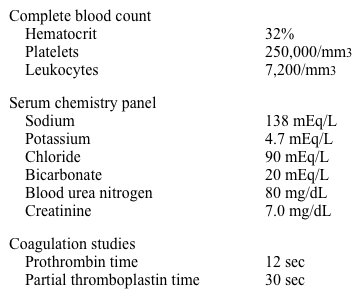
After anterior and posterior nasal packing, oozing into and around the packing continues.
Which of the following is the most appropriate next step in management?
A) Cryoprecipitate
B) DDAVP
C) Hemodialysis
D) Estrogens
E) Blood transfusion
Correct Answer:

Verified
Q206: A 28-year-old woman recently completed her first
Q207: A 76-year-old man is brought to the
Q208: An 82-year-old man comes to the emergency
Q209: A 45-year-old woman is brought to the
Q210: A 32-year-old woman comes to the emergency
Q212: A 38-year-old woman is brought to the
Q213: A 33-year-old man comes to the emergency
Q214: A 53-year-old woman comes to the emergency
Q215: An 84-year-old man is admitted to the
Q216: A 76-year-old man is brought to the
Unlock this Answer For Free Now!
View this answer and more for free by performing one of the following actions

Scan the QR code to install the App and get 2 free unlocks

Unlock quizzes for free by uploading documents