An 81-year-old man is transferred from a skilled nursing facility to the hospital due to lethargy and poor oral intake over the last 24 hours. For the past 2 days, he has had increased urinary frequency and dysuria. A urinalysis showed evidence of urinary tract infection, and he was started on oral ciprofloxacin. He was recently hospitalized with acute ischemic stroke, and his hospital course was complicated by pneumonia requiring intravenous antibiotics. He also had an episode of urinary retention requiring Foley catheter placement for 5 days. His other medical problems include mild cognitive impairment, hypertension, and type 2 diabetes mellitus. He has no known drug allergies.
His temperature is 38.9° C (102° F) , blood pressure is 92/58 mm Hg, and pulse is 112/min. Lungs are clear to auscultation. His extremities are warm and well perfused.
Foley catheter placement yields 230 mL of cloudy urine.
Laboratory results are as follows: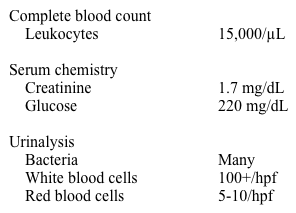
Urine culture obtained at the nursing facility 2 days earlier showed extended spectrum beta-lactamase-producing Klebsiella.
Which of the following is the best initial antibiotic regimen for this patient?
A) Aztreonam
B) Ceftriaxone
C) Daptomycin
D) Levofloxacin
E) Meropenem
Correct Answer:

Verified
Q62: A 43-year-old woman is seen in the
Q63: There has been a continuous increase in
Q64: A 72-year-old woman is sent to the
Q65: An 84-year-old man with a long history
Q66: A 40-year-old woman is seen 48 hours
Q68: A 75-year-old woman with stage 4 breast
Q69: A 63-year-old man with recent elective right
Q70: A 69-year-old man is admitted to the
Q71: A 36-year-old man is brought to the
Q72: A 46-year-old woman is seen in the
Unlock this Answer For Free Now!
View this answer and more for free by performing one of the following actions

Scan the QR code to install the App and get 2 free unlocks

Unlock quizzes for free by uploading documents