A 39-year-old man is admitted to the hospital for acute alcoholic pancreatitis. His initial APACHE II score was 20, suggestive of severe disease. Within the first 48 hours, he received a total of 10 liters of intravenous fluid resuscitation. Because of decreasing oxygenation, he was intubated and started on mechanical ventilation. Due to increased oxygen requirements, both PEEP and FiO2 were progressively increased. Over the past 12 hours, his urine output decreased and his serum creatinine increased from 1.2 mg/dL at admission to 2.2 mg/dL at present.
His blood pressure is 110/70 mm Hg and pulse is 98/min. Jugular venous pressure is elevated. Lung examination reveals bilateral crackles at the lung bases. His abdomen is diffusely tender and tensely distended. Bowel sounds are diminished. There are no flank or periumbilical ecchymoses. There is 3+ pitting edema to mid-thighs bilaterally.
Urinalysis results are as follows: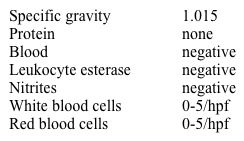
Which of the following would most likely establish the cause of the acute kidney injury?
A) Abdominal CT scan
B) Fractional excretion of sodium
C) Measurement of bladder pressure
D) Renal ultrasound
E) Serum complement levels
Correct Answer:

Verified
Q107: A 65-year-old man is admitted to the
Q108: A 47-year-old man with known HIV infection
Q109: A 60-year-old woman is brought to the
Q110: A 41-year-old previously healthy man is admitted
Q111: A 58-year-old man with a history of
Q113: A 64-year-old man with a moderate right-sided
Q114: A 35-year-old woman underwent ultrasound evaluation for
Q115: A 46-year-old man with known kyphoscoliosis complains
Q116: A 45-year-old hospitalized man is evaluated for
Q117: A 78-year-old woman is admitted to the
Unlock this Answer For Free Now!
View this answer and more for free by performing one of the following actions

Scan the QR code to install the App and get 2 free unlocks

Unlock quizzes for free by uploading documents