A 56-year-old woman who is post-operative day #1 after a laparoscopic cholecystectomy complains of chest discomfort. The patient reports that in the early hours of the morning, she was awakened from sleep with nausea, one episode of vomiting, and persistent burning in her chest. Her only medical history includes hypertension, which has been well-controlled with medication. Her other current medications include ondansetron, acetaminophen, and hydrocodone.
Her temperature is 37.9 C (100.2 F) , blood pressure is 92/60 mm Hg, heart rate is 90 /min, and respirations are 18 /min. Her BMI is 31 kg/m2. She is in moderate distress and appears anxious. There is no murmur on cardiac examination and bilateral fine crackles are heard at the lung bases. Her abdomen is distended and non-tender with an incision that is clean and intact. Bowel sounds are diminished. There is no rebound tenderness or rigidity. There is no peripheral edema.
A 12 lead EKG is performed and displayed below: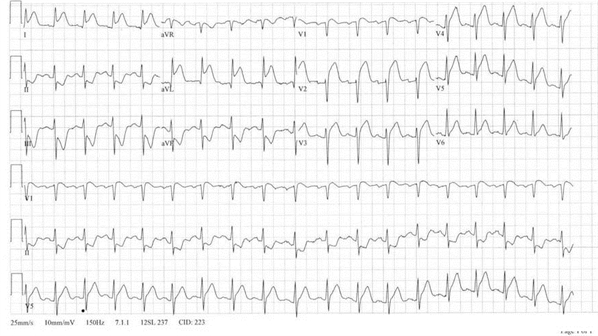
Which of the following would be the most appropriate next step in managing this patient?
A) Coronary angiography
B) CT scan of the chest with contrast
C) Intravenous metoprolol
D) Pantoprazole and morphine
E) Transthoracic echocardiogram
Correct Answer:

Verified
Q2: An analysis of results from 18,317 patients
Q3: A 76-year-old man comes to the office
Q4: Cardiovascular disease is the leading cause of
Q5: A 79-year-old woman is referred for perioperative
Q6: A recent study of patients with stage
Q8: A 29-year-old Middle Eastern man is evaluated
Q9: A 67-year-old man comes to the office
Q10: A 36-year-old man comes to the physician
Q11: A 50-year-old man asks about starting a
Q12: In a study comparing treatment to placebo,
Unlock this Answer For Free Now!
View this answer and more for free by performing one of the following actions

Scan the QR code to install the App and get 2 free unlocks

Unlock quizzes for free by uploading documents