A 39-year-old man comes to the physician after he loses consciousness. His wife reports that they were at a school play when she heard her husband making some "gurgling noises." When she looked over at him, he looked "out of it" and started slumping towards her. She could not awaken him. After about ten seconds, he regained consciousness. He denies any prodrome of chest pain or pressure, shortness of breath, or palpitations. He currently has no complaints.
He denies any prior history of syncope or presyncope. He is physically active and plays in a doubles tennis league three times per week. He takes no medications on a regular basis. His family history is unknown as he was adopted.
His blood pressure is 115/70 mm Hg, pulse is 67/min, and BMI is 23 kg/m2. The patient is in no distress. There is a normal S1 and S2 and no murmurs are appreciated. His lungs are clear to auscultation. The abdomen is soft and non-distended. The peripheral pulses are 2+ and symmetric.
His EKG is shown is this exhibit. 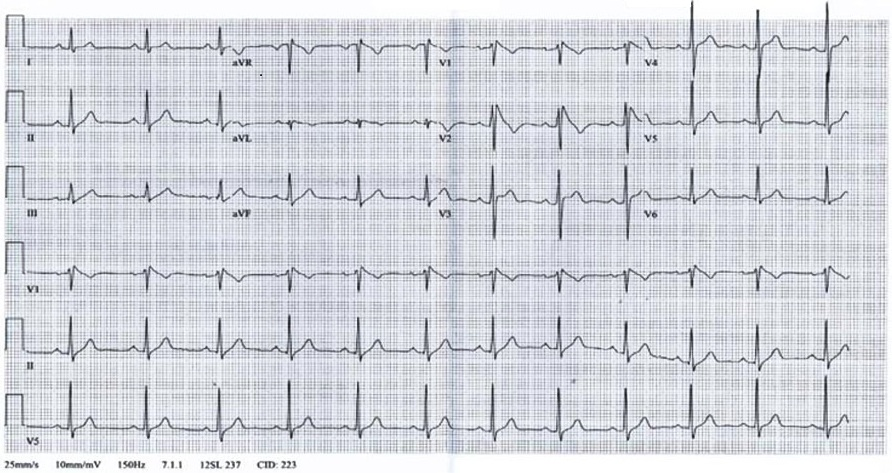
Which of the following is the most likely diagnosis?
A) Acute anterior wall myocardial infarction
B) Brugada syndrome
C) Hypertrophic cardiomyopathy
D) Vasovagal syncope
E) Wolff-Parkinson-White syndrome
Correct Answer:

Verified
Q19: A large multicenter double-blinded randomized placebo-controlled study
Q20: A new nuclear stress test modality is
Q21: A 42-year-old woman comes to the physician
Q22: A 78-year-old woman comes to the physician
Q23: A 23-year-old man comes to the physician
Q25: A 75-year-old man residing in a nursing
Q26: A 25-year-old immigrant from the Ukraine comes
Q27: A 40-year-old man comes to the physician
Q28: A 32-year old woman comes to the
Q29: A 54-year-old man comes to the clinic
Unlock this Answer For Free Now!
View this answer and more for free by performing one of the following actions

Scan the QR code to install the App and get 2 free unlocks

Unlock quizzes for free by uploading documents