A 65-year-old woman comes to the physician because of unsteadiness and near-falls over the last 6 months. In the evening, she has to hold on to the wall in the hallway while going to the bathroom. She also complains of bilateral knee pains, occasional low back pain, and difficulty falling asleep. She is concerned that she has become more forgetful than usual. She denies dizziness, headaches, blurry vision, or weight loss. She has hypothyroidism, osteoporosis, and hypertension. Current medications include risedronate, hydrochlorothiazide, vitamin D, and levothyroxine. Her mother suffered from dementia and died at the age of 75. Her mammogram results 1 year ago and colonoscopy results 3 years ago were unremarkable.
Her blood pressure is 133/82 mmHg while supine and 135/85 mmHg while standing, and pulse is 78/min. On neurologic exam, position and vibration sensation is diminished in both feet as well as a slight decrease in light touch sensation. Cranial nerves are intact. Motor strength is normal and symmetric. Deep tendon reflexes are symmetric and decreased in her feet. There are no pathologic reflexes. Her score on a Folstein mini-mental status exam is 26/30.
The patients labs reveal: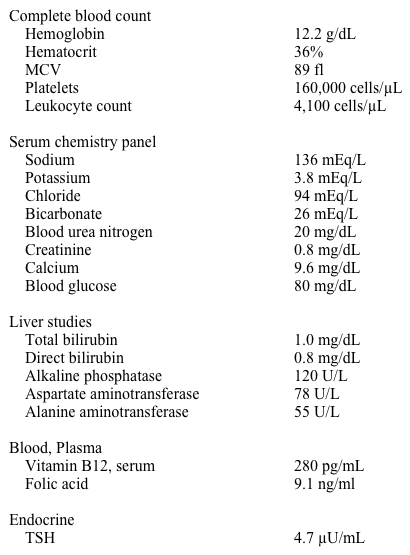
Which of the following is the most appropriate next step in management?
A) ANA, ESR and C-reactive protein
B) Cancer screening
C) CT scan of the head
D) Methylmalonic acid level
E) Serum protein electrophoresis
Correct Answer:

Verified
Q401: A 75-year-old man has a 3 month
Q402: A 40-year-old woman comes to the physician
Q403: A 63-year-old man comes to the office
Q404: A 28-year-old woman comes to the physician
Q405: A 60-year-old man comes to the office
Q407: A 23-year-old African American man returns to
Q408: A 60-year-old immigrant from India comes to
Q409: A 28-year-old woman comes to the physician
Q410: A 57-year-old man with prostate cancer comes
Q411: A 67-year-old man comes to the physician
Unlock this Answer For Free Now!
View this answer and more for free by performing one of the following actions

Scan the QR code to install the App and get 2 free unlocks

Unlock quizzes for free by uploading documents